Towering Above the Canopy: The Rise and Fall of Tikal
In the annals of history, the stories of "lost cities" have always captivated the human imagination. In the Arab world, tales of the ancient, hidden city of Iram of the Pillars or the magnificent rose-red rock city of Petra evoke a sense of mystery and a profound respect for the ancestors who carved thriving civilizations out of unforgiving landscapes. Half a world away, buried deep within the dense, emerald jungles of northern Guatemala, lies a metropolis that evokes that exact same sense of wonder: Tikal. While the ancient Arabs conquered the vast, arid deserts, the Maya of Tikal conquered the impenetrable rainforest of the Petén Basin. They built a towering urban center that served as one of the most powerful kingdoms in the ancient Americas, leaving behind a legacy of architectural brilliance, deep astronomical knowledge, and complex dynastic history.
The Scale of a Jungle Metropolis
To comprehend Tikal is to understand urban planning on a truly massive scale. At its zenith, during what archaeologists call the Classic Period (roughly 200 to 900 CE), Tikal was not merely an isolated ceremonial site; it was a bustling, cosmopolitan capital. Covering an area of more than 16 square kilometers at its core, the city contained over 3,000 individual structures, including royal palaces, administrative buildings, extensive residential complexes, and a network of paved causeways.
At its height, the population is estimated to have reached up to 100,000 people. Much like the great historical capitals of Damascus or Baghdad during their golden ages, Tikal was the absolute center of gravity for its region. It dictated vast trade routes that brought precious jade, obsidian, and cacao from distant lands. It established the cultural and artistic standards of the era and asserted military dominance over dozens of smaller surrounding city-states. The rulers of Tikal transformed a hostile, humid jungle environment into a highly organized, technologically advanced society that managed water and agriculture with incredible precision.
The Heights of Temple IV
The architectural ambition of Tikal is best personified by its towering step-pyramids, the most magnificent of which is Temple IV. Standing at a dizzying height of 213 feet (65 meters), it was one of the tallest structures in the pre-Columbian Americas. Built in the 8th century to mark the reign of the powerful king Yik'in Chan K'awiil, Temple IV is a marvel of ancient engineering and human labor.
The steep, monumental stone staircase leads up to a heavy roof comb that pierces straight through the thick jungle canopy. For the Mayan priests and rulers, ascending this temple was a deeply spiritual act. It elevated them above the trees and brought them closer to the celestial bodies they worshipped and studied with mathematical precision. Even today, visitors who make the grueling climb to the top are rewarded with a panoramic view of the vast rainforest, with the crests of other ancient temples poking through the green expanse like stone islands in a sea of leaves—a sight that instills a deep sense of humility and awe.
A Culture of Lineage and Recorded History
One of the most striking parallels between the ancient Maya and traditional Arab culture is the profound importance placed on lineage, ancestry, and the meticulous recording of history. In Arab culture, the preservation of Nasab (genealogy and lineage) has always been a cornerstone of societal identity, ensuring that the deeds of the forefathers are never forgotten. The rulers of Tikal shared this exact obsession with their ancestral legacy.
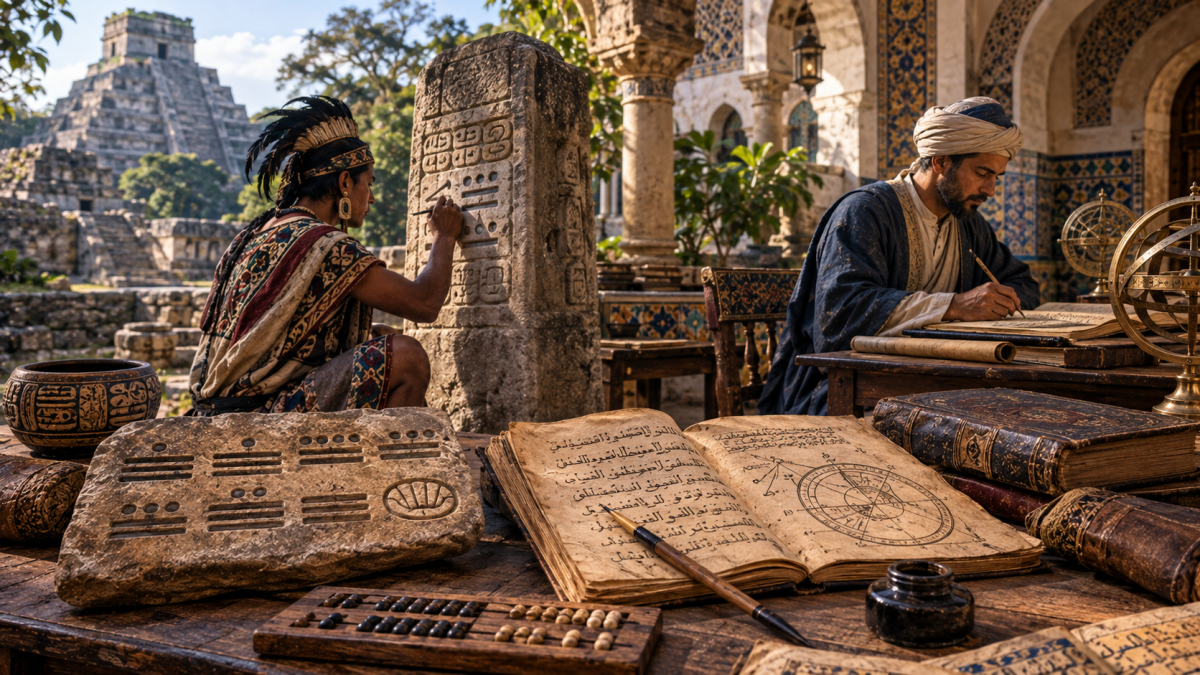
Throughout the grand plazas of the city, archaeologists have discovered dozens of intricately carved stone monuments known as stelae. These towering stone slabs are inscribed with complex Mayan hieroglyphics that act as historical archives. They detail the exact lineage of the kings, their precise dates of ascension, their military victories, and their sacred rituals. By decoding these stelae, modern historians have been able to reconstruct the dynastic history of Tikal with incredible accuracy. We can read the names of legendary rulers like Jasaw Chan K'awiil and Great Jaguar Paw, ensuring that their names and deeds echo through eternity just as they originally intended.
Geopolitics and the "Star Wars"
The history of Tikal, however, is not just a story of peaceful building; it is a saga of intense geopolitical rivalry. For centuries, Tikal engaged in a bitter, protracted conflict with another massive Mayan superpower located to the north, the city of Calakmul. The two cities fought for total hegemony over the Maya lowlands, forming complex alliances with smaller city-states and engaging in prolonged proxy wars.
The Maya engaged in a highly specific type of religiously motivated warfare known to modern archaeologists as "Star Wars." These decisive, devastating military campaigns were not launched randomly; they were timed to coincide with specific astronomical events, most notably the phases of the planet Venus, which the Maya associated with warfare. When Tikal was ultimately victorious over Calakmul in the late 7th century under the leadership of Jasaw Chan K'awiil, it ushered in a spectacular golden age of wealth, monumental architectural expansion, and cultural flourishing for the city.
The Great Collapse and the Lessons of Amanah
Yet, no empire lasts forever. The great Arab sociologist and historian Ibn Khaldun famously wrote about the cyclical nature of empires—how they rise through solidarity and ambition, peak in wealth and monumental building, and eventually collapse due to internal decay and environmental limits. The fate of Tikal perfectly mirrors Ibn Khaldun’s historical theories.
By the 10th century, the great metropolis was completely abandoned. The reasons for this catastrophic collapse remain a subject of intense scientific study, but the prevailing evidence points to a deadly combination of severe, prolonged drought, endemic warfare, and catastrophic environmental degradation. The population simply grew too large for the fragile jungle ecosystem to support. Forests were cleared at an unsustainable rate to burn the limestone needed to create the vast amounts of white plaster stucco that covered the city's buildings. This massive deforestation led to soil erosion, rising temperatures, and widespread crop failure.
The fall of Tikal serves as a stark historical reminder of the Islamic principle of Amanah—the sacred trust and responsibility humanity has been given to manage the earth's resources sustainably and ethically. When that balance was broken, the jungle reclaimed the city.
Conclusion
Following the collapse, dense vegetation swallowed the towering pyramids, and roots tore through the grand limestone plazas, hiding the city from the outside world for nearly a millennium until its formal rediscovery in the mid-19th century. Today, Tikal National Park is recognized as a UNESCO World Heritage site, celebrated equally for its archaeological magnificence and its incredible biodiversity. For the modern traveler, walking through the shaded, echoing plazas of Tikal offers a profound journey into the past. It stands as a monumental tribute to human ingenuity, a testament to the importance of recording our history, and a timeless reminder of the delicate balance that must always be maintained between civilization and the natural world.