Walls of the New World: The Fortifications of Cartagena
Throughout history, the construction of massive, impenetrable walls has been a defining feature of great civilizations seeking to protect their most vital assets. In the Arab world, one immediately thinks of the towering Saladin Citadel in Cairo, the ancient, impregnable walls of Acre that repelled empires, or the massive stone gates of Aleppo. These fortifications were not merely military installations; they were the physical embodiment of a city's wealth, strategic importance, and resilience against constant foreign threats. Thousands of miles across the Atlantic Ocean, on the northern coast of modern-day Colombia, another great walled city was forged in the same spirit of survival and defiance. Founded in 1533, Cartagena de Indias became the shining jewel of the Spanish Main, requiring the construction of the most extensive and formidable military fortifications ever built in the Americas.
The Treasure Hub of the Americas
To understand why Cartagena required such colossal defenses, one must first understand its immense economic importance. During the 16th and 17th centuries, the Spanish Empire extracted unimaginable wealth from the South American continent, primarily in the form of silver from the mines of Potosí and gold from the Andean highlands. Before this immense wealth could be shipped across the treacherous Atlantic Ocean to Spain, it had to be gathered, counted, and stored.
Cartagena served as this primary gathering point. Much like the great historical trading hubs of Basra or Alexandria, where the riches of the Silk Road and the Indian Ocean converged before heading to Europe, Cartagena was a nexus of global wealth. The city's deep, naturally protected bay made it the perfect harbor for the Spanish treasure fleets, known as the galleons, which would anchor there to load up the continent's riches. However, this staggering accumulation of wealth also made the city the ultimate target.
The Scourge of the Corsairs
Where there is great wealth, predators inevitably follow. The Caribbean Sea quickly became a hunting ground for privateers, pirates, and rival European navies eager to cripple the Spanish monopoly. These maritime raiders functioned much like the fierce corsairs of the Mediterranean, launching devastating, lightning-fast strikes against coastal targets.
In its early, undefended decades, Cartagena suffered terribly. In 1552, the city was reduced to ashes by a massive fire, and shortly after, it was repeatedly sacked by notorious French and English pirates. The most devastating blow came in 1586 when the infamous English privateer Sir Francis Drake launched a massive assault. Drake captured the city, held it hostage for over a month, and extorted a staggering ransom of gold and silver before burning down a significant portion of the town. This humiliating defeat forced the Spanish Crown to realize that if they were to hold onto their American empire, Cartagena had to be turned into an impregnable fortress.
Las Murallas: An Engineering Marvel
In response to the relentless attacks, the Spanish commissioned the finest military engineers of the era to design a comprehensive defensive ring around the city. The construction of Las Murallas (The Walls) began in the late 16th century and continued for nearly two hundred years. The result was a masterpiece of military engineering: 11 kilometers of thick, sloping stone ramparts encircling the old city, interspersed with heavily armed bastions designed to create overlapping fields of cannon fire.
The builders faced a significant challenge: a lack of traditional quarry stone in the immediate area. To solve this, they turned to the sea, constructing the massive walls out of coral stone cut directly from the Caribbean reefs. This material proved to be exceptionally brilliant for military defense. Unlike rigid granite or limestone, which can shatter into deadly shrapnel when struck by a heavy cannonball, the porous, honeycomb-like structure of the coral stone absorbed the impact of enemy artillery, cushioning the blows and leaving the walls largely intact.
Castillo San Felipe de Barajas: The Invincible Citadel
While the city walls protected the urban center from naval bombardment, the true masterpiece of Cartagena's defense lay slightly inland: the Castillo San Felipe de Barajas. Built atop the Hill of San Lázaro, this massive fortress dominated the landward approaches to the city, ensuring that no invading army could bypass the bay and attack Cartagena from the rear.
Comparing Castillo San Felipe to the great citadels of the Middle East is highly appropriate. It is considered the most formidable defensive complex ever built by the Spanish in the New World. Its sloping geometry was designed to deflect cannon fire, while its multiple tiered batteries meant that even if the outer walls were breached, the defenders could retreat to higher ground and continue firing down upon the attackers.
However, the fortress's most brilliant defensive feature was hidden underground. The engineers carved a complex, labyrinthine network of tunnels deep into the bedrock of the hill. These tunnels served multiple purposes. They allowed for the safe movement of troops and supplies during a siege, but they were also designed with profound acoustic ingenuity. The corridors were shaped so that the sound of an enemy's approaching footsteps would be amplified and travel for hundreds of meters, alerting the defenders. Furthermore, the tunnels were designed with narrow choke points and dead ends where invaders could be easily trapped and neutralized. Thanks to this brilliant design, Castillo San Felipe was never successfully taken by storm.
Echoes of Al-Andalus in the Caribbean
While the exterior of Cartagena is defined by imposing military might, the interior of the walled city reveals a completely different, deeply familiar architectural heritage. When the Spanish colonized the Americas, they brought with them centuries of Moorish cultural and architectural influence from the Iberian Peninsula.
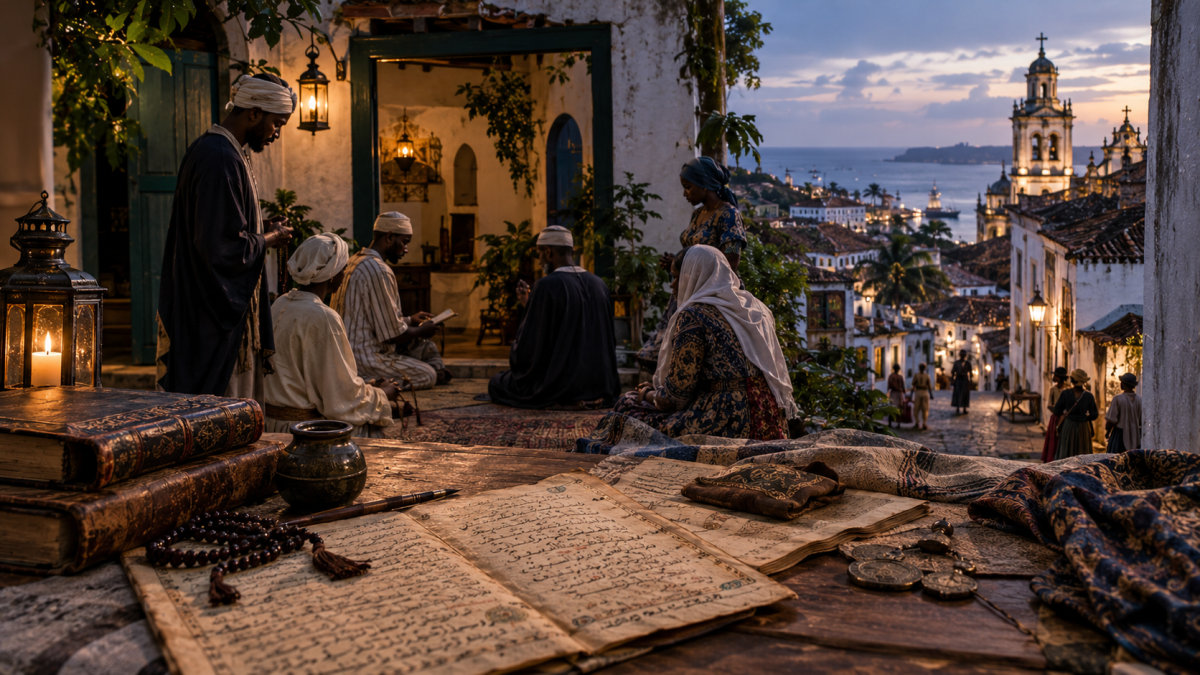
Walking through the narrow, cobbled streets of Cartagena’s historic center feels remarkably similar to walking through the ancient quarters of Andalusia, or even the medinas of North Africa. The colonial homes are designed around interior courtyards featuring cooling central fountains—a direct inheritance from the Arab architectural focus on privacy and internal family life. The city is famous for its ornate, intricately carved wooden balconies, which bear a striking resemblance to the traditional mashrabiya windows of the Middle East, designed to allow the sea breeze to pass through while shielding the inhabitants from the harsh sun and the eyes of the street. This deep Mudéjar (Moorish-influenced) style serves as a beautiful reminder of the Arab world's indirect, yet profound, cultural footprint in the Caribbean.
Conclusion
In 1741, the fortifications of Cartagena faced their ultimate test during the Battle of Cartagena de Indias. A massive British armada, consisting of 186 ships and nearly 30,000 men, laid siege to the city. Despite being vastly outnumbered, the Spanish defenders, utilizing the brilliant engineering of Castillo San Felipe and the city walls, inflicted a crushing defeat on the British forces, securing the Spanish Empire's hold on South America for another century.
Today, Cartagena stands as a UNESCO World Heritage site, beautifully preserving its violent and romantic past. The massive coral walls and imposing cannons that once served to keep the world out now draw millions of visitors in. For the modern traveler, exploring the fortifications of Cartagena is a journey through a masterclass in military engineering. It is a stunning Caribbean echo of the great walled cities of antiquity, proving that the human drive to protect what we value can result in architectural wonders that outlast the empires that built them.