The Sun's Fortress: The History of Ingapirca
In the Arab world, the concept of a high-altitude fortress is a deeply familiar and respected architectural feat. From the ancient, towering stone villages of Al Hajarah in the mountains of Yemen to the imposing, heavily fortified walls of Nizwa Fort in Oman, these structures represent humanity’s ability to find security, spiritual elevation, and strategic dominance in extreme topographies. To build in the mountains requires not just brute strength, but a profound understanding of the landscape. High in the southern Andes of Ecuador, sitting at a breathtaking elevation of over 10,500 feet (3,200 meters), lies an archaeological masterpiece built with that exact same spirit of resilience. Ingapirca—translating directly from Kichwa as the "Inca Wall"—is the largest and most significant pre-Columbian archaeological site in Ecuador. It is a stunning monument to military strategy, diplomatic coexistence, and the ancient mastery of astronomy.
A Story of Conquest and Coexistence
When exploring the history of great empires, the most fascinating chapters often involve the blending of two distinct cultures. During the rapid expansion of the Islamic Golden Age, as Arab influence spread across North Africa and into the Iberian Peninsula, the resulting societies were often brilliant syntheses of Arab administration and local traditions, creating unique architectural and cultural landscapes. The history of Ingapirca reflects a remarkably similar dynamic in the Andean world.
Before the Incas ever reached modern-day Ecuador, the region was inhabited by the Cañari people. The Cañari were a fierce, proud, and highly organized matriarchal society who worshipped the moon. When the mighty Inca Empire, led by the ambitious Emperor Tupac Yupanqui, began their northern expansion in the late 15th century, they expected a swift victory. Instead, they were met with fierce, unyielding resistance from the Cañari warriors.
After years of bitter conflict, the Inca leadership realized that sheer military force would not be enough to subdue this mountainous territory. They pivoted to a strategy of diplomacy and cultural integration. The Inca emperor married a prominent Cañari princess, forging a powerful political alliance. Ingapirca became the physical manifestation of this truce. It was built as a shared city, where the Cañari’s moon-worshipping traditions and the Incas' sun-worshipping religion coexisted within the same complex.
The Architectural Marvel of the Ellipse
The undisputed crown jewel of Ingapirca is the Temple of the Sun. For those familiar with traditional Inca architecture in Peru, which is heavily characterized by strict, rectangular geometric layouts, this temple is a stunning anomaly. The Temple of the Sun at Ingapirca is built in the shape of a massive ellipse—an oval structure perched atop a prominent natural rock formation. It is the only known elliptical temple of its kind in the entire Inca Empire.
The construction of this temple is a masterclass in ancient engineering. The Incas utilized their signature ashlar masonry technique. Master stonemasons quarried massive blocks of green andesite stone, carving and polishing them with such microscopic precision that they fit together perfectly without the use of a single drop of mortar. This technique was essential for survival in the Andes; the mortar-less stones were capable of shifting and absorbing the shockwaves of frequent, devastating earthquakes, settling right back into place once the tremors ceased. The fact that the sweeping, curved walls of the ellipse have stood firm for over five centuries is a testament to the absolute genius of these ancient engineers.
Masters of the Heavens: The Solstice Rituals
In Arab heritage, the study of the stars is a revered science. The vast deserts required precise astronomical knowledge for navigation, and religious observances necessitated an exact understanding of lunar and solar cycles. This profound respect for astronomy was entirely shared by the Incas. They did not just build structures to live in; they built them to interact directly with the cosmos.
The Temple of the Sun at Ingapirca was meticulously designed as a massive astronomical observatory. The elliptical walls feature small, trapezoidal niches and doorways. The building is oriented with such flawless geographic precision that during the summer and winter solstices, the sunlight shines perfectly through the main doorway, illuminating a specific sacred stone carved into the center of the temple floor.
This precise alignment was critical for the celebration of Inti Raymi, the ancient Inca Festival of the Sun. In the freezing, high-altitude environment of the Andes, the sun was the ultimate source of warmth, life, and agricultural success. The solstice rituals held at Ingapirca were deep, spiritual ceremonies thanking the sun deity, Inti, for the harvest and pleading for his return after the cold, dark winter months.
The Great Highway: The Qhapaq Ñan
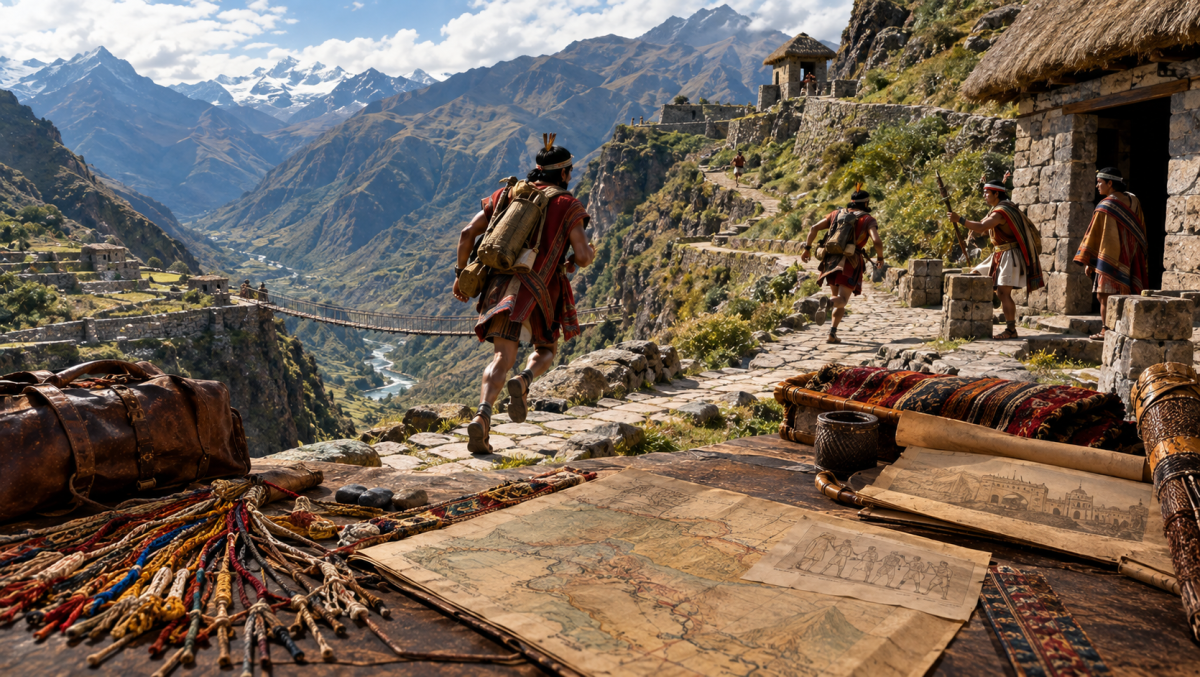
Ingapirca did not exist in isolation. It was a vital northern stronghold connected to a vast, continental network. To manage their sprawling territory, the Incas constructed the Qhapaq Ñan—the Great Inca Road. This astonishing network of paved stone paths stretched for over 30,000 kilometers, navigating sheer cliffs, deep river gorges, and freezing mountain passes, all the way back to the imperial capital of Cusco in Peru.
For the historical Arab traveler, this concept is highly recognizable. Much like the legendary ancient caravan routes of the Silk Road or the Incense Route that crossed the Arabian Peninsula, the Qhapaq Ñan was the economic and administrative lifeblood of the empire. Ingapirca served as a major tambo—a fortified waystation and administrative center along this route. It provided shelter, provisions, and military security for the fast-running messengers (chasquis), traveling dignitaries, and massive llama caravans transporting vital goods across the empire.
The Fall and the Legacy
The golden age of Ingapirca was tragically
During the colonial era, much like the fate that befell many ancient Roman or Persian ruins, the magnificent ashlar stones of Ingapirca were looted by Spanish settlers to build nearby colonial churches and haciendas. It was not until the mid-20th century that the Ecuadorian government secured the site and began extensive archaeological preservation.
Conclusion
Today, Ingapirca stands as a proud, enduring monument to the complexities of history. It is a site where fierce warfare ultimately gave way to diplomacy, and where two distinct cultures built a shared home among the clouds. For the modern traveler walking its ancient, wind-swept stone paths, Ingapirca offers a profound lesson in humanity's shared drive to understand the heavens. It proves that whether in the vast deserts of the East or the towering Andes of the West, our ancestors looked up at the exact same sun and built monuments of staggering brilliance to capture its light.