Arabic Echoes in Latin America: How Al-Andalus Quietly Shaped the New World
Imagine walking through the old center of Lima, Peru, and looking up at a dark wooden balcony, closed on every side by delicate latticework. Anyone who has wandered the old lanes of Cairo, Jeddah, or Damascus would feel an instant sense of familiarity. It looks remarkably like a mashrabiya. This is not a coincidence, and it is only one of countless threads that tie Latin America to the Arab world through a shared ancestor: Al-Andalus.
For nearly eight centuries, from 711 until 1492, much of the Iberian Peninsula was shaped by Arab and Muslim civilization. Cities like Córdoba, Seville, and Granada became centers of science, poetry, agriculture, and architecture. When Spain began its expansion across the Atlantic in the very same year that Granada fell, the people who sailed to the Americas carried that inheritance with them, often without realizing it. Their words, their building techniques, their crops, and even their way of arranging a home all bore the fingerprints of Andalusian culture.
A Language Full of Arabic Words
Spanish is the language spoken by more than 400 million people across Latin America, and it holds an estimated 4,000 words of Arabic origin when derived forms are counted. Many of them are part of everyday life. When a family in Mexico City pours aceite (oil) into a pan, they are using a word that comes from the Arabic az-zayt. When a child in Buenos Aires asks for azúcar (sugar), the word traces back to as-sukkar. A pillow is an almohada, from al-mikhadda, and cotton is algodón, from al-qutn. Rice, arroz, comes from ar-ruzz.
Perhaps the most touching example is ojalá, the word Latin Americans use to express hope. It comes from the Arabic phrase law sha' Allah, "if God wills." Millions of people in Colombia, Chile, and Venezuela say it every day, many without knowing that they are echoing a phrase that Arabic speakers use constantly.
Some Arabic-origin words took on a special life in the Americas. In Mexico, a swimming pool is called an alberca, from the Arabic al-birka, meaning a pool or reservoir. Across the region, a town official has long been called an alcalde, from al-qadi, the judge. Even the humble word hasta, meaning "until," is thought to come from the Arabic hatta.
Moorish Design in Colonial Cities
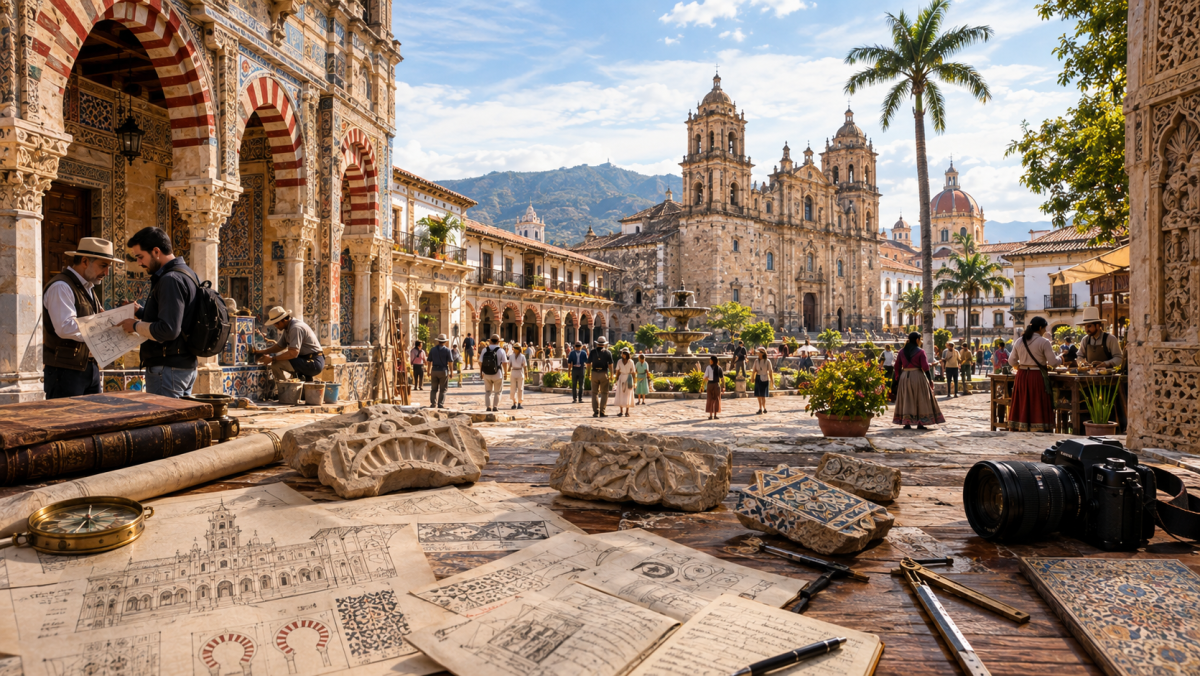
When Spanish builders arrived in the Americas, many of them brought the Mudéjar style, a blend of Islamic and Christian architecture that had developed in Spain after the Christian conquests. Mudéjar craftsmen were famous for their intricate wooden ceilings, called artesonados, built from interlocking geometric patterns that recall the star designs found in mosques and palaces across the Arab world.
Visitors can still admire these ceilings today. The Church and Convent of San Francisco in Quito, Ecuador, and several colonial churches in Lima, Bogotá, and Sucre feature geometric woodwork that would look perfectly at home in Andalusian palaces. The closed wooden balconies of Lima, known locally as balcones de cajón, are widely compared to the mashrabiya and served a similar purpose: allowing families to look out onto the street while keeping their privacy and staying cool.
Inner courtyards are another shared feature. Colonial houses in Cartagena, Antigua Guatemala, and Havana were often built around a central patio with a fountain and plants, a design with deep roots in the Andalusian home and, before that, in the courtyard houses of the Middle East.
Tiles, Water, and Gardens
Glazed tiles are another beautiful inheritance. The Spanish word azulejo comes from the Arabic az-zulayj, meaning a small polished stone. In Puebla, Mexico, artisans have produced colorful Talavera ceramics since the colonial era, a tradition that grew from Spanish workshops influenced by Islamic tile-making. Walk through Puebla's historic center and you will see church domes and house facades covered in blue, yellow, and white tiles that shine in the sun.
Water management tells a similar story. The acequia, an irrigation channel whose name comes from the Arabic as-saqiya, was introduced to parts of Mexico and to what is now the southwestern United States. Some communities still manage their shared water through acequia systems whose basic principles would be familiar to farmers in Andalusia centuries ago, and to the farmers of the Arab world who developed them.
When Conquistadors Saw "Mosques"
One of the most surprising historical details is found in the letters of Hernán Cortés, the Spanish conquistador who reached the Aztec capital of Tenochtitlan in 1519. When he described the great temples of the Mexica people to the Spanish king, he often called them mezquitas, the Spanish word for mosques. For men who had grown up in a Spain still full of Andalusian buildings, the mosque was the natural reference point for any large religious building that was not a church. It is a small detail, but it shows how deeply Al-Andalus shaped the way Spaniards understood the world.
Why This Matters for Arab Travelers
For Arab visitors, Latin America can feel both far away and strangely familiar. The sound of ojalá in a Bogotá café, the geometric ceiling of a Quito church, the patio fountain of a colonial home in Cartagena: all of these are quiet reminders of a civilization that Arabs helped build. Exploring these connections turns a trip to Latin America into something more meaningful, a journey into a shared history that stretches from Damascus to Córdoba and across the ocean to the Andes. The next time you hear a Latin American friend say ojalá, you will know exactly where that hope began.