The Middle Eastern Roots of Latin American Street Food
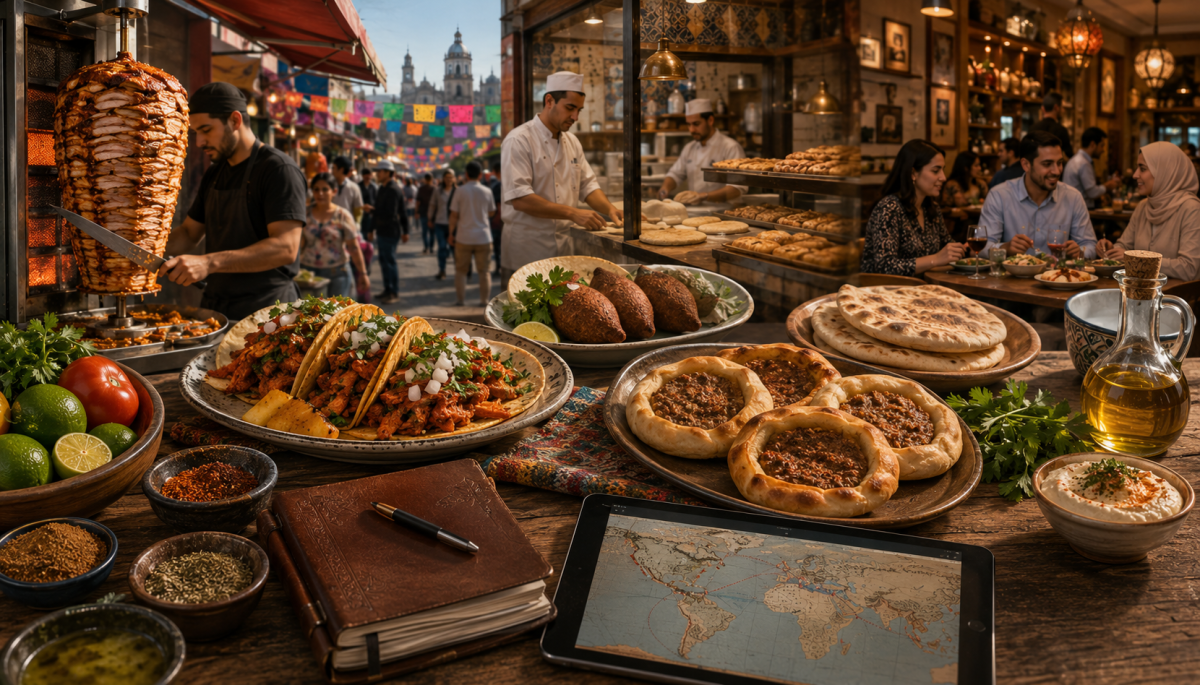
Stand on almost any street corner in Mexico City around dinnertime and you'll likely catch the smell before you see it — meat turning slowly on a vertical spit, shaved thin, tucked into a small corn tortilla with a sliver of pineapple on top. It's called tacos al pastor, and it's considered as Mexican as anything gets. What most people don't realize, including many Mexicans themselves, is that this entire cooking method didn't originate in Mexico at all. It arrived with Lebanese immigrants in the early twentieth century, carrying with them the technique for shawarma — meat stacked and roasted vertically on a rotating spit.
From Shawarma to Al Pastor: A Culinary Transformation
The story of tacos al pastor is really a story about adaptation. Lebanese immigrants who settled in central Mexico in the 1930s brought their shawarma technique, originally made with lamb, and gradually swapped the ingredients to match what was locally available and culturally familiar — pork instead of lamb, a corn tortilla instead of pita bread, and Mexican chilies and achiote replacing the traditional Levantine spice blend. The trompo, the vertical spit itself, remained essentially unchanged, and it's why the dish is sometimes still called "tacos árabes" in parts of Puebla, the city where the fusion is believed to have first taken hold.
Kibbeh and Esfihas: A Brazilian Obsession
Brazil tells a parallel but distinct story. Waves of Syrian and Lebanese immigration beginning in the late 1800s brought an entirely different set of dishes that, remarkably, never had to change much to become beloved. Kibbeh — a torpedo-shaped dish of bulgur wheat and ground meat, spiced and either fried or baked — is sold today in bakeries, food courts, and street stalls across São Paulo with the same enthusiasm as any dish considered natively Brazilian. Esfihas, the open-faced Lebanese meat pies, have become such a fixture of Brazilian fast food that entire restaurant chains, some with hundreds of locations, exist purely to sell them alongside kibbeh and tabbouleh.
Why the Fusion Took Root So Deeply
Part of what makes this culinary history so remarkable is how completely these dishes were absorbed into local identity rather than remaining confined to immigrant enclaves. Unlike some diaspora cuisines that stay within their original community, Arab food in Latin America crossed over almost immediately into the mainstream, likely because the flavors — warm spices, grilled meats, bread-based vehicles for filling — translated naturally to palates already accustomed to bold, hearty street food traditions.
Argentina shares a similar story, with its own significant Syrian-Lebanese population shaping regional food culture, particularly in cities like Córdoba and Tucumán, where Middle Eastern bakeries selling baklava and Arab-style flatbread sit comfortably alongside traditional Argentine parrillas.
A Living Legacy on Every Corner
What makes this history worth telling isn't just culinary trivia — it's a reminder of how deeply intertwined Arab and Latin American cultures have become over more than a century of migration. A taco al pastor eaten on a Mexico City street corner carries, whether the eater realizes it or not, a direct lineage back to Beirut. A plate of kibbeh in São Paulo represents the same journey, just told through a different set of ingredients. For Arab travelers visiting the region today, these dishes offer something unexpected: a genuine taste of home, reshaped by a century of distance and adaptation, but unmistakably rooted in the same origin.
The fusion also runs both directions in subtler ways — Arab bakeries across the region have adapted to include local fruits and flavors in their pastries, while some Latin American home cooks now casually reach for za'atar or sumac without necessarily tracing the ingredient back to its origin. It's a quiet, ongoing culinary conversation between two regions that, on the surface, seem worlds apart but have been trading recipes, techniques, and traditions for well over a hundred years.