Deciphering the Past: The Inscriptions of Palenque
Palenque does not sit on an open plain the way many Maya cities do. It rises out of dense jungle in the foothills of Chiapas, its pale limestone temples wrapped in humidity and half-shaded by rainforest canopy, with the sound of howler monkeys often carrying across the ruins before the first tourists arrive. It is one of the most visually striking Maya sites ever excavated, and it is also, quietly, one of the most important. More than almost any other city, Palenque helped modern scholars finally learn to read what the Maya had been writing all along.
The Reign of Pakal the Great
Palenque's golden age is inseparable from one ruler: K'inich Janaab' Pakal, who came to the throne as a boy in 615 CE and reigned for an extraordinary 68 years, until his death in 683 CE. Under Pakal and his immediate successors, Palenque underwent a building boom, producing some of the most architecturally sophisticated structures in the entire Maya world, including the multi-story Palace complex with its distinctive tower, and the Temple of the Inscriptions, the pyramid built as Pakal's own funerary monument.
A Tomb Sealed for 1,300 Years
In 1952, Mexican archaeologist Alberto Ruz Lhuillier made one of the most significant discoveries in Mesoamerican archaeology. Beneath the floor of the Temple of the Inscriptions, he found a hidden stairway, sealed and forgotten, descending deep into the pyramid's core. At the bottom lay a crypt containing an enormous carved sarcophagus, and inside it, the remains of Pakal himself, adorned with a jade mosaic death mask and jade jewelry. The discovery proved conclusively, for the first time, that Maya pyramids could function as royal tombs in the same way Egyptian pyramids did, a connection scholars had long suspected but never confirmed with such striking evidence. The sarcophagus lid itself became one of the most analyzed pieces of Maya art ever found, carved with an elaborate scene of Pakal at the moment of death, framed by a world tree and cosmic imagery representing the boundary between the earthly and the underworld.
Cracking the Code
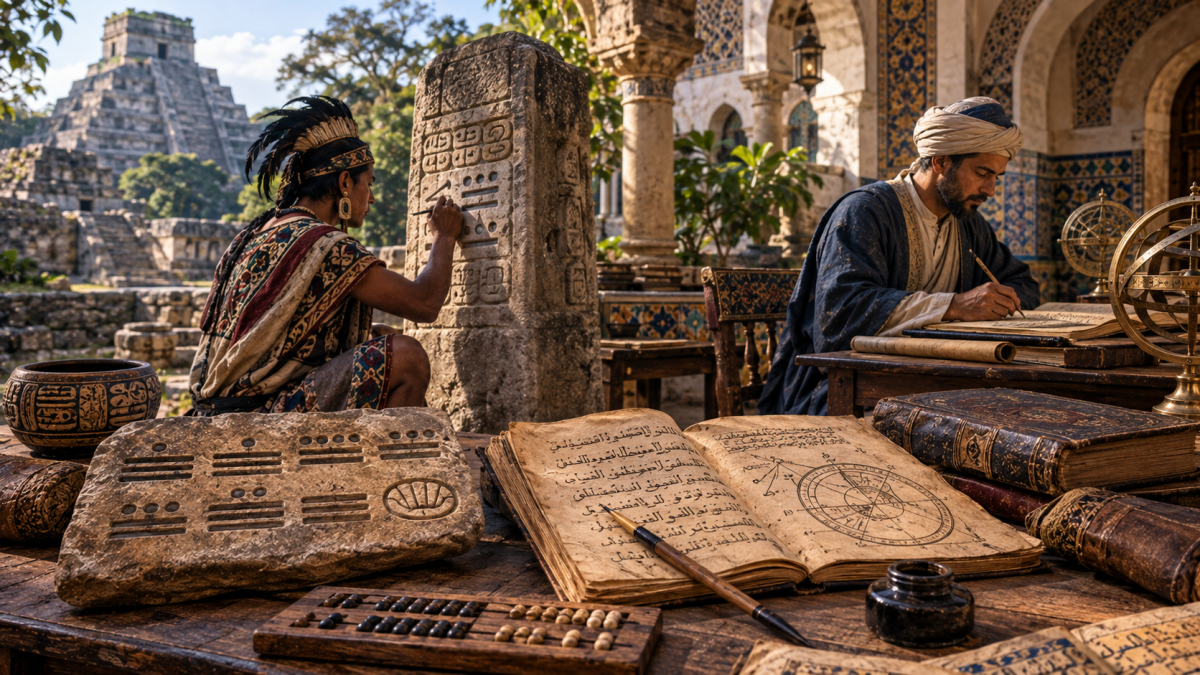
The temple that housed Pakal's tomb takes its name from what covers its interior walls: long panels of hieroglyphic text, among the most extensive inscriptions surviving from any single Maya site. For much of the 20th century, Maya writing remained largely mysterious, dismissed for decades by some scholars as purely symbolic or calendrical rather than a full written language. Palenque's inscriptions, alongside breakthroughs by Soviet linguist Yuri Knorozov and later refined by researchers including Linda Schele and David Stuart working directly with Palenque's texts, proved instrumental in demonstrating that Maya glyphs recorded actual spoken language, phonetic sounds combined with logographic signs, capable of narrating real historical events, royal genealogies, and precise dates. Palenque's scribes were particularly ambitious with time itself. Some of the site's inscriptions calculate calendar dates so far into the future that they extend millions of years beyond the date of carving, demonstrating a mastery of the Maya Long Count calendar system and a worldview in which cosmic time dwarfed any single human reign, even one as long as Pakal's.
A City Built for a King
Beyond the Temple of the Inscriptions, Palenque's Palace complex, with its unique four-story observation tower, likely served administrative, ceremonial, and possibly astronomical functions, offering views across the surrounding jungle and out toward the distant plains. The Temple of the Sun, Temple of the Cross, and Temple of the Foliated Cross, grouped together in what is now called the Cross Group, were commissioned by Pakal's son and successor, K'inich Kan Bahlam II, each one dedicated to a different patron deity and inscribed with further genealogical and mythological text tying the dynasty to the origins of the Palenque triad of gods.
Palenque Today
Designated a UNESCO World Heritage Site in 1987, Palenque remains under active excavation, with large portions of the ancient city still unexcavated beneath the surrounding jungle. Researchers estimate that what is currently open to visitors represents only a fraction of the original urban area. Walking through Palenque today, past the Palace tower and up toward the Temple of the Inscriptions, it is worth remembering that this city did more than build beautifully. It left behind a written record detailed enough that, centuries later, it helped an entire civilization's voice be heard again.