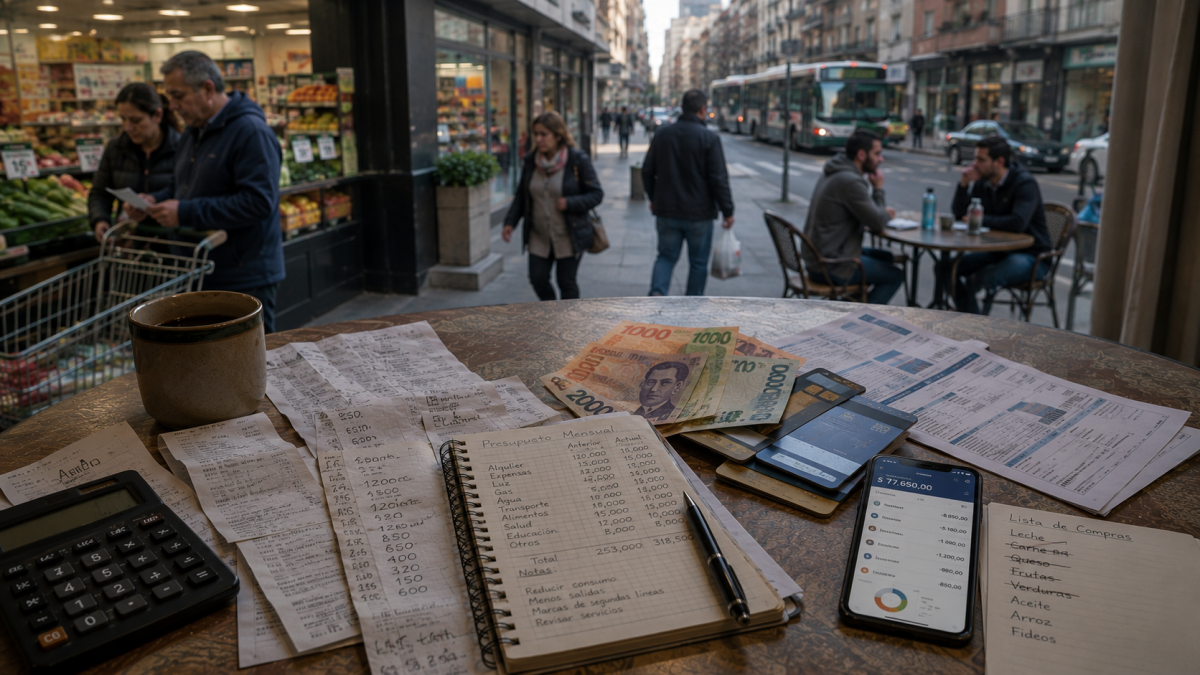
Why Inflation Affects Everyday Life in Argentina
Inflation is often presented as a percentage on a television screen. Economists discuss monthly price increases, annual inflation rates, interest rates, fiscal deficits, and exchange-rate expectations. For an ordinary family in Argentina, however, inflation is not primarily a statistic. It is the difference between buying meat this week or replacing it with pasta. It is checking a restaurant menu online and wondering whether the prices are still valid. It is receiving a salary and immediately deciding which bills must be paid before the money loses more purchasing power.
Argentina has made significant progress in reducing the speed of inflation. Official data showed monthly consumer-price inflation of 2.1% in May 2026, compared with the extraordinary 25.5% monthly increase recorded in December 2023. Nevertheless, slower inflation does not mean that prices return to their previous levels. It only means that they are increasing more slowly. Years of accumulated price increases, declining purchasing power, adjustments in utility subsidies, and household debt continue to affect everyday life.
When Prices Lose Their Meaning
One of the most disruptive effects of persistent inflation is the disappearance of what might be called “price landmarks.” In a stable economy, people usually know approximately what basic goods should cost. They know whether a kilogram of meat, a cup of coffee, a taxi journey, or a monthly electricity bill is cheap, expensive, or reasonably priced.
In a highly inflationary environment, that mental map begins to disappear.
A person may enter a supermarket and see a product priced at 5,000 pesos but have no immediate idea whether that price is normal. The same product may have cost 3,500 pesos a few months earlier and 2,000 pesos before that. Consumers must constantly relearn prices, and even experienced shoppers can struggle to distinguish genuine discounts from outdated reference prices.
This creates a strange form of economic disorientation. Numbers continue to exist, but they communicate less information. A salary increase may sound impressive in nominal terms while leaving the employee poorer in real terms. A shop may advertise a large discount, but customers cannot easily remember the product’s original price. A restaurant bill may appear shockingly high, yet diners may be uncertain whether the restaurant is expensive or whether the entire price structure has changed again.
The Race to Spend Money
In many countries, receiving a salary marks the beginning of a monthly budget. In Argentina, during periods of high inflation, payday can feel more like the beginning of a race.
Families often prioritize purchases immediately after receiving their income. They pay rent, utilities, school fees, medical expenses, and credit-card balances before allocating what remains to food and transportation. When consumers expect prices to rise, delaying a necessary purchase can become financially irrational.
Someone who knows that cooking oil, cleaning products, medicine, or car parts may cost more next month has an incentive to buy them today. Families may stock up on nonperishable products, not because of panic, but because storing goods can preserve value better than holding cash.
This reverses the financial habits encouraged in more stable economies. Saving money in the local currency may involve a loss of purchasing power, while spending quickly can appear prudent. A washing machine, mobile phone, box of medicine, or supply of household products becomes more than a purchase: it becomes a way of transforming depreciating money into something useful.
The Blue Dollar and Argentina’s Dual-Currency Mindset
For years, Argentina’s economy functioned with several exchange rates. Alongside the official rate, the “dólar blue” emerged as the best-known parallel rate for buying and selling US dollars outside the formal banking system.
Currency restrictions were substantially relaxed in April 2025, narrowing the gap between the official exchange rate and the Blue Dollar and reducing the importance of informal street trading. Nevertheless, the Blue Dollar remains culturally and psychologically significant because generations of Argentines learned to use the dollar as a measure of value and protection against peso depreciation.
People may earn salaries, pay taxes, and buy groceries in pesos, but they often think about major assets in dollars. Apartments are commonly discussed in US dollars. Cars, imported technology, international travel, and long-term savings are frequently evaluated according to the exchange rate.
This produces a dual monetary consciousness. The peso is the currency of everyday circulation; the dollar is often treated as the currency of memory, protection, and long-term value.
The exchange rate also influences prices even when a product is manufactured locally. Businesses may depend on imported machinery, replacement parts, fuel, packaging, software, fertilizers, or intermediate materials. If companies expect the peso to weaken, they may adjust prices in advance to protect themselves against the cost of replacing their inventory.
As a result, news about the dollar can affect behaviour before any physical shortage occurs. A sudden exchange-rate movement may lead consumers to accelerate purchases and sellers to suspend prices while they calculate replacement costs.
Cuotas: The Cultural Art of Paying in Installments
Few concepts explain Argentine consumer life better than “cuotas,” or installment payments.
In a stable economy, installments are often used to purchase expensive items that would otherwise be unaffordable. In an inflationary economy, cuotas can also function as a defensive financial instrument. Consumers attempt to lock in today’s price and pay for the product later with pesos that may be worth less.
Suppose a refrigerator costs 600,000 pesos and can be purchased in six interest-free installments. If wages and prices rise during those six months, the final installments may represent a smaller share of the buyer’s monthly income. The customer has effectively transferred part of the inflation risk to the seller or financial institution.
This logic has made installment culture deeply embedded in Argentina. Clothing, appliances, furniture, mobile phones, travel, dental treatment, and sometimes ordinary supermarket purchases may be financed through credit cards. Historical consumer research found widespread use of cuotas among Argentine households, while more recent reports show that households increasingly rely on credit as purchasing power remains under pressure.
However, cuotas can provide relief and create danger at the same time. A household may accumulate overlapping installment plans: three payments remaining on a mobile phone, six on school supplies, nine on a refrigerator, and several more on clothing or medical expenses. Each individual payment appears manageable, but together they can consume much of the next salary before it arrives.
This is no longer merely “buy now, pay later.” It can become “live now, pay from several future salaries.”
The Psychological Cost of Inflation
Inflation does not only reduce purchasing power. It consumes attention.
People repeatedly check prices, promotions, exchange rates, bank applications, salary negotiations, and credit-card closing dates. They compare supermarkets, calculate installment costs, change brands, delay medical appointments, and reconsider social invitations.
The psychological burden comes from permanent calculation. A simple purchase becomes a financial decision. Should a family buy a product now because its price may rise? Should they wait for a promotion? Should they pay in cash, use a credit card, or choose twelve cuotas? Should they keep pesos for rent or convert part of their savings into dollars?
Persistent inflation also damages the ability to imagine the future. Planning a holiday, starting a business, moving to another apartment, saving for education, or preparing for retirement requires assumptions about future prices. When those assumptions are unreliable, long-term planning becomes emotionally exhausting.
Inflation can therefore shorten people’s time horizon. Attention shifts from “Where do we want to be in five years?” to “How do we reach the end of this month?”
Food, Rent, Transport, and the Everyday Negotiation of Dignity
Inflation is experienced most sharply through recurring necessities.
Food prices force families to modify diets, reduce quantities, replace familiar brands, and search for promotions. Meat consumption may become less frequent. Restaurants become occasional luxuries. Parents may protect their children’s food while cutting their own discretionary spending.
Rent creates another form of vulnerability. Tenants must anticipate contract adjustments while landlords attempt to protect the real value of their property income. Even when wages rise, rent adjustments can absorb a large part of the increase.
Transportation costs affect where people can work, study, and socialize. Utility-price adjustments influence whether households limit heating, air conditioning, or other forms of energy use. These are not abstract changes in a price index; they determine comfort, mobility, nutrition, and participation in society.
Inflation also changes relationships. Friends may meet at home instead of at cafés. Families may postpone weddings, travel, renovations, or celebrations. Adult children may remain with their parents longer. Couples may argue not because they disagree about money in principle, but because every available option involves sacrifice.
Why Falling Inflation Does Not Immediately Feel Like Relief
When monthly inflation declines, the improvement is real. Businesses can plan more confidently, wages have a better chance of catching up, and consumers can begin rebuilding reliable price references.
Yet stabilization takes time to become emotionally believable.
People who have experienced repeated crises do not immediately trust a few months of improved data. They remember devaluations, frozen bank deposits, recessions, changing regulations, and failed stabilization plans. Their defensive habits—buying dollars, spending salaries quickly, stockpiling goods, or using cuotas—were developed through experience.
Moreover, lower inflation does not reduce the accumulated price level. A product that rose from 1,000 pesos to 10,000 pesos does not return to 1,000 simply because inflation slows. Relief depends on wages, pensions, employment, credit conditions, rents, utility costs, and consumer confidence—not only on the inflation rate.
That is why inflation affects everyday life in Argentina so deeply. It changes more than prices. It changes the meaning of money, the rhythm of consumption, the relationship between pesos and dollars, the use of credit, and the ability to plan.
Above all, it turns ordinary life into a continuous exercise in economic adaptation. Argentines have developed remarkable creativity in response: comparing prices, negotiating, buying collectively, using cuotas strategically, changing currencies, and finding new ways to protect their families.
But resilience should not be confused with comfort. Behind every clever strategy lies a basic desire shared by households everywhere: to know what their money is worth today, what it might be worth tomorrow, and whether the future can be planned without fear.