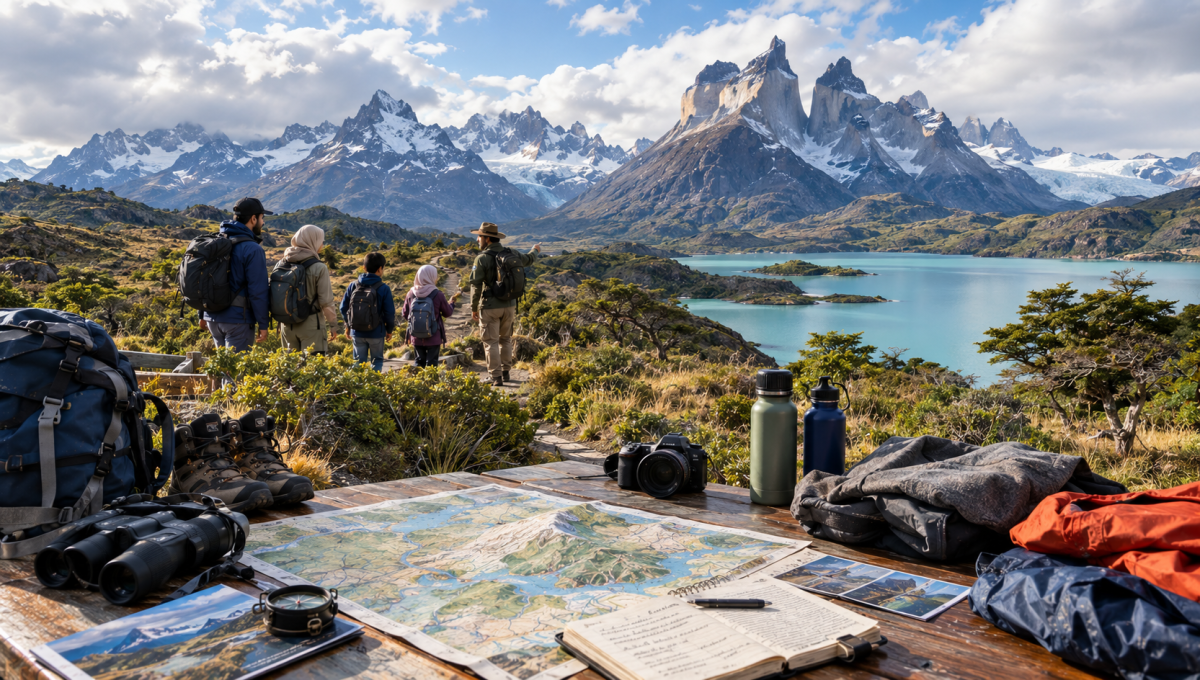
Torres del Paine: A Practical Guide to Chilean Patagonia
Introduction
At the southern end of Chile, Torres del Paine National Park brings together granite peaks, broad steppe, clear lakes, rivers, waterfalls, forests and glaciers in one protected landscape. For readers in the Arab world, the park offers a useful introduction to Patagonia because its scenery is dramatic, its visitor routes are well established and its environmental rules are clear. It is not a place to approach casually. Distances are long, weather can change quickly and services must often be reserved before arrival. With thoughtful preparation, however, a visit can be comfortable, educational and deeply memorable. This guide explains the park's geography, natural character, main viewing areas, travel planning and responsible conduct without turning the journey into a race between famous viewpoints.
Where mountains meet the steppe
Torres del Paine lies in Chile's Magallanes region, between the Andes and the Patagonian steppe. The national park covers about 227,298 hectares, according to Chile's National Forest Corporation, CONAF. Its most recognizable forms are the Paine Towers and the Cuernos del Paine, whose steep profiles rise above open plains and glacial valleys. The Paine massif is a distinct mountain system shaped by geological forces and later carved by moving ice. That history remains visible in sharp ridges, wide valleys, moraines and rock faces. The landscape is therefore more than a scenic background. It is a readable record of deep time, showing how rock, ice, wind and water produced the varied terrain seen today.
A landscape built by ice and water
Water organizes the park. Lakes such as Pehoé, Nordenskjöld, Sarmiento and Grey differ in colour because of depth, sediments, light and surrounding geology. Rivers and waterfalls connect these basins, while glaciers descend from the Southern Patagonian Ice Field. Grey Glacier is among the best-known features and can be observed from approved trails and viewpoints. Visitors should remember that this is a dynamic environment rather than a fixed postcard. Wind shapes lake surfaces, cloud can hide the peaks within minutes and ice continues to influence the valleys. Seeing the park well depends on patience. A cloudy morning can reveal unexpected texture in the hills, while a calm interval may transform a lake into a bright mirror.
Four ecological worlds
UNESCO describes the wider Torres del Paine Biosphere Reserve as containing four clearly defined ecological zones. Within and around the park, visitors encounter Patagonian steppe, pre-Andean scrub, deciduous Magellanic forest and high Andean environments. Each responds differently to wind, altitude, moisture and temperature. Low vegetation dominates exposed plains, while lenga forests occupy more sheltered ground. The transition between these zones can happen over a relatively short distance, making a road journey or day walk unusually instructive. Guanacos are commonly seen on open land, and condors may appear above ridges. Other native species also inhabit the reserve, but observation must remain quiet and distant. Wildlife should never be approached, fed or surrounded for photographs.
Choosing the right kind of visit
Torres del Paine is often associated with long trekking circuits, yet a rewarding visit does not require several continuous days on remote trails. Travellers can combine vehicle-accessible viewpoints with shorter walks to lakes, waterfalls and panoramic areas. This is especially practical for families, first-time hikers and visitors who prefer a measured schedule. The famous W route links major valleys and usually requires several days, confirmed accommodation and suitable fitness. The longer O circuit demands even more preparation. Day visitors can instead focus on selected sectors, allowing time for landscape observation and rest. The best plan is the one that matches ability, daylight, weather and confirmed services rather than an ambitious checklist copied from another traveller.
Getting there and building a realistic plan
Puerto Natales is the usual base for reaching the park. Chile's official tourism service notes that seasonal flights may serve Puerto Natales from Santiago, while Punta Arenas generally offers a wider range of air connections. Road transport then links the regional gateways with Puerto Natales and the park entrances. Because routes, timetables and operating conditions can change, visitors should confirm current information with official providers. A sensible itinerary includes buffer time before and after the park. It also groups nearby sights instead of crossing the protected area repeatedly. Accommodation inside and near the park can fill early during popular periods, so reservations for rooms, campsites and relevant transport should be completed before departure.
Weather, clothing and daily comfort
Patagonian weather is famous for rapid variation. Strong wind, rain, low temperatures and bright sun can occur within the same day. Layered clothing is therefore more useful than one heavy item. A practical system includes a breathable base, an insulating middle layer and a wind-resistant waterproof outer layer. Closed walking shoes with reliable grip are important even on short routes, because surfaces can be wet or uneven. Travellers should also carry sun protection, gloves, a warm hat, a reusable bottle, simple food suitable for the day's plan and a small bag for personal waste. Mobile coverage cannot be assumed in all sectors, so offline maps and written booking details provide useful backup.
Rules that protect visitors and nature
CONAF manages the national park and publishes official notices about openings, seasonal restrictions and safety requirements. Conditions may lead to temporary closures, and some routes can require an authorized guide during particular periods. Travellers should check the latest park notice shortly before arrival and follow ranger instructions on site. Fires are tightly controlled because dry vegetation and strong wind can spread flames rapidly. Marked paths protect fragile ground and reduce the chance of becoming lost. Quiet behaviour helps preserve the experience for others and limits disturbance to wildlife. These rules are not obstacles to enjoyment; they are the practical framework that allows a delicate and heavily visited landscape to remain accessible.
A respectful experience for Arab travellers
Visitors from the Arab world may find the park's scale familiar in one sense and surprising in another. Like desert landscapes, Patagonia rewards attention to wind, horizon, colour and distance. Yet water and ice dominate the visual story here. Comfort improves when meals, transport and accommodation are arranged in advance, especially for travellers with specific dietary or privacy needs. Puerto Natales is the best place to confirm supplies and communicate requirements clearly with providers. A calm schedule also leaves room for regular rest and personal routines. Courtesy toward staff, guides and other visitors is straightforward: arrive on time, keep shared areas orderly, lower noise on trails and ask before photographing local workers or private property.
Conclusion
Torres del Paine deserves its reputation because several powerful landscapes meet within one protected area: granite towers, open steppe, forest, lakes and glacial ice. The park is most rewarding when visited with realistic expectations and respect for changing conditions. A successful journey begins with official information, advance reservations, layered clothing and a route suited to the traveller's ability. It continues with patient observation rather than hurried collection of photographs. For an Arab reader seeking a family-friendly introduction to southern South America, Torres del Paine offers both wonder and a clear lesson in responsible travel: the finest view is inseparable from the care that keeps the place intact.