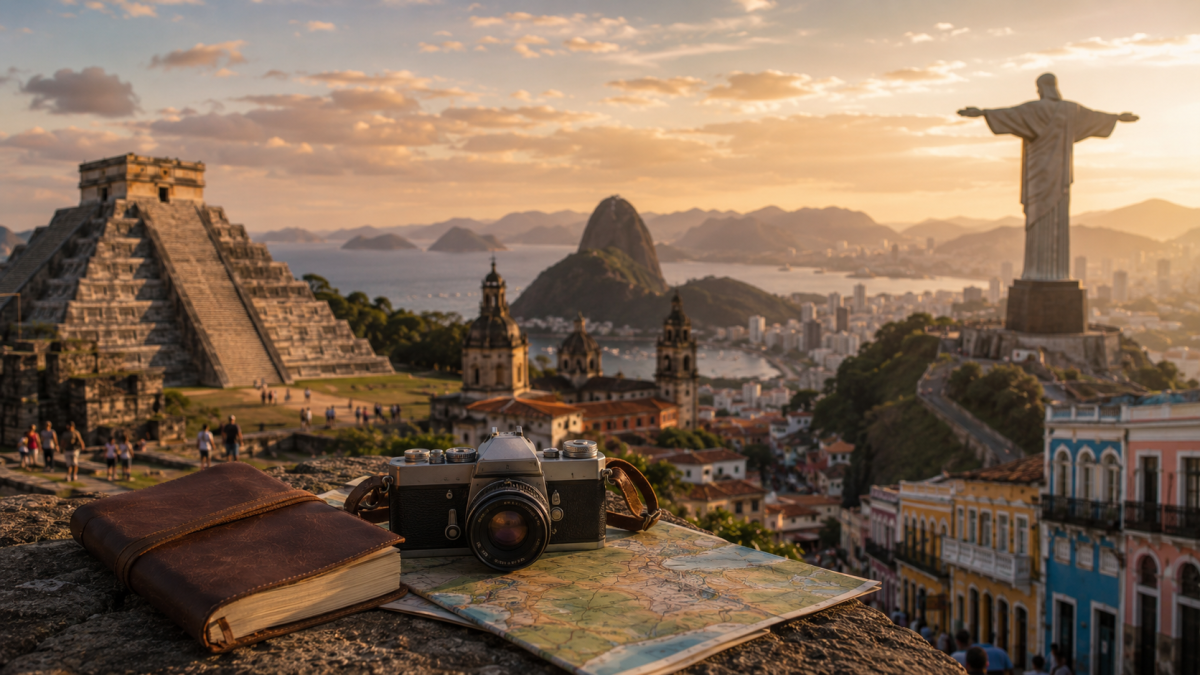
Timeless Wonders: The Most Famous Landmarks in Latin America
The vast and geographically diverse region of Latin America is a living museum. Across its towering mountain ranges, dense rainforests, and sprawling coastlines lies a profound historical narrative etched in stone and nature. The famous landmarks in Latin America are not merely tourist attractions; they are the physical manifestations of complex ancient civilizations, brutal colonial conquests, and the breathtaking power of the natural world. From the astronomical precision of pre-Columbian pyramids to colossal modern monuments overlooking modern metropolises, these iconic sites draw millions of visitors annually, serving as enduring symbols of the continent's rich, multifaceted heritage.
Machu Picchu: The Incan Citadel in the Clouds (Peru)
No discussion of Latin American landmarks can begin anywhere other than high in the Peruvian Andes. Hidden beneath thick jungle canopies and surrounded by terrifyingly steep drop-offs, Machu Picchu is the undisputed crown jewel of the Incan Empire. Built in the 15th century, likely as a royal estate for the Incan emperor Pachacuti, the citadel was abandoned during the Spanish conquest and remained unknown to the outside world until it was brought to international attention by American historian Hiram Bingham in 1911.
What makes Machu Picchu an architectural marvel is the astonishing quality of its masonry. The Incas utilized a technique called ashlar, where blocks of stone are cut to fit together so tightly that not even a blade of grass can be inserted between them—all without the use of mortar. This incredibly precise engineering has allowed the city to survive centuries of powerful earthquakes. Today, walking through the terraces, the Temple of the Sun, and the Intihuatana stone offers a profound glimpse into a civilization that lived in absolute harmony with some of the most unforgiving geography on the planet.
Chichén Itzá: The Astronomical Masterpiece (Mexico)
Descending from the Andes to the dense jungles of the Yucatán Peninsula, we find Chichén Itzá, one of the most significant and well-preserved political and cultural centers of the ancient Maya civilization. A UNESCO World Heritage site and one of the New Seven Wonders of the World, this sprawling complex serves as a masterclass in ancient astronomy and mathematics.
The centerpiece of Chichén Itzá is El Castillo, also known as the Temple of Kukulcan. This perfectly symmetrical step pyramid is essentially a massive stone calendar. It features 365 steps—one for each day of the solar year. The genius of Mayan architects is put on global display twice a year during the spring and autumn equinoxes. As the late afternoon sun hits the pyramid, it casts a series of triangular shadows down the northern staircase, creating the unmistakable illusion of a massive feathered serpent slithering down the stone steps to join the carved serpent head at the base. It is a stunning display of architectural alignment and astronomical mastery.
Christ the Redeemer: The Guardian of Rio (Brazil)
Transitioning from ancient ruins to modern monumental art, Christ the Redeemer (Cristo Redentor) is the ultimate symbol of Brazilian culture and faith. Perched 2,300 feet above the city of Rio de Janeiro on the summit of Mount Corcovado, this colossal Art Deco statue watches over the sprawling metropolis, its arms stretched wide in a gesture of peace and welcoming.
Completed in 1931, the statue was a collaborative international effort, created by French sculptor Paul Landowski and built by Brazilian engineer Heitor da Silva Costa, with the face fashioned by Romanian artist Gheorghe Leonida. Standing 98 feet tall, not including its massive pedestal, and coated in millions of triangular soapstone tiles to resist the elements, the monument offers arguably the most famous panoramic view in the world. Looking down from the statue’s base, one can see the entirety of Rio’s dramatic topography, from the famous beaches of Copacabana and Ipanema to the dense urban sprawl of the favelas and the striking peak of Sugarloaf Mountain.
Teotihuacan: The City of the Gods (Mexico)
Predating the Aztec empire by centuries, the ancient metropolis of Teotihuacan, located just outside modern-day Mexico City, is one of the most enigmatic archaeological sites in the Americas. At its zenith around the first half of the first millennium CE, it was the largest city in the pre-Columbian Americas, housing an estimated 125,000 inhabitants. To this day, the original builders of the city remain unknown, as the Aztecs simply discovered the abandoned ruins and named it "The Place Where Men Become Gods."
The sheer scale of Teotihuacan is deeply humbling. The city is bisected by the massive Avenue of the Dead, which aligns with monumental structures including the Pyramid of the Sun—the third largest pyramid in the world—and the elegantly structured Pyramid of the Moon. Climbing the steep, uneven steps of the Pyramid of the Sun to look out over the sprawling complex provides a profound sense of the immense labor, religious devotion, and organized societal structure required to build such a megalopolis in the ancient world.
The Moai of Easter Island: The Silent Sentinels (Chile)
While geographically located in the middle of the Pacific Ocean, Easter Island (Rapa Nui) is a special territory of Chile and hosts one of the most deeply mysterious landmarks on earth: the Moai. These colossal monolithic human figures, carved by the Rapa Nui people between the years 1250 and 1500, are instantly recognizable by their oversized heads, heavy brows, and stoic expressions.
There are nearly 1,000 Moai scattered across the isolated island, some weighing over 80 tons and standing up to 33 feet tall. The statues were carved from the volcanic tuff of the Rano Raraku quarry and then transported—often over distances of up to 11 miles—to massive stone platforms called ahus located along the coastline. The logistical method used by the ancient Polynesians to move these massive stones without the use of wheels, large animals, or metal tools remains a subject of intense archaeological debate and fascination, making Easter Island an unparalleled destination for historical intrigue.
Salar de Uyuni: The Mirror of the Sky (Bolivia)
Not all famous landmarks in Latin America were built by human hands; some of the most profound monuments were forged by geology. Salar de Uyuni in southwestern Bolivia is the world's largest salt flat, stretching over 4,000 square miles across the high Andean plateau. Formed by the transformation of several prehistoric lakes, it leaves behind an expansive crust of blindingly white salt, beneath which lies the world's largest reserve of lithium.
During the dry season, the flats form an endless expanse of cracked, hexagonal salt tiles, allowing for incredible perspective-bending photography. However, it is during the wet season that the landmark achieves its most magical state. A thin layer of water covers the flat, transforming it into the world's largest natural mirror. The reflection of the sky is so perfect that the horizon line completely vanishes, giving visitors the surreal sensation of walking among the clouds.
Tikal: The Jungle Metropolis (Guatemala)
Deep in the heart of the Petén Basin in northern Guatemala lies Tikal, one of the most powerful and expansive urban centers of the classic Maya civilization. Unlike the relatively cleared grounds of Chichén Itzá, Tikal remains heavily enveloped by a dense, biologically diverse rainforest. The piercing cries of howler monkeys and the colorful flashes of toucans and macaws serve as the living soundtrack to this ancient city.
Tikal is famous for its towering, steep-sided limestone pyramids that breach the jungle canopy. Temple IV, the tallest pre-Columbian structure in the Americas, stands at 213 feet. Climbing the wooden wooden staircases to the crest of this temple and looking out over the endless sea of green jungle—with only the peaks of other ancient pyramids breaking the surface—is a transformative experience. For pop culture enthusiasts, this exact view was famously used as the rebel base on the moon of Yavin 4 in the original Star Wars film.
Conclusion
The famous landmarks in Latin America are vastly different in their origins, architectures, and environments, yet they share a common thread: they command absolute awe. From the dizzying heights of Machu Picchu and the astronomical brilliance of Chichén Itzá to the serene natural majesty of the Bolivian salt flats, these sites tell the story of a region defined by resilience, ingenuity, and a deep, enduring connection to both the spiritual and natural worlds. Protecting these wonders in the face of modern mass tourism and climate change remains a vital responsibility, ensuring that future generations can continue to stand in the shadows of the region's great historical and geographical monuments.