The Olmecs: The First Great Civilization of Mesoamerica
Long before the magnificent pyramids of the Maya pierced the jungle canopy, and centuries prior to the rise of the Aztec empire in central Mexico, a mysterious and highly advanced civilization flourished along the humid Gulf Coast of what is now Mexico. From approximately 1200 BCE to 400 BCE, the Olmec civilization thrived in the modern-day states of Veracruz and Tabasco. Frequently referred to by archaeologists as the "mother culture" of Mesoamerica, the Olmecs laid the foundational cultural, religious, and architectural blueprints that would be adopted and adapted by virtually every subsequent civilization in the region.
The Heartland of the Olmec: San Lorenzo and La Venta
The Olmec civilization was not a unified empire but rather a network of powerful urban centers that dominated the tropical lowlands. The earliest of these major centers was San Lorenzo, which reached its peak around 1200 BCE. Built on a massive artificial plateau, San Lorenzo was a marvel of early engineering, featuring complex drainage systems and monumental plazas.
When San Lorenzo declined around 900 BCE, the center of Olmec power shifted to La Venta. This site is famous for the Great Pyramid, a massive earthen mound that stands over 100 feet tall, representing one of the earliest monumental structures in Mesoamerica. La Venta also served as a profound religious center, containing buried offerings of precious jade, elaborate mosaic pavements depicting abstract masks, and massive sculpted monuments.
The Enigma of the Colossal Heads
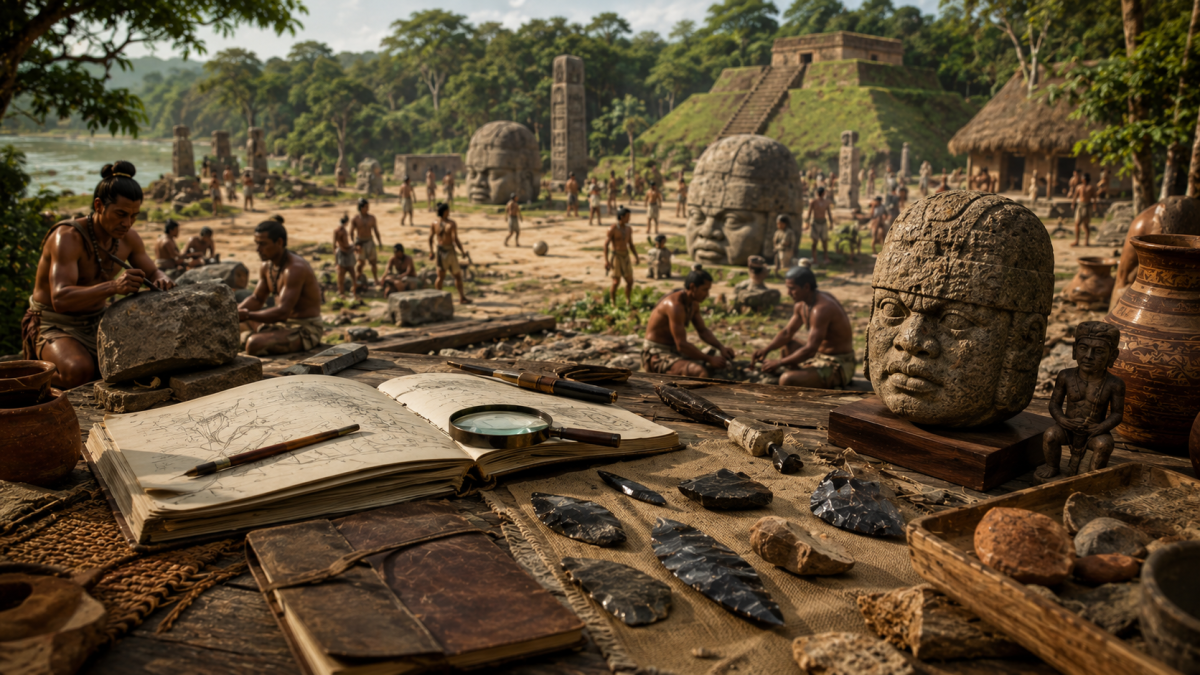
The most iconic and instantly recognizable legacy of the Olmecs are the Colossal Heads. To date, 17 of these massive stone sculptures have been discovered in the Olmec heartland. Carved from single blocks of volcanic basalt, these heads weigh up to 40 tons and measure up to 3 meters (nearly 10 feet) in height.
What makes these sculptures truly remarkable is their distinct, highly individualized facial features—broad noses, thick lips, and unique headdresses or helmets. Most historians and archaeologists believe these heads are not depictions of gods, but rather powerful, individual Olmec rulers. The logistical achievement of creating these monuments is staggering; the Olmecs had no beasts of burden and no wheeled vehicles, yet they transported these massive basalt blocks from the Tuxtla Mountains over distances of up to 50 miles, likely utilizing a complex network of rafts and waterways.
Innovations: Rubber, Writing, and the Ballgame
The very name "Olmec" is a Nahuatl (Aztec) word meaning "the rubber people." The Olmecs were the first known civilization to extract latex from rubber trees and mix it with the juice of morning glory vines to create bouncy rubber. This technological breakthrough allowed them to create the solid rubber balls used in the Mesoamerican ballgame. This ritualistic sport, which held deep religious and political significance, was played on I-shaped courts and became a staple of later Maya and Aztec societies.
Furthermore, there is growing evidence that the Olmecs were among the first in the Americas to develop a calendar system and early forms of writing. Discoveries such as the Cascajal Block, dating to around 900 BCE, feature symbols that many scholars argue represent a nascent writing system, establishing the Olmecs as intellectual pioneers.
Art, Religion, and the Were-Jaguar
Olmec religion was deeply animistic, attributing spiritual power to elements of the natural world such as caves, mountains, and water. Their art was heavily laden with religious symbolism. They were masterful carvers of jade, a material they valued more than gold, crafting exquisite masks, celts, and figurines.
A recurring motif in Olmec art is the "were-jaguar," a supernatural creature combining human and jaguar traits, often depicted with a cleft head and a snarling, down-turned mouth. The jaguar was a symbol of raw power and the underworld. The Olmec pantheon also included early representations of the Feathered Serpent and the Rain God, deities that would later become central to the religions of the Toltecs, Maya, and Aztecs.
Decline and Lasting Legacy
Around 400 BCE, the great Olmec cities were gradually abandoned, and their civilization faded. The exact cause of their decline remains a mystery, though scholars suggest that dramatic environmental changes, such as shifting river courses, volcanic eruptions, or agricultural exhaustion, may have made their heartland uninhabitable.
However, the Olmecs did not simply vanish; their culture diffused. The trade networks they established spread their artistic styles, religious concepts, and social structures across Mesoamerica. By the time the Olmec centers fell quiet, the seeds of their brilliance had already been sown, ensuring that the legacy of the "rubber people" would live on in the DNA of every great civilization that followed.