The Mystery in the Desert: How Were the Nazca Lines Created?
Stretching across the arid, sun-baked plains of southern Peru lies one of the world's most captivating archaeological enigmas. The Nazca Lines—a sprawling network of massive geoglyphs depicting geometric shapes, intricate plants, and colossal animals like a monkey, a spider, and a hummingbird—cover roughly 170 square miles of the Pampa de San José. Because these enormous figures are best viewed from the air, their discovery in the 1920s with the advent of commercial flight immediately sparked a whirlwind of speculation.
For decades, the sheer scale of the geoglyphs led to wild theories. Pseudoscientists and pop-culture writers suggested that the lines were runways for extraterrestrial spacecraft or that the ancient Nazca people must have possessed advanced, lost technology like hot air balloons to oversee their construction. However, modern archaeology has grounded this mystery firmly in reality. The truth of how the Nazca Lines were created is not a story of aliens or lost technology; it is a remarkable testament to human ingenuity, communal organization, and a profound understanding of applied geometry.
The Perfect Canvas: The Environment of the Nazca Desert
To understand how the lines were made, one must first understand the canvas upon which they were drawn. The Nazca Desert is one of the driest places on Earth, receiving only a fraction of an inch of rain per year. The surface of this desert plain is covered with a layer of iron-oxide-coated pebbles and rocks, which have been baked to a deep, dark reddish-brown by the relentless sun.
Crucially, directly beneath this thin layer of dark, oxidized gravel lies a highly contrasting subsoil made of light-colored clay, earth, and sand. Furthermore, the ground contains large amounts of gypsum. When the rare morning mist rolls in from the nearby Pacific Ocean, it moistens the gypsum, essentially cementing the stones to the ground and locking the surface in place. This unique geological combination—dark rocks over light soil, sealed by a hyper-arid, windless climate—provided the Nazca people with a perfect, permanent drawing board.
Subtractive Drawing: The Physical Process
The actual physical method used to create the lines is surprisingly simple and is known as a subtractive process. The Nazca people did not bring material to the desert to "paint" the lines; instead, they removed material.
By manually clearing away the top layer of dark, sun-baked rocks, they exposed the much lighter subsoil beneath. To give the lines crisp, defined edges, the removed rocks were carefully stacked along the borders of the cleared paths. This created a slight, raised lip along the edges of the lines, usually no more than a foot high. Because of the stark color contrast between the cleared light earth and the surrounding dark desert pavement, the lines become highly visible, especially when the sun casts slight shadows on the piled border rocks.
Scaling Up: From Small Models to Giant Geoglyphs
The most common question surrounding the Nazca Lines is how the ancient builders maintained such perfect proportions over hundreds of feet without an aerial vantage point. How do you draw a perfectly symmetrical 300-foot monkey when you are standing on the ground?
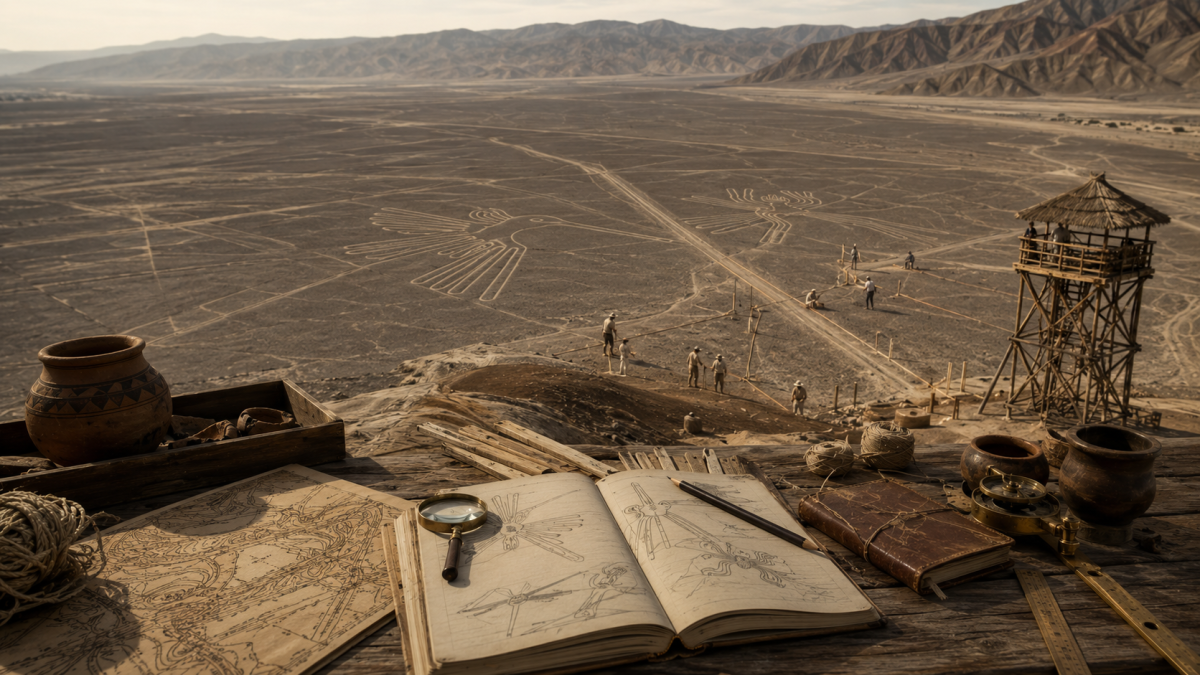
Archaeological evidence suggests the Nazca utilized a grid and stake method, heavily relying on surveying techniques and mathematics. It is highly likely that the designs were first drafted on a small scale, perhaps woven into textiles or drawn on small plots of land. Once the master design was perfected, it was scaled up using a system of wooden stakes and ropes.
By placing a central stake and measuring specific distances and angles with ropes, the Nazca could precisely map the coordinates of the small model onto the vast desert floor. If a line on the small model was one inch long, they might use a rope to make it 100 feet long on the desert floor, maintaining the exact same angle. Proof of this method is not just theoretical; archaeologists have discovered the remains of wooden stakes driven into the ground at the terminal points of several lines. Carbon dating of these wooden stakes precisely aligns with the era of the Nazca culture (roughly 200 BCE to 600 CE), definitively solving both the "when" and the "how."
The Human Element: Time and Workforce
Another common misconception is that creating the Nazca Lines would have required a massive, slave-like labor force working for decades. In reality, experimental archaeology has proven that clearing the lines is a relatively fast process.
A team of just a dozen people, equipped only with their hands, baskets, and simple wooden tools, can clear a large, complex geoglyph in a matter of days or weeks. The Nazca Lines were not built all at once in a massive, centralized construction boom. Instead, they are the accumulated effort of centuries. Generation after generation of Nazca people added to the desert canvas, drawing new lines over older ones, which is why the desert today looks like a chaotic, overlapping chalkboard of geometric shapes and animals.
The Purpose: Why Walk the Lines?
While understanding how they were created answers the mechanical question, understanding why completes the picture. The Nazca lines were not designed to be viewed by gods in the sky, but rather to be interacted with on the ground.
Almost all the biomorphic figures (the animals and plants) are drawn with a single, continuous line that never intersects itself. This suggests they were intended as ritual pathways. In a hyper-arid environment where water was a matter of life and death, archaeologists believe the Nazca people walked these giant labyrinths in ceremonial processions, likely praying to deities associated with water, agriculture, and fertility. The lines were an active part of their religious life—a temple without walls.
Conclusion
The creation of the Nazca Lines remains one of the greatest achievements of the pre-Columbian Americas. By demystifying their construction, we do not diminish their wonder; rather, we elevate our respect for the Nazca people. Armed only with wooden stakes, ropes, and a profound understanding of their harsh environment, they engineered a masterpiece that has withstood the ravages of time. The Nazca Lines prove that with mathematical precision, communal dedication, and a deep spiritual drive, ancient human beings were entirely capable of creating miracles on Earth—no extraterrestrial assistance required.