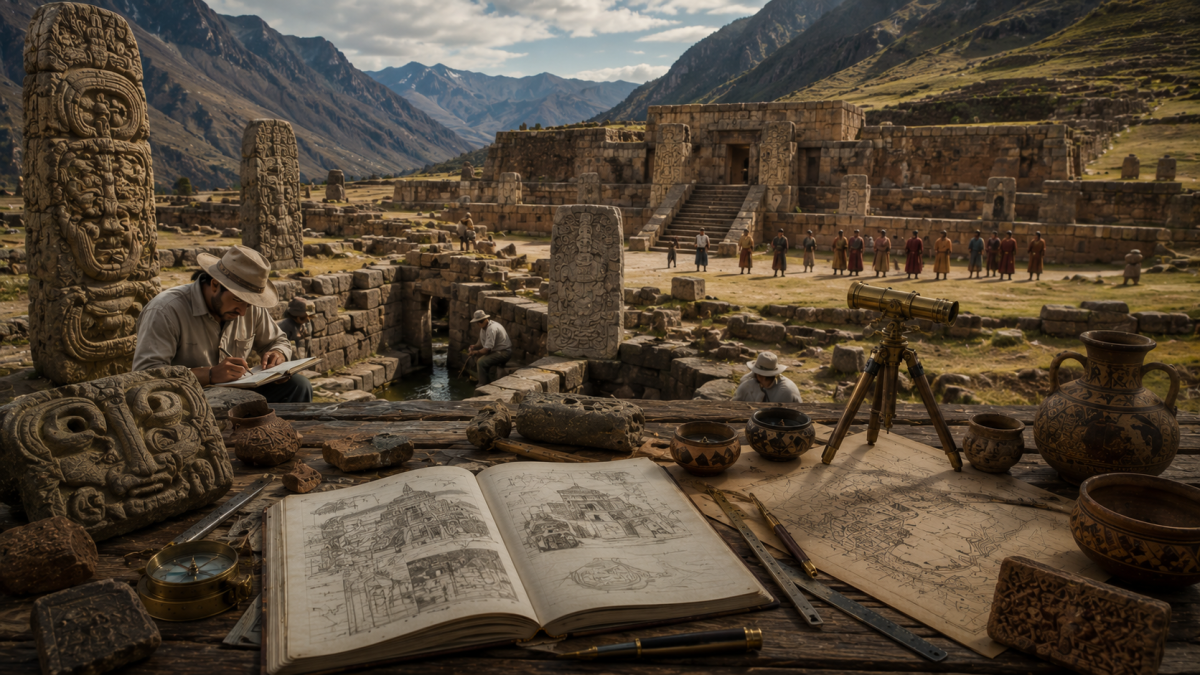
The Cradle of Ancient Peru: Unlocking the Chavín Civilization
Long before the legendary Inca Empire carved its domain across the rugged peaks of the Andes, the foundations of South American civilization were being laid in a high-altitude valley in central Peru. Emerging around 900 BCE and flourishing until approximately 200 BCE, the Chavín civilization represents one of the most critical turning points in pre-Columbian history. Often described by archaeologists as the foundational "mother culture" of the Andes—much like the Olmecs in Mesoamerica—Chavín was not a sprawling military empire. Instead, it was a powerful religious and cultural phenomenon that united disparate highland and coastal peoples under a single, mesmerizing ideological banner.
Chavín de Huántar: The Sacred Epicenter
The beating heart of this civilization was the monumental ceremonial center of Chavín de Huántar. Located at a staggering elevation of over 10,000 feet (3,150 meters) where the Mosna and Huachecsa rivers converge, the site was considered the center of the spiritual world. Its geographic placement was highly strategic, serving as a natural crossroad connecting the Pacific coast, the high Andean peaks, and the lush Amazonian rainforest to the east.
Because it was positioned at this ecological nexus, Chavín de Huántar became the ultimate pilgrimage destination. People from across the ancient Andean world traveled for weeks, braving harsh terrains, to bring offerings of gold, exotic shells, and ceramics to the temple priests. The city grew wealthy not through conquest, but through the magnetic pull of its awe-inspiring religious authority.
Engineering the Divine: Labyrinths and Acoustics
What truly sets the Chavín civilization apart is its astonishing mastery of psychological and architectural engineering. The temple complex at Chavín de Huántar is a massive, flat-topped pyramid made of stone, but its true genius lies hidden underground. The interior of the temple is a dizzying, pitch-black labyrinth of narrow stone corridors, dead ends, and multi-level galleries.
The Chavín priests designed this complex to induce sensory deprivation and profound spiritual experiences. They built a highly sophisticated network of subterranean water canals beneath the temple. When the nearby rivers were diverted into these canals, the rushing water created a deafening, thunderous echo that vibrated through the stone floors, designed to mimic the roar of a supernatural jaguar. For an ancient pilgrim walking through the dark, winding tunnels, the temple itself would have felt alive, breathing and roaring with divine power.
The Lanzón and Shamanic Rituals
At the very center of the underground labyrinth stands the supreme deity of the Chavín religion: the Lanzón monolith. Carved from a single, fifteen-foot-tall piece of white granite, the Lanzón depicts a terrifying, anthropomorphic figure with a snarling feline mouth, jaguar fangs, and hair made of writhing serpents. It is shaped like a giant traditional Andean agricultural knife, physically anchoring the heavens to the earth.
Encounters with the Lanzón were highly controlled and deeply psychedelic. Archaeological evidence, including stone carvings found at the site, heavily indicates that Chavín priests utilized the San Pedro cactus—a potent hallucinogen containing mescaline. Pilgrims, already disoriented by the dark maze and the roaring acoustic effects of the water canals, would consume the psychoactive brew. When they finally reached the central chamber, priests positioned above the Lanzón would use hidden air shafts to project their voices, making it appear as though the stone idol was speaking directly to the worshipper. This intense, mind-altering experience ensured absolute devotion to the Chavín cult.
Art, Metallurgy, and Cultural Diffusion
The influence of the Chavín civilization radiated outward across Peru, primarily carried by pilgrims returning to their homelands. This spread is most visible in the sudden uniformity of art and iconography across different regions. The Chavín artistic style is highly complex, intentionally difficult to decipher, and dominated by apex predators: the jaguar (representing the earth), the condor (representing the sky), and the serpent (representing the underworld).
Furthermore, the Chavín were pioneers in metallurgy. They were among the first in the Americas to master the working of gold, not for currency, but for creating spectacular religious adornments, crowns, and pectoral ornaments meant to catch the sun and elevate the status of the ruling priesthood. They also advanced textile production, using the wool of llamas and alpacas to weave intricate tapestries that carried their religious symbols far beyond the Mosna valley.
Decline and the Eternal Legacy
Around 200 BCE, the Chavín civilization gradually fractured and faded. Like many ancient Andean cultures, its decline was likely accelerated by severe environmental changes and shifting trade routes, which undermined the centralized power of the temple priests at Chavín de Huántar. As the religious center lost its grip, the region splintered into smaller, regionalized cultures.
However, the DNA of Chavín culture was permanently embedded in the Andean world. The religious motifs, the tripartite view of the universe (sky, earth, underworld), the mastery of stonework, and the agricultural innovations they pioneered were inherited by subsequent civilizations, including the Moche, the Nazca, and ultimately, the Incas. Today, Chavín stands as a testament to a unique moment in human history when architecture, art, and mysticism converged to create the very cradle of ancient Peruvian civilization.