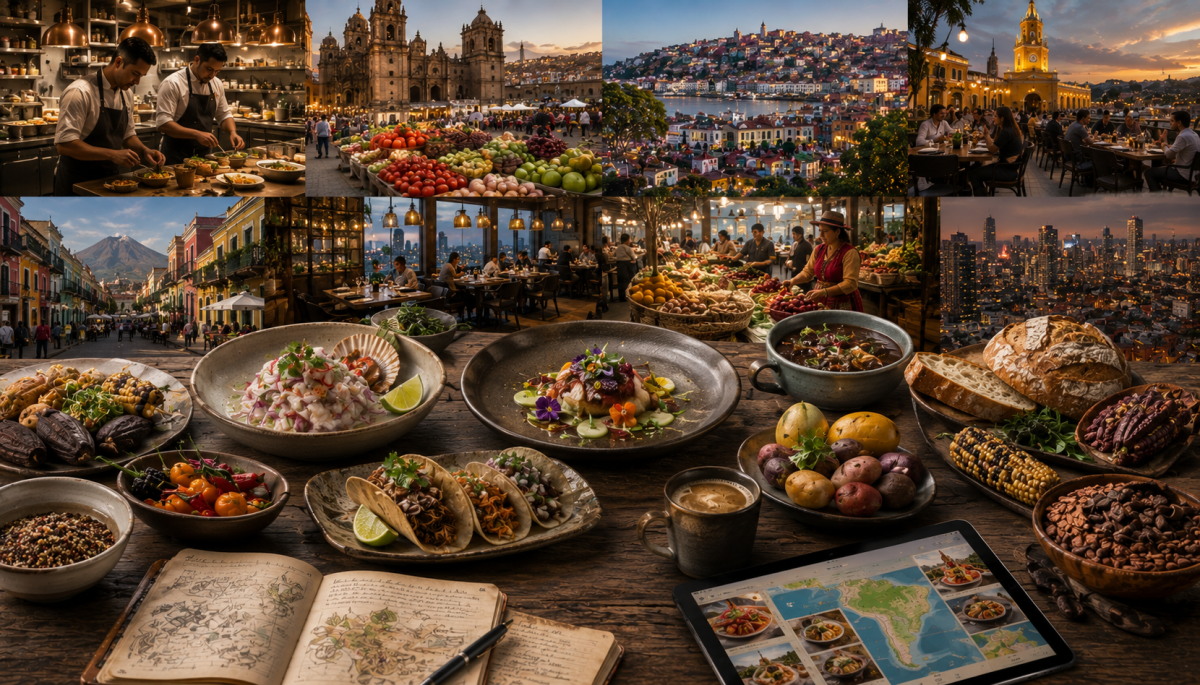
Taste of the Continent: The Culinary Capitals of Latin America
Every region tells its history through food, but few tell it as vividly as Latin America. A single plate can carry centuries of migration, trade, and adaptation — indigenous ingredients that predate colonization sitting next to techniques imported from Europe, Africa, and Asia, all reworked into something that belongs entirely to its city of origin. For anyone who wants to understand a place quickly and honestly, its food market is usually a better starting point than its museums.
Lima: The Fusion of the Pacific and the Andes
Lima has spent the last fifteen years quietly becoming one of the most respected culinary capitals on earth, and the transformation wasn't an accident. Peruvian chefs took the country's extraordinary natural pantry — over three thousand varieties of potato, seafood pulled fresh from the cold Humboldt Current, Amazonian fruits most of the world has never tasted — and paired it with serious technique, much of it influenced by the large Japanese and Chinese immigrant communities that settled in Peru over a century ago.
The result is Nikkei and Chifa cuisine, two distinct fusion traditions that now sit comfortably alongside Peru's more traditional dishes on the world's most competitive restaurant lists. Ceviche, cured with citrus and chili rather than heat, remains the dish most visitors remember longest, perfectly encapsulating the country's bright, bold flavors.
Mexico City: The Unrivaled Kings of Street Food
Mexico City operates on an entirely different rhythm — less about tasting menus and more about the relentless, joyful energy of street food done exceptionally well. A proper taco, built on a fresh corn tortilla with a filling that's been cooking slowly for hours, tells you more about Mexican cooking than most formal restaurants can.
Markets like Mercado de San Juan showcase ingredients most visitors have never encountered, while neighborhoods across the city each seem to have their own unofficial specialty, passed down through family stalls that have operated on the same corner for generations. It is a culinary landscape defined by abundance, spice, and a deep respect for ancestral techniques like nixtamalization.
São Paulo: A Multicultural Culinary Giant
São Paulo, meanwhile, reflects Brazil's status as one of the most diverse countries on the planet. Waves of Italian, Japanese, Lebanese, and Portuguese immigration have all left permanent marks on the city's food culture, creating one of the most genuinely multicultural food scenes in the Western Hemisphere.
Liberdade, the city's historic Japanese district, sits a short walk from neighborhoods shaped by Levantine immigration — a reminder that Arab culinary influence has quietly threaded its way through Latin America for well over a century, with kibbeh and tabbouleh appearing on Brazilian menus as comfortably as the traditional black-bean and pork feijoada.
Buenos Aires: Heritage, Beef, and Café Culture
Buenos Aires brings its own distinct identity to the table, one built on the country's vast agricultural wealth. Beef remains central, anchored by the legendary asado (barbecue) tradition, but the city's food culture runs deeper than grilling technique alone.
Italian immigration reshaped Argentine pasta and pastry traditions so thoroughly that dishes like ñoquis (gnocchi) and facturas (sweet pastries) are now considered fully Argentine rather than borrowed. The city's café culture, meanwhile, mirrors something familiar to anyone raised around long, unhurried gatherings over strong coffee and conversation that stretches well past the last cup.
A Platter of Shared Values
What makes these four cities worth exploring together, rather than separately, is the pattern that emerges. Latin American cuisine isn't one thing — it's dozens of regional traditions shaped by geography, immigration, and centuries of trade, each city interpreting its inherited ingredients in a completely different direction. Lima leans toward precision and fusion, Mexico City toward abundance and street-level creativity, São Paulo toward multicultural layering, Buenos Aires toward heritage and craft.
For travelers approaching the region for the first time, food offers a low-pressure, high-reward entry point. A market visit requires no reservation, no dress code, and no advance planning — just an appetite and a willingness to point at something unfamiliar. And for readers with roots in Arab culinary tradition, the parallels are often striking: the deep respect for spice, the communal nature of eating, the sense that a meal is a social event rather than a functional necessity. Latin America's culinary capitals reward exactly that kind of curiosity, one plate at a time.