Salar de Uyuni: A Practical Guide to Bolivia's Extraordinary Salt Landscape
Introduction
Across the high plateau of southwestern Bolivia lies a landscape that seems to erase the boundary between ground and sky. Salar de Uyuni, the world's largest salt flat, covers roughly 10,000 square kilometres at an elevation above 3,000 metres. Its scale is difficult to understand from photographs alone. A visitor can travel for hours across a bright surface while distant mountains appear almost motionless on the horizon. During wetter periods, a shallow layer of water may transform parts of the plain into a vast natural mirror. During drier months, the surface reveals geometric salt polygons that stretch in every direction.
For readers in the Arab world, Salar de Uyuni offers an especially interesting comparison with familiar desert environments. Both can create a powerful sense of openness, silence and changing light. Yet Uyuni is not a sand desert. It is the remnant of ancient lakes, shaped by evaporation, minerals, altitude and seasonal weather. Understanding these differences makes the destination more meaningful. The salt flat is not merely a background for remarkable photographs; it is a geological archive, a demanding travel environment and an important part of regional life.
A Landscape Created by Ancient Lakes
The story of Salar de Uyuni begins long before modern travel. Large prehistoric lakes once occupied parts of the Andean plateau. As climate patterns changed over long periods, the water gradually receded and evaporated. Minerals remained behind, forming extensive salt deposits and smaller present-day lakes. The result is an exceptionally flat basin covered by a crust dominated by halite, the mineral form of common salt.
This origin explains the unusual regularity of the surface. In the dry season, heat, cooling, moisture and evaporation interact with the crust. Cracks develop and often form repeating polygonal patterns. These shapes can look carefully designed, although they arise through natural physical processes. Below the crust lies mineral-rich brine. The combination of crust, brine and sediments records a complex environmental history that continues to attract scientific attention.
The enormous, level surface also has practical scientific value. Remote-sensing specialists have used salt flats as reference surfaces when checking satellite instruments. A broad area with strong reflectivity and limited relief can help researchers compare measurements. This scientific role adds another dimension to Uyuni: the same landscape that attracts travellers also helps experts observe Earth from space.
Two Seasons, Two Visual Experiences
Salar de Uyuni presents two distinct visual characters. In the drier season, travellers usually encounter a firm white crust, clear polygonal textures and wide routes across the plain. The brightness can be intense because sunlight reflects strongly from the salt. Distant objects may appear closer or larger than expected because the flat terrain offers few visual clues for judging scale.
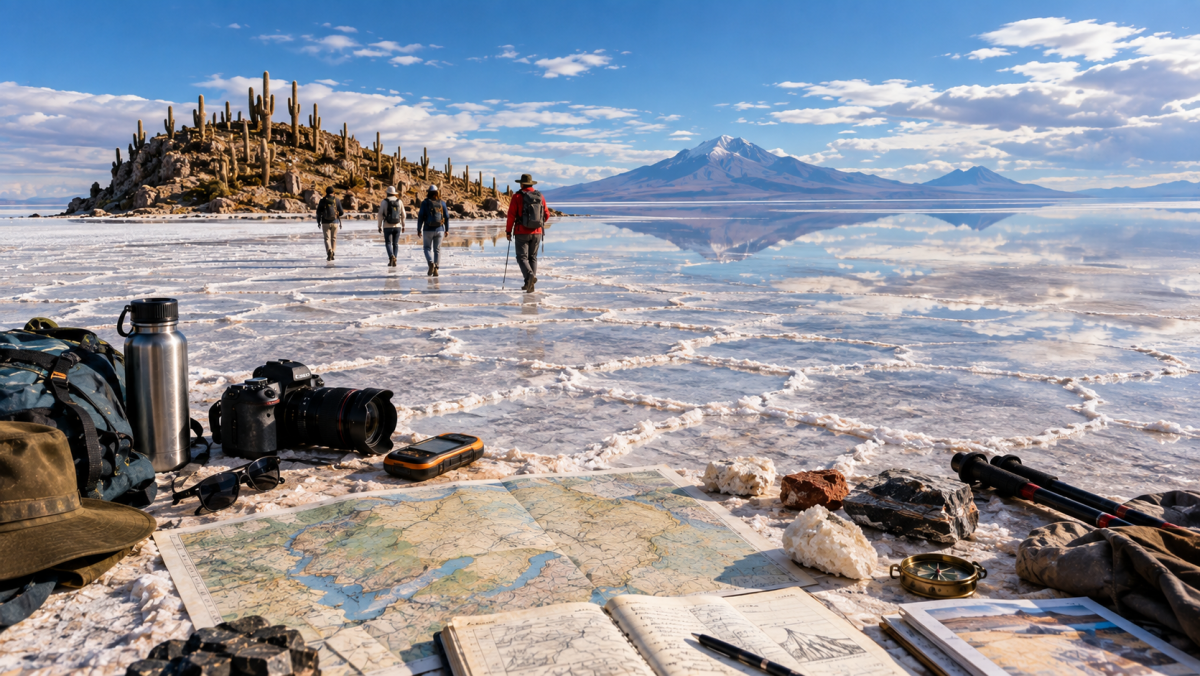
In the wetter season, rain may leave a thin layer of water over parts of the salar. When the surface is calm, it reflects clouds and blue sky with extraordinary clarity. The horizon can nearly disappear, creating the famous mirror effect. Conditions vary from day to day and from one area to another. Heavy water coverage can also restrict access to certain routes, so the reflective experience should never be treated as guaranteed.
Neither season is simply better. The dry landscape makes the salt structures easier to see and may allow broader access. The wet landscape can create striking reflections but may require more flexible planning. A thoughtful traveller chooses according to personal interests and accepts that weather will shape the visit.
Islands, Cacti and Distant Volcanoes
Although the salar often looks perfectly empty, it contains and borders several features that enrich the journey. Rocky rises sometimes called islands emerge from the white plain. Incahuasi is among the best known. Its elevated ground offers a wider view across the salt, while tall cacti provide a dramatic contrast with the bright surface. These plants grow slowly in a harsh environment, and their presence reminds visitors that the plateau supports specialised forms of life.
The surrounding mountains and volcanic forms create another layer of perspective. Their dark or reddish tones frame the white basin and make its scale more visible. Light changes rapidly at high elevation, so the appearance of the landscape can shift between morning, midday and late afternoon. Shadows sharpen, colours become warmer and the salt may change from brilliant white to softer shades.
Travel routes may also include small settlements, craft stops, salt structures and viewpoints beyond the central plain. These places show that tourism is connected to regional services, transport, guiding, food preparation, maintenance and skilled local knowledge. Choosing responsible operators helps visitors experience the landscape safely while supporting communities around the salar.
Preparing for Altitude and Strong Sunlight
Salar de Uyuni requires practical preparation. Its elevation means that some visitors may feel headache, tiredness, shortness of breath or disturbed sleep, especially after arriving quickly from lower areas. A slower itinerary can provide time to adapt. Travellers with health concerns should seek qualified medical advice before visiting high-altitude destinations.
Sun protection is essential. The salt surface reflects light upward, increasing exposure beyond what a traveller may expect from the air temperature. High-protection sunscreen, sunglasses with reliable ultraviolet protection, a hat and clothing that covers exposed skin are sensible choices. Carrying sufficient water, using lip protection and keeping an extra warm layer are also important. Temperatures can fall sharply after sunset, and wind can make conditions feel colder.
Footwear should be practical and easy to clean. During wet conditions, salty water may affect unsuitable materials. Electronic equipment also deserves care because moisture, fine salt and cold temperatures can reduce performance. A protective bag, spare power and a cleaning cloth can be useful. Visitors should follow guide instructions, especially when routes change because of water, soft ground or weather.
Photography with Respect and Perspective
Uyuni is famous for creative photography. Because the surface is so flat and the horizon so open, objects placed at different distances can produce playful changes in apparent size. The mirror effect offers another approach, turning reflections into symmetrical compositions. Yet successful photography depends less on complicated equipment than on patience, clean lenses and attention to light.
Responsible behaviour matters more than any image. Vehicles should remain on permitted routes, and visitors should avoid leaving waste or damaging fragile features. Cacti and rocky areas should be treated carefully. When photographing near settlements or service locations, normal courtesy and permission remain important. The best travel image is one created without disturbing the place that made it possible.
A Bridge of Landscape and Imagination
Salar de Uyuni speaks to themes that resonate across cultures: vast horizons, endurance, careful adaptation and respect for land. Arab readers familiar with desert travel may recognise the importance of preparation, local guidance and reading the weather. At the same time, the salt crust, high-altitude climate and seasonal mirror reveal a very different environmental system.
The destination therefore offers more than visual surprise. It encourages travellers to look closely at geology, scale and the relationship between natural conditions and regional livelihoods. It also rewards humility. No itinerary can control the clouds, water level, wind or light. Uyuni's character emerges from these changes.
Conclusion
Salar de Uyuni is one of Latin America's most memorable natural landmarks because it combines immense scale with delicate detail. Ancient lake history, mineral patterns, seasonal reflections, island cacti and mountain horizons create a landscape that is both simple and complex. A well-prepared visit can be comfortable, safe and deeply rewarding. By choosing responsible services, respecting routes and accepting seasonal variation, travellers can experience the salar as more than a photographic attraction. It becomes a lesson in time, climate, geography and the quiet power of open space.