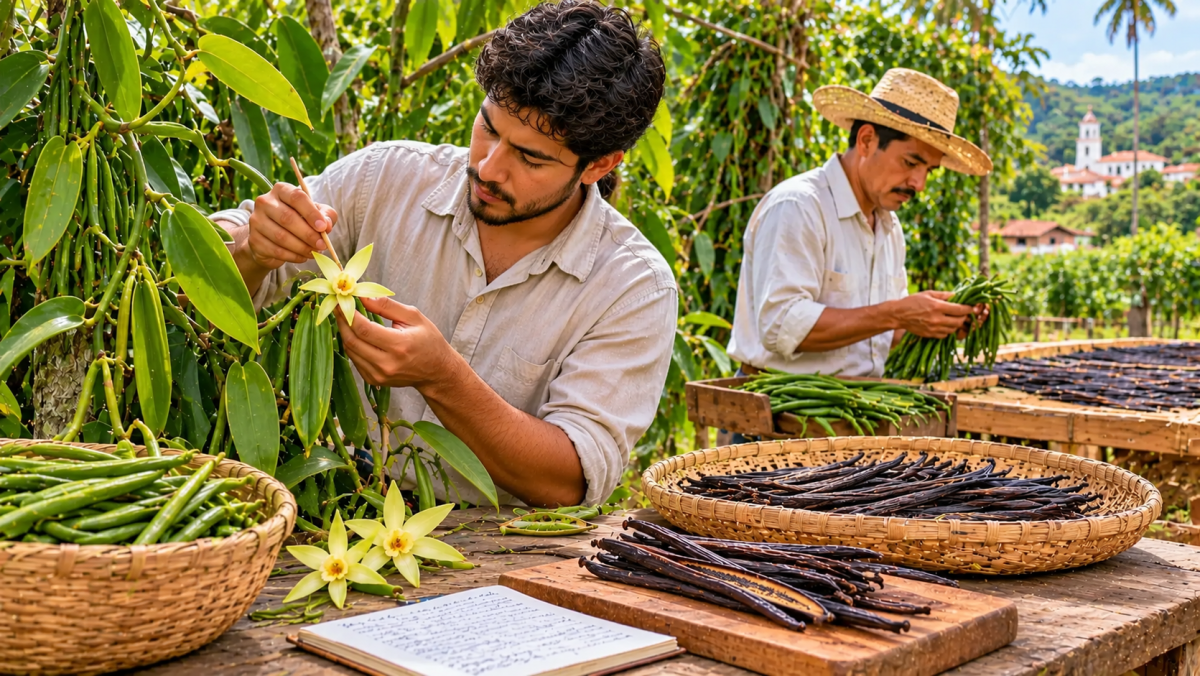
Vanilla from Papantla: How a Mexican Orchid Becomes a Fragrant Ingredient
A familiar fragrance, an unfamiliar plant
Open a fresh packet of whole vanilla pods and the aroma suggests warmth, sweetness and a surprising complexity. Few ingredients appear so familiar while their origin remains so poorly understood. In Mexico’s Veracruz and Puebla regions, vanilla begins not as a flavouring produced in a factory but as the elongated fruit of a climbing orchid. Papantla, in the historical Totonac region, is particularly associated with knowledge of cultivating and preparing this plant. For Arab readers who encounter vanilla in sweets, cakes or dairy desserts, the Mexican story gives the ingredient an entirely different dimension. It reveals a chain of work stretching from shaded gardens to hand pollination, months of fruit development, carefully controlled drying and eventual use in the kitchen.
The orchid behind the pod
The principal commercial species is Vanilla planifolia. Unlike many orchids grown as decorative houseplants, this plant produces a climbing stem with fleshy leaves and aerial roots that can attach to supports. It belongs to a genus distributed across tropical regions, but this species has a particularly important history in Mexico and Central America. Smithsonian Gardens describes its fruit as the source of most natural vanilla products in world markets. The slender green structure that develops after pollination is botanically a fruit capsule, although the culinary expression vanilla bean is widely used. It contains many tiny seeds. Its green appearance is very different from the dark, flexible pod sold for cooking. The transformation between the two is one of the most fascinating aspects of the craft.
Why Papantla is significant
The landscape around Papantla is part of Totonacapan, a region extending across parts of Veracruz and Puebla. Knowledge associated with vanilla in this territory has been documented for generations, and historic evidence connects cultivation in Papantla with the Totonac people. Vanilla was also used in other Mesoamerican settings, including preparations of cacao. Researchers distinguish between early collection of wild fruit and later documented cultivation, so a precise single date for its discovery should not be invented. What is clear is that the local tradition connects practical botanical understanding with a distinctive regional identity. Today the geographical designation Vainilla de Papantla has a defined production area covering 39 municipalities in Veracruz and Puebla. The name is therefore more specific than the broad commercial expression Mexican vanilla.
Growing under living shade
Vanilla needs a suitable balance of light, warmth, moisture and air movement. The climbing stems require something to grow on, while excessive sun or unsuitable drainage can damage the plants. Traditional growers have managed vanilla within mixed vegetation, sometimes using trees as supports. Research in Papantla describes a range of cultivation systems, from traditional agroforestry in recovering vegetation to plots beneath citrus trees and more controlled shade structures. These systems differ in their labour requirements, exposure to weather and management opportunities. A living support can provide both shade and a framework for the vine; a shade structure allows growers to adjust conditions differently. Neither should be assumed automatically superior under every circumstance. The quality of a crop depends on the interaction of plant health, weather, soil, skill and careful maintenance.
A flower with a short opportunity
Commercial vanilla cultivation often requires hand pollination. A flower’s reproductive parts are separated by a small structure that normally prevents easy transfer of pollen. A trained grower can manipulate the flower gently to bring the relevant surfaces together, allowing fertilization to occur. Each flower is open for a limited time, which makes observation and timing essential. Successful pollination is only the beginning: the developing fruit must remain healthy on the vine for months. The grower must inspect plants, notice disease, manage their supports and avoid damaging immature fruit. This helps explain why vanilla is labour-intensive even before processing begins. A field of flowering plants does not translate automatically into a large harvest, and harvesting too early can reduce the quality of the resulting cured material.
From green fruit to aromatic vanilla
A newly harvested green pod does not have the same sensory characteristics as finished vanilla. Curing creates the conditions in which aroma develops while water content gradually falls. Studies of Mexican processing describe an initial treatment to stop growth, followed by cycles of warming and moisture retention often called sweating, along with drying and a final conditioning period. Producers may use different equipment and schedules, so these stages are better understood as a sequence of functions rather than one universal recipe. Biochemical reactions release vanillin and other aromatic compounds from precursors in the fruit. The aim is a stable, fragrant product, not simply the driest possible piece of plant material. Overheating, uneven drying or uncontrolled moisture can harm quality. Experience matters because each batch requires observation and adjustment.
How to recognize and use the ingredient
Whole cured pods are commonly dark brown and flexible rather than brittle. Their appearance alone cannot prove origin or quality, but it is useful to inspect packaging, stated botanical identity and traceability. A cook may split a pod and scrape the tiny seeds into a dairy dessert, or steep the opened pod in a warm liquid and remove it before serving. The outer pod also contributes aroma. Ground vanilla, whole pods and flavouring preparations are different products, so measurements should not be exchanged blindly. For households with specific dietary requirements, choose whole pods, pure vanilla powder or a suitable preparation with clearly labelled ingredients. Keep the package closed and follow the supplier’s storage instructions. Good ingredients deserve thoughtful use, and vanilla works best when its fragrance is allowed to complement rather than overwhelm the dish.
Why origin and careful buying matter
A geographical designation is more than a decorative name. It links a defined product to a specified territory and applicable production requirements. WIPO’s record of Vainilla de Papantla describes the protected designation and its geographical boundaries. A buyer should distinguish between a product whose origin is documented and a generic item simply using an attractive regional image. Traceability also helps customers learn who cultivated and processed the crop. For small food businesses interested in premium ingredients, requesting product specifications, samples and consistent lot information can be more useful than relying on the strongest aroma in a single packet. Growing conditions and processing can vary even within the same area. A thoughtful relationship with a transparent supplier benefits quality control and gives proper recognition to the work behind the product.
Conclusion: an ingredient worth understanding
Papantla vanilla shows that a small ingredient can embody a remarkably extended process. A climbing orchid must be established in suitable conditions, flowers pollinated at the right moment, fruit allowed to mature and the harvest transformed through patient curing. The regional tradition adds historical depth, while scientific study helps explain why each stage matters. For Arab readers exploring Latin American food heritage, whole Mexican vanilla offers a practical connection between a distant landscape and a familiar kitchen. Its fragrance becomes more meaningful when one understands the relationship between botany, cultivation and craft. The next time a vanilla pod is opened, the dark surface and tiny seeds can be read as evidence of months of skilled work rather than taken for granted.