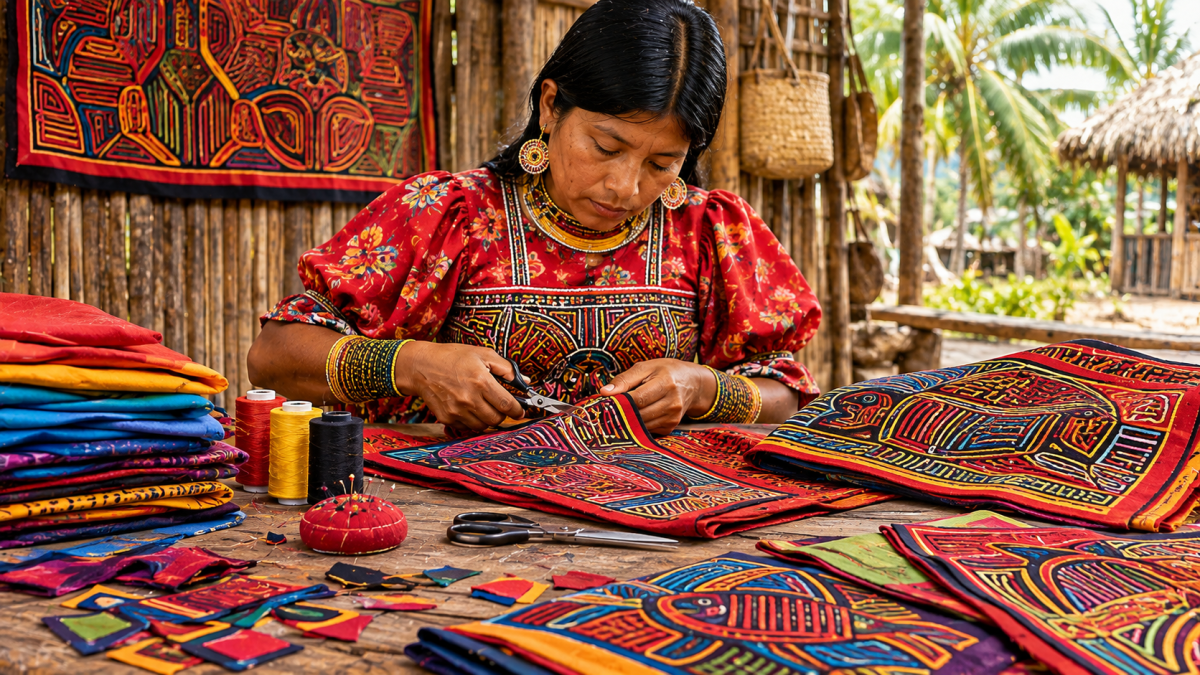
Panama’s Guna Molas: Colour, Layers and the Art of Reverse Appliqué
A design revealed rather than painted
A Guna mola can appear at first glance to be a brightly coloured drawing. Look more closely and the image changes character: the lines and shapes are not printed on a flat surface, but constructed from layers of fabric, careful cuts and closely spaced stitches. This textile tradition belongs to the Guna people of Panama and neighbouring Colombia and is especially associated with the Caribbean region of Guna Yala. Its distinctive technique, commonly described as reverse appliqué, offers an important lesson in design: colour can be revealed by removing part of an upper layer rather than adding paint or thread over the entire surface. For readers interested in Latin American crafts, the mola provides a compelling opportunity to discover how simple materials can produce extraordinary visual complexity through patience and skilled construction.
The name and the place
In Dulegaya, the Guna language, the word mola relates to cloth and clothing. In museum and craft contexts, it commonly identifies both a decorative textile panel and the garment into which panels can be incorporated. Historical museum records sometimes spell the community’s name Kuna or Cuna, while Guna is now widely used. These terms can help a researcher find older catalogue records without treating the different spellings as names for unrelated traditions. The coastal and island landscape associated with Guna Yala forms part of the cultural context, but a textile is not simply an illustration of scenery. Its identity arises from the language, knowledge and decisions of the people who create it. Understanding the name is a useful first step towards interpreting the finished object without reducing it to a generic souvenir.
How reverse appliqué works
The starting material is usually several pieces of cloth in contrasting colours. A maker places the layers together and plans a design on the upper surface. Small sections are cut away to expose a chosen colour beneath. The edges of each opening are folded under and stitched to secure the shape, producing a defined line without leaving the fabric to fray freely. Additional layers can be exposed at different depths. The Cleveland Museum of Art describes how conventional appliqué, which adds a piece of fabric on top, and embroidery can complement the reverse technique. A finished panel may therefore combine several methods within one composition. The construction rewards a careful sequence: an uncontrolled cut could expose the wrong layer or remove material that was needed for another detail.
Geometry and the use of negative space
Many molas contain repeated lines, angular turns and nested forms. The visual effect can resemble a maze, but each shape is created within the physical limits of the cloth. A line is not merely a mark; it may be a narrow opening revealing a colour below. A maker must decide how much material remains between adjacent cuts, where folds can be made and how a repeated shape will connect with the overall design. The background may be filled with smaller decorative elements that enhance the rhythm of the principal motif. To understand this relationship, examine one region of a panel instead of trying to interpret the entire composition at once. Notice how a dark line can separate two brighter colours and how changes in width direct the viewer’s attention. The design is inseparable from the technique that produces it.
Animals, plants and creative variation
Museum collections document molas featuring animals, plants, abstract geometry and imagery drawn from changing everyday environments. One example in the Cleveland Museum of Art depicts an iguana against a richly patterned background. Other panels demonstrate how letters or familiar graphic shapes can become components of a decorative composition. Such variety shows that the tradition is not restricted to a single immutable set of patterns. Different makers have explored different arrangements while maintaining the recognizable layered construction. It is also important not to assign a universal meaning to every motif. An image may have particular significance within its original context, but a visitor unfamiliar with that context should ask rather than invent an explanation. A museum catalogue or a maker’s account is more reliable than a quick interpretation based solely on resemblance.
From a finished panel to museum collections
The Smithsonian’s National Museum of the American Indian holds numerous examples of Guna textiles. Individual object records identify materials, techniques, approximate dates and places of origin where such information is available. The Textile Museum of Canada also catalogues finished and unfinished panels, which can be particularly helpful for studying construction. An unfinished object may reveal which fabric layers were joined and where a design was still being developed. Comparing two documented objects can show differences in stitch size, colour selection and composition without requiring a claim that one maker was following exactly the same pattern as another. Online collections offer this educational opportunity to readers who cannot travel to Panama. They also remind us that the history of an object includes its acquisition, documentation and preservation, not only its visual appearance.
Buying and caring for an authentic textile
A printed pattern may imitate the outline of a mola without using its construction technique. To recognize a hand-worked piece, examine the edges of the shapes, the visible stitching and the layered structure. These observations are helpful but should be combined with a credible account of the maker and origin. Purchase through reputable artisans, community-associated outlets or transparent sellers, and ask whether an item was made as a traditional panel or designed specifically for another use. Avoid assuming that a low price reflects the time needed for intricate work. A completed textile should be stored away from prolonged direct sunlight and cared for according to advice appropriate to its fabric and dyes. When displaying an older or delicate panel, consider professional textile-conservation guidance rather than attaching it permanently with adhesive or subjecting it to repeated washing.
What the craft teaches a wider audience
The mola is especially interesting for readers who appreciate geometry, embroidery and hand-assembled decorative objects. It offers a comparison with other textile traditions in the Arab world without implying that their techniques share an identical history. The central principle is that a finished pattern can arise from the interaction of material, construction and colour. A cut changes the surface permanently, so a beautiful result requires planning as well as patience. A carefully folded edge becomes part of the visual language, while contrasting layers create depth without a complicated range of materials. The mola invites us to recognize the intelligence embedded in ordinary cloth. Its beauty lies not simply in the number of colours but in the relationship between the design and the skilled hands that assemble it.