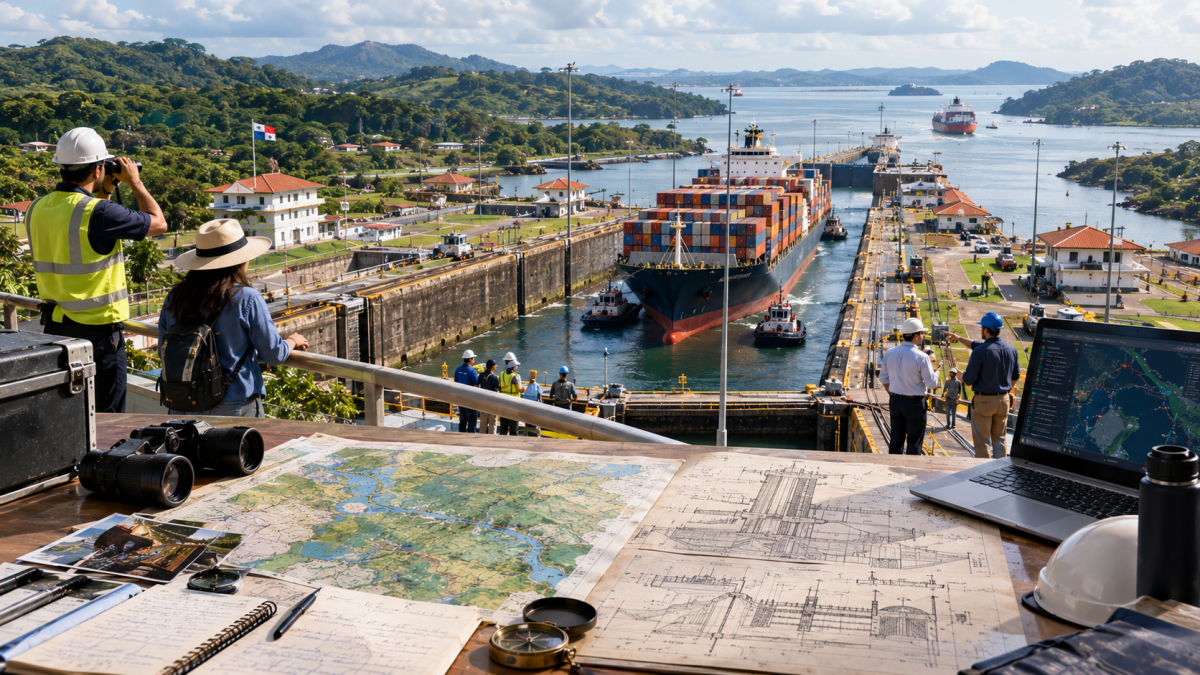
Panama Canal: Engineering, Global Trade and the Journey Between Two Oceans
Introduction
Across the narrow Isthmus of Panama, an approximately 80-kilometre waterway connects the Atlantic and Pacific oceans. The Panama Canal is both an engineering landmark and a working route for global commerce. Ships enter a carefully managed sequence of channels, lakes and locks, rise above sea level, cross the continental divide and descend toward the other ocean. The journey demonstrates how civil engineering can work with terrain and gravity rather than attempting to remove every natural obstacle.
For Arab readers, the canal is relevant beyond tourism. Ports, shipping, logistics and international trade are central to many Arab economies, so the waterway offers a practical case study in infrastructure. It reduces the need for numerous ships to travel around the southern end of South America, saving distance and supporting supply chains. A visit can therefore combine architectural interest, business learning and an accessible explanation of water management.
Why the Canal Uses Locks
A sea-level passage through Panama would have required a very different approach to terrain. The existing canal instead raises vessels to Gatun Lake, about 26 metres above sea level, and later lowers them. Locks operate as large water lifts. A ship enters a chamber, gates close and water level changes until the chamber matches the next stage. The vessel then moves forward under controlled guidance.
Gravity performs the essential movement of water in the original lock system. Water flows from Gatun Lake through large passages built into the lock structures. No pumping is required for the basic filling and emptying cycle. This design links the canal's operation directly to its freshwater watershed. The mechanism may appear simple in summary, but safe transit depends on gates, valves, communication, vessel positioning and coordinated teams working with precision.
Gatun Lake and the Continental Crossing
Gatun Lake is not merely scenery beside the canal; it forms a major part of the navigation route and stores water used by the system. Ships travel across the lake before entering narrower channel sections. Forested shores create a striking contrast with the industrial scale of a large vessel. From a visitor viewpoint, this combination of infrastructure and tropical landscape makes the canal visually distinctive.
The Culebra Cut is one of the best-known sections. It was excavated through the continental divide and extends for roughly 13.7 kilometres between the Pedro Miguel area and the southern end of Gatun Lake. Rock removal, slope stability and continuing maintenance made this section a major engineering challenge. The canal is therefore not a structure completed once and left unchanged. Dredging, monitoring, repair and improvement are continuing responsibilities.
The Lock Systems in Practice
The traditional lock route includes Gatun on the Atlantic side and Pedro Miguel and Miraflores on the Pacific side. At viewing areas, visitors can watch gates open, vessels move and water levels change. The process is deliberate rather than fast. Large ships may appear to fit with little spare space, making the scale of the chambers easier to appreciate.
An expanded set of locks opened in the modern era to serve larger vessels. These newer facilities use a different chamber arrangement and water-saving basins that allow part of the water to be reused during a transit cycle. The original and expanded systems together illustrate how major infrastructure adapts to changing ship dimensions and trade patterns. For business students, the lesson is clear: capacity planning must consider future demand, not only present traffic.
A Link in Global Supply Chains
The Panama Canal supports routes connecting ports across the Americas, Asia, Europe and other regions. Shipping companies choose routes by comparing distance, time, vessel size, cargo requirements, canal capacity and operating cost. A shorter geographic path is valuable, but dependable scheduling and safe transit are equally important. Delays at one point can influence ports, warehouses, factories and customers far away.
This makes the canal useful for understanding supply-chain interdependence. A container may begin far from Panama, pass through the waterway and continue to a distribution centre on another continent. The canal does not manufacture the goods, yet it adds value by enabling movement. Its activity also supports maritime services, maintenance, scheduling, inspection, information systems and many specialised skills.
Water as an Operational Resource
Every lock transit depends on freshwater, making water management central to canal reliability. Rainfall fills the watershed and helps maintain lake levels. Dry periods can require operational adjustments, careful forecasting and efficiency measures. The relationship between navigation and water supply shows that infrastructure performance depends on natural systems.
This is especially meaningful for readers in water-conscious regions. Engineering can improve efficiency, but it cannot treat water as unlimited. Watershed protection, measurement, maintenance and long-term planning are part of the same operational picture as ships and locks. The canal provides a vivid example of how environmental conditions affect business capacity and transport decisions.
Visiting the Canal
Miraflores is one of the most familiar visitor areas near Panama City. Exhibits and viewing platforms help explain the lock process, and ship movements can sometimes be observed at close range. Agua Clara offers perspectives on the expanded locks from the Atlantic side. Exact hours, access conditions and vessel schedules may change, so visitors should consult official information before travelling.
A useful visit allows enough time to watch a complete lock movement rather than only taking a quick photograph. Interpretive displays explain chamber levels, gate operation and canal geography. Binoculars may improve distant views, while sun protection and light rain protection are practical because weather can shift. Visitors should remain in authorised areas and follow staff guidance around operational infrastructure.
Learning Opportunities for Students and Business Readers
The canal can be studied from several noncontroversial perspectives. Engineering students can examine locks, excavation, slope management and maintenance. Environmental students can explore watersheds, rainfall and freshwater use. Business readers can analyse capacity, route choice, scheduling, service reliability and the economic value of time. Technology students can consider sensors, communication and traffic coordination.
A strong educational visit begins with questions: Why was a lock canal selected? How does gravity move water? What limits the number and size of transits? How do operators balance maintenance with continuous service? These questions transform a landmark into a practical classroom. Universities and training organisations can use the canal as a case study even without arranging a physical trip, drawing on official diagrams, videos and operational explanations.
Cultural Comfort and Practical Planning
Arab travellers can prepare by checking suitable meal options, privacy needs and daily schedules with accommodation and tour providers. Panama City offers a broad range of services, while facilities may be more limited on routes farther from the capital. Light clothing is useful in warm, humid conditions, but respectful dress, sun protection and a light rain layer improve comfort.
Spanish is widely used, and a few prepared phrases can help with transport and visitor services. Guided tours may be available in more than one language, but availability should be confirmed. The best experience comes from combining observation with explanation, because the canal's importance is found in the process, not only in the size of a passing ship.
Conclusion
The Panama Canal is a powerful meeting point of geography, engineering and commerce. Its locks raise ships to Gatun Lake, its channels cross the isthmus and its operations connect distant supply chains. The waterway also teaches a broader lesson: successful infrastructure depends on continuous maintenance, skilled coordination and careful use of natural resources. For Arab readers interested in tourism, universities, business or transport, the canal offers an unusually clear example of how a physical route can shape global movement. A well-planned visit turns moving ships into an understandable story of gravity, water, design and dependable service.