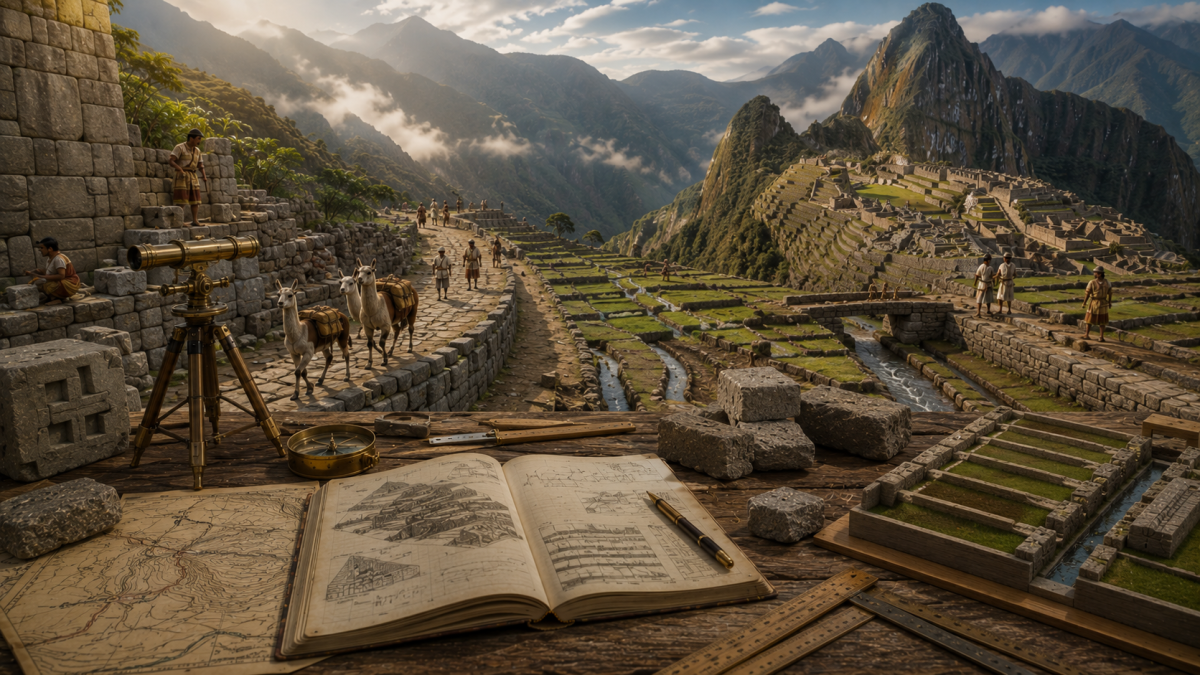
Master Builders of the Andes: The Engineering Marvels of the Inca Empire
When assessing the great builders of the ancient world, the Roman aqueducts and the Egyptian pyramids frequently dominate the conversation. However, nestled in the jagged, towering peaks of the South American Andes, another civilization achieved structural feats that rival, and in some ways surpass, those of classical antiquity. The Inca Empire, or Tawantinsuyu, was the largest empire in pre-Columbian America, stretching from modern-day Colombia to central Chile. What makes their legacy truly astonishing is that they achieved absolute mastery over one of the most hostile, vertically extreme environments on Earth—without the use of the wheel, without iron or steel tools, and without a written language. Their success was built entirely on communal organization and a profound, intuitive understanding of engineering.
The Qhapaq Ñan: The Great Inca Road System
To control an empire that spanned nearly 2,500 miles across soaring mountains, dense jungles, and hyper-arid deserts, the Incas required an unparalleled communication and logistical network. Their solution was the Qhapaq Ñan, an astonishing road system that covered an estimated 40,000 kilometers (nearly 25,000 miles).
Unlike Roman roads, which were built for wheeled carts and marching armies, Inca roads were designed for human pedestrians and caravans of llamas. They featured incredibly steep, perfectly carved stone staircases ascending thousands of feet up mountainsides, retaining walls hugging sheer cliffs, and paved highways crossing vast, high-altitude deserts. Along these roads, the Incas built a vast network of tambos (way stations) positioned a day's walk apart, providing food, shelter, and military supplies. This infrastructure allowed the chasquis—a highly trained relay system of elite runners—to deliver messages and fresh fish from the coast to the highland capital of Cusco in a matter of days.
Ashlar Masonry: The Stone Whisperers
The most visually iconic engineering marvel of the Inca is their stonework, specifically their dry-stone ashlar masonry. In sites like Machu Picchu, Sacsayhuamán, and the city of Cusco, massive granite and andesite blocks are fitted together with such mind-boggling precision that not even a single blade of grass or a piece of paper can slide between them.
Because the Andes is a highly active seismic zone, the Incas engineered their buildings to be completely earthquake-proof. They did not use mortar, which would crack and crumble during a tremor. Instead, they carved their stones into irregular, multi-angled polygonal shapes—such as the famous Twelve-Angled Stone in Cusco—that interlocked like a massive three-dimensional puzzle. When an earthquake strikes, these dry-fitted stones "dance"; they bounce and shift slightly with the earth's movement, and when the tremor stops, they settle exactly back into their original places. Furthermore, Inca engineers constructed their buildings with a slight inward inclination (usually around 3 to 5 degrees) and designed trapezoidal doors and windows, significantly increasing the structural stability of the walls.
Agricultural Terracing: Mastering the Vertical Landscape
Feeding an empire of an estimated 10 to 12 million people in a landscape entirely devoid of flat, arable land required a radical rethinking of agriculture. The Inca solution was the construction of andenes—massive, step-like agricultural terraces carved directly into the steep mountain slopes.
These terraces were not merely flat patches of dirt; they were sophisticated engineering works. Each terrace was built with complex layers: a base of large retaining stones, a layer of smaller gravel and sand for drainage, and a top layer of rich topsoil brought up from the valley floors. This prevented the torrential Andean rains from washing the soil away. The most spectacular example of this is Moray, a site featuring enormous circular depressions consisting of concentric terraces. Modern thermal analysis has revealed that Moray functioned as a massive agricultural research station. The design creates significant microclimates, with the temperature at the bottom of the rings being up to 15°C (27°F) warmer than the top, allowing the Incas to experiment with and adapt crops from different altitudes across their empire.
Hydraulic Engineering: Channeling the Sacred Water
Water, or Unu, was deeply sacred in Inca cosmology, and their hydraulic engineering treated it with both profound reverence and brilliant utility. The Incas were masters at manipulating the flow of water, capturing glacial snowmelt and natural mountain springs and channeling them through complex, stone-lined aqueducts that stretched for miles.
At sites like Tipón, a sprawling estate near Cusco, the Inca mastery of hydrodynamics is on full display. The site features a series of meticulously calculated channels, aqueducts, and ceremonial fountains that cascade perfectly down the terraced landscape. The water flow is mathematically engineered to maintain a constant, soothing acoustic resonance, turning the engineering feat into a sensory, spiritual experience. Even today, centuries after the empire fell, many of these ancient aqueducts and fountains are still functioning perfectly, providing clean water to local Andean communities.
The Suspension Bridges of Grass
Where the mountains could not be carved, and the canyons were too deep for stone, the Incas wove their way across. The Qhapaq Ñan required crossing deep, roaring river gorges, prompting the Incas to invent highly durable suspension bridges made entirely of woven ichu grass.
The most famous of these is the Q'eswachaka bridge, which spans the Apurímac River. Creating these bridges was an astonishing feat of communal engineering. Entire villages would harvest the tough mountain grass, pounding and twisting it into small cords, which were then braided together to form massive cables as thick as a human torso. These bridges were incredibly strong but susceptible to weather decay. Therefore, the Incas instituted a system where the bridges were ritually cut down and completely rebuilt by the local community every single year—a breathtaking tradition that the communities surrounding Q'eswachaka still honor and perform to this exact day.
Conclusion
The engineering marvels of the Inca Empire represent a pinnacle of human adaptation. They did not seek to bulldoze, flatten, or conquer the harsh Andean environment; instead, they engineered brilliant ways to integrate with it. By harmonizing their roads, cities, and farms with the natural contours of the earth, the Incas built a civilization that was structurally robust enough to withstand earthquakes, extreme weather, and the test of time. Their legacy is not just written in the ruins of Machu Picchu, but in the enduring brilliance of a people who turned the most challenging geography on the planet into a masterpiece of human ingenuity.