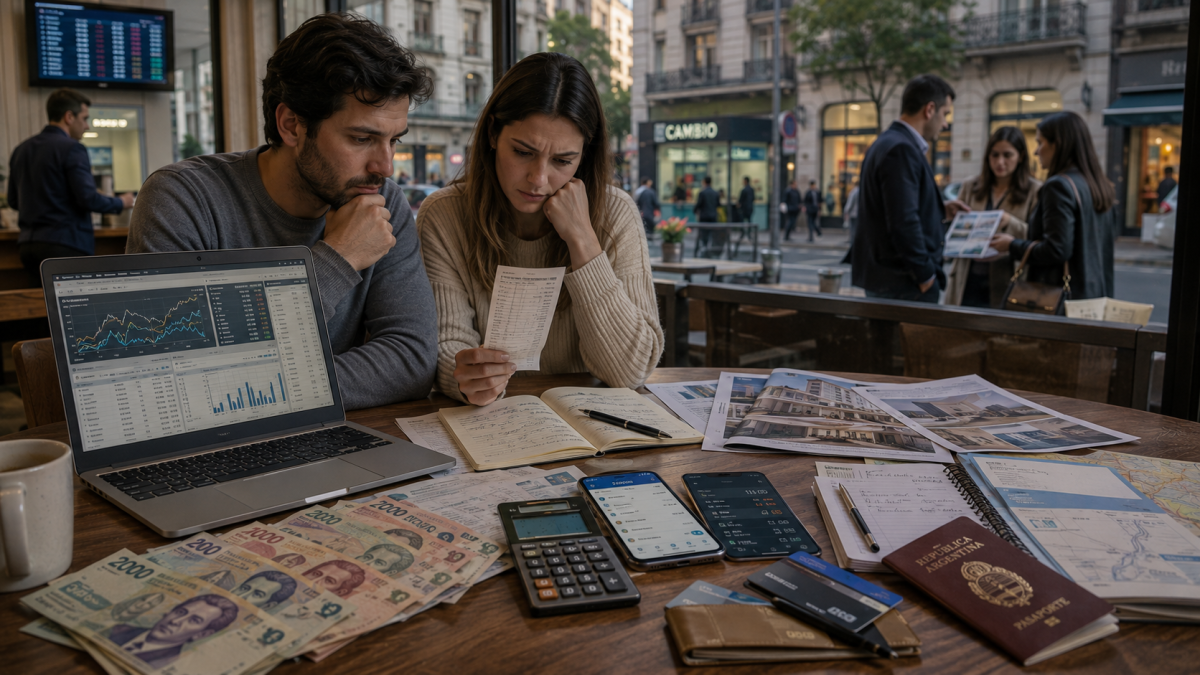
Living with Currency Instability in Argentina
Imagine receiving your salary in one currency, calculating the value of your savings in another, checking several exchange rates before making an important purchase, and knowing that the price of a product may change because of a political speech, an election, or a sudden movement in financial markets.
For millions of Argentines, this is not an unusual financial scenario. It is part of ordinary life.
Currency instability is often described through the changing value of the Argentine peso against the US dollar. Yet living with it involves far more than watching an exchange-rate chart. It affects how people think about money, how businesses set prices, how families preserve savings, how property is bought, and how long-term decisions are made.
Argentina has introduced major reforms intended to normalize its foreign-exchange system. On April 11, 2025, the country moved toward a floating exchange rate within adjustable bands and eliminated restrictions that had prevented individuals from freely buying foreign currency through formal markets. Beginning in January 2026, the upper and lower limits of the exchange-rate band started being adjusted monthly according to a lagged measure of inflation.
These reforms changed the mechanics of the currency market. They did not, however, immediately erase the habits created by decades of devaluations, controls, crises, and broken expectations.
A Country Where Money Has More Than One Meaning
In a stable monetary system, a currency performs three basic functions. It is used to make payments, measure prices, and preserve value over time.
In Argentina, the peso continues to dominate everyday payments. Salaries, groceries, transport fares, taxes, restaurant bills, and most local services are paid in pesos. But when people want to measure long-term value or protect savings, many instinctively turn to the dollar.
This creates a bimonetary way of thinking.
The peso becomes the currency of the present: the money used to live today. The dollar becomes the currency of the future: the unit used to preserve value, compare major assets, and reduce exposure to another devaluation.
A person may say that a meal costs a certain number of pesos but describe an apartment, a car, an investment, or a lifetime of savings in dollars. Many Argentine property transactions have traditionally been negotiated and settled in US currency, partly because neither buyers nor sellers want the agreed value to change dramatically during a long transaction.
This does not mean that every Argentine owns substantial dollar savings. The ability to convert income into foreign currency depends heavily on income, employment stability, and access to financial services. Nevertheless, even households with no dollars may mentally calculate important prices using the exchange rate.
The dollar is therefore more than a foreign currency. It has become a language for discussing security.
The Daily Habit of Checking the Dollar
In many countries, people check the exchange rate only before travelling abroad. In Argentina, it can be part of the daily news cycle.
A movement in the dollar may influence expectations about food, fuel, imported electronics, medication, vehicle parts, machinery, software, and other products. Businesses may begin recalculating prices before their actual costs change because they must consider how much it will cost to replace existing inventory.
This is known as thinking in terms of replacement cost.
Suppose a store imported a mobile phone when the dollar was cheaper. Technically, it could sell that phone based on its original cost. But if the peso has since weakened, the store may be unable to replace the phone at the same price. The owner therefore prices the product according to tomorrow’s replacement cost rather than yesterday’s purchase cost.
The same logic can affect locally produced goods. Argentine factories may use imported machinery, chemicals, packaging, fuel, software, spare parts, or components. Argentina imported more than USD75 billion in merchandise during 2025, including substantial quantities of machinery, transport equipment, chemical products, plastics, rubber, and metals. This international connection means that exchange-rate movements can spread through domestic production chains even when the finished product is labelled “Made in Argentina.”
Consequently, a currency movement can affect prices long before a new shipment reaches a port.
Why Argentina Has So Many Dollar Names
One of the first things an outsider notices about Argentina is the vocabulary surrounding the dollar.
There is the official exchange rate used in the formal foreign-exchange market. There is the “dólar blue,” historically associated with informal cash transactions. There are financial exchange rates such as the MEP and CCL rates, produced through the buying and selling of securities. At different moments, Argentina has also had special rates or regulations for exporters, tourists, card purchases, and particular industries.
Each rate developed in response to a restriction, tax, market demand, or attempt to preserve foreign-exchange reserves.
When access to the official market was limited, alternative markets allowed people and companies to obtain dollars or protect themselves against peso depreciation. The resulting exchange-rate gaps created distortions. The same number of dollars could have very different peso values depending on how they were acquired and what rules applied.
The relaxation of controls in April 2025 narrowed some of these differences and allowed individuals to buy foreign currency formally without limits on amount or purpose. However, the system did not become completely unrestricted for every economic actor. The IMF noted in its 2026 assessment that certain exchange restrictions and cross-restrictions remained relevant for resident companies.
Even when the gap between different rates becomes small, the vocabulary survives. People continue to ask: Which dollar? At what rate? Through which market?
That question reflects a deeper reality: in Argentina, the value of money has historically depended not only on what currency a person holds, but also on the channel through which it is exchanged.
Saving Often Means Escaping the Peso
One of the most powerful effects of currency instability is the transformation of saving behaviour.
In a stable economy, people may save through an ordinary bank account, a fixed-term deposit, a pension fund, or long-term local bonds. They expect the domestic currency to preserve enough value for future needs.
Argentines have repeatedly experienced periods in which peso savings lost substantial purchasing power. As a result, buying dollars became a defensive habit. Families save dollar notes for emergencies, education, property, travel, retirement, or simply to protect the result of years of work.
The expression “dollars under the mattress” is not merely a figure of speech. Distrust of inflation, devaluation, banking restrictions, and changing financial rules encouraged many households to keep foreign currency outside the banking system or abroad.
Recent reforms have attempted to bring more of these savings into formal institutions. According to the Central Bank, after the political uncertainty surrounding the 2025 legislative elections subsided, around 90% of the dollars purchased by households for savings—approximately USD1 billion per month—remained inside Argentina’s domestic financial system.
That is an important sign of improved financial intermediation. Yet it also demonstrates how deeply the dollar remains embedded in household saving decisions.
People may be more willing to keep their dollars in an Argentine bank, but they are still choosing dollars.
Earning in Pesos and Planning in Dollars
Currency instability creates a difficult mismatch: most people earn in pesos, while many long-term objectives are measured in dollars.
A young couple may save for a home whose price is quoted in dollars while their salaries are paid in pesos. Every depreciation can move the target further away, even if they save consistently.
A family planning an international trip faces the same problem. Airline tickets, foreign hotels, travel insurance, and spending abroad are tied directly or indirectly to foreign currencies. A holiday that seems affordable during one month may become considerably more expensive after an exchange-rate movement.
Imported technology presents another example. A laptop may be needed for work or education, but its peso price can respond rapidly to currency expectations. The consumer is not merely deciding whether the laptop is worth its price. The consumer is trying to predict the peso.
This mismatch also affects contracts. Workers want salary adjustments that protect purchasing power. Employers hesitate to promise increases when future revenue and costs are uncertain. Landlords and tenants search for formulas that neither side will regret. Suppliers shorten the validity of quotations because a price offered for thirty days may become commercially dangerous.
Time itself acquires a financial cost.
How Currency Instability Changes Business Behaviour
For businesses, currency instability complicates nearly every stage of planning.
A company importing machinery must calculate the exchange rate, import schedule, taxes, financing expenses, and the possibility of further depreciation before payment. A manufacturer purchasing local materials must still ask whether its suppliers depend on imported inputs.
Exporters face the opposite calculation. A weaker peso can make exported goods more competitive and increase the local-currency value of dollar revenues. But this advantage may be reduced if domestic costs, taxes, wages, and imported inputs rise shortly afterward.
Businesses also struggle to set credit terms. Selling a product today and receiving payment in three months can produce a loss if the peso falls sharply. Companies respond by shortening payment periods, charging interest, indexing contracts, requesting advance payment, or linking quotations to the dollar.
Small businesses face particular difficulties. Large companies may use financial instruments, professional advisers, foreign-currency accounts, and hedging strategies. A family-run shop may rely mainly on instinct, supplier messages, and the morning exchange rate.
In this environment, price changes do not always represent an attempt to increase profit. Sometimes they are an attempt to avoid selling an asset that cannot later be replaced.
The Psychological Cost of Multiple Monetary Realities
Currency instability demands constant attention.
People monitor the dollar, inflation, interest rates, elections, Central Bank announcements, and rumours about new controls. They calculate whether to leave money in pesos, buy dollars, purchase goods, pay debts, or wait.
This creates decision fatigue.
Even good news can be difficult to trust. A stable exchange rate may encourage optimism, but people who have lived through repeated devaluations may wonder how long the stability will last. They do not evaluate only the current policy. They compare it with previous stabilization programs that eventually failed.
The IMF’s May 2026 review described continued progress toward stabilization, but it also noted that political uncertainty during 2025 contributed to a surge in dollarization and delayed the rebuilding of international reserves.
This illustrates how confidence can move money. People do not wait for a crisis to be officially declared. If they fear a future devaluation, they may convert savings, reduce peso holdings, or accelerate purchases. When many people act defensively at the same time, the fear itself can place additional pressure on the currency.
Currency Instability Is Also a Form of Inequality
Not everyone can protect themselves equally.
Higher-income households may hold dollars, property, securities, or foreign accounts. Businesses with financial expertise can hedge some currency risk. Workers with foreign clients may receive dollar-linked income.
Lower-income families usually hold more of their limited resources in pesos and spend most of their income on immediate needs. They have less money available to convert into dollars and fewer opportunities to purchase assets before prices rise.
They therefore experience currency instability primarily through higher prices, weaker wages, and reduced access to imported or durable goods.
A person with savings may see devaluation as an investment challenge. A person living from one salary to the next experiences it as a threat to food, transport, medicine, and rent.
Can Argentina Leave Currency Instability Behind?
Argentina’s current exchange-rate framework is designed to reduce abrupt movements while allowing the peso to fluctuate within a band. Since January 2026, the band limits have been adjusted according to earlier inflation data, while the Central Bank has also pursued a reserve-accumulation program.
These measures may help create a more predictable monetary environment. Greater formal access to foreign currency may also reduce the need for informal markets, while a smaller gap between exchange rates can improve price transparency.
But technical reforms alone cannot immediately eliminate bimonetary behaviour.
Trust in a currency is built through years of stability. People must believe that saving in pesos will not punish them, that contracts can remain valid, that regulations will not suddenly change, and that political events will not repeatedly produce sharp devaluations.
Living with currency instability in Argentina has taught people to be alert, flexible, and financially inventive. They compare exchange rates, divide savings between currencies, advance purchases, renegotiate contracts, and develop a sophisticated understanding of monetary risk.
Yet this adaptability comes at a cost. Money should make economic life easier by providing a shared and predictable measure of value. When the measure itself is unstable, every salary, price, investment, and future plan becomes harder to interpret.
True monetary stability will therefore mean more than keeping the dollar quiet for a few months. It will mean reaching a point where ordinary people no longer need to begin every important decision by asking what their pesos might be worth tomorrow.