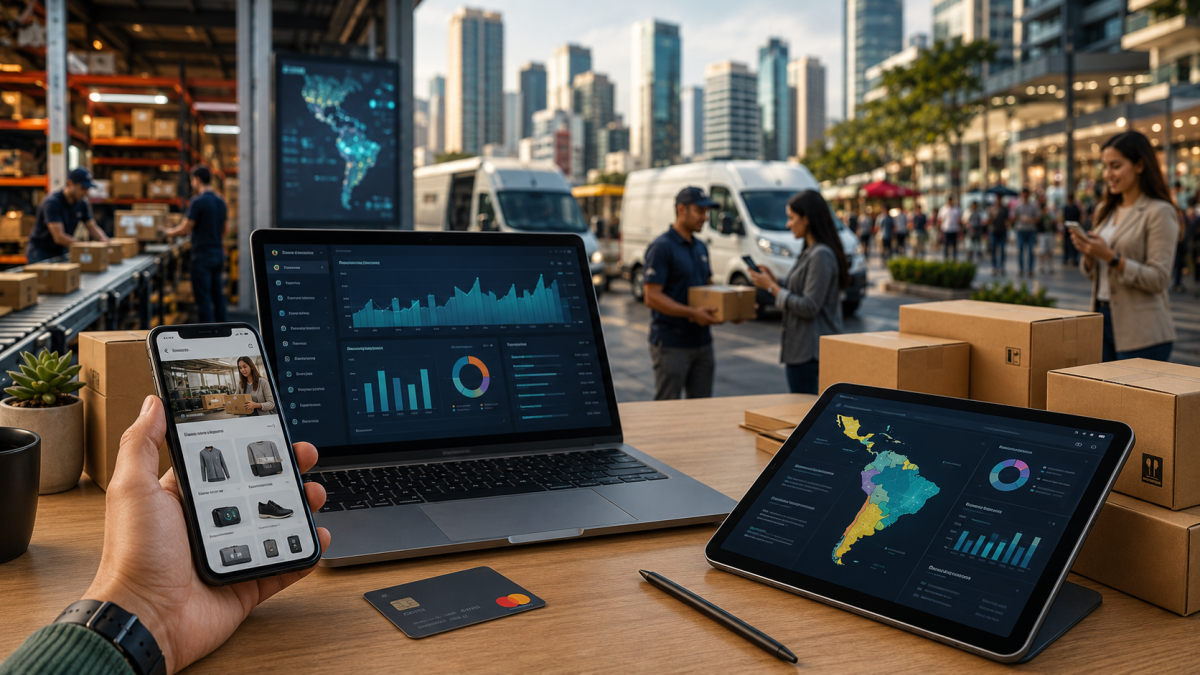
Latin America’s E-Commerce Boom: 5 Countries Driving a $200 Billion Market
For the past decade, analysts have closely monitored the digital transformation of Latin America. In 2026, the region has officially crossed a historic threshold, solidifying its status as one of the fastest-growing digital economies on the globe. The Latin American e-commerce market is now valued at a staggering $200 billion. This explosive growth is not an anomaly; it is the result of skyrocketing smartphone penetration, unprecedented fintech innovation, and a massive shift in consumer behavior.
While the entire continent is experiencing a digital retail surge, the heavy lifting of this $200 billion market is primarily carried by five powerhouse nations. Here is the statistical breakdown of the countries driving Latin America's e-commerce boom.
1. Brazil: The Undisputed Digital Giant
Brazil accounts for roughly 30% of the entire region's e-commerce volume. With an internet penetration rate exceeding 85% among its massive population, Brazil is the cornerstone of the Latin American digital economy. The true statistical driver of Brazil's e-commerce boom in recent years, however, has been the fintech sector.
The Central Bank's instant payment system, "Pix," has revolutionized digital transactions. In 2026, data shows that over 40% of all online retail purchases in Brazil are completed using Pix, drastically reducing cart abandonment rates associated with traditional credit card friction. Mobile commerce (m-commerce) dominates here, with nearly 75% of all digital purchases happening on smartphones.
2. Mexico: The Hyper-Growth Engine
If Brazil is the established giant, Mexico is the hyper-growth engine. Proximity to the United States and massive logistical investments by global titans like Amazon and regional leader Mercado Libre have transformed the Mexican market.
Statistically, Mexico boasts the highest year-over-year e-commerce growth rate in the region. A key metric driving this is the digital inclusion of the historically unbanked population. The proliferation of digital wallets and convenience store payment solutions (like Oxxo Pay) has allowed millions of cash-reliant consumers to finally participate in the online retail economy. Consequently, retail e-commerce sales in Mexico are projected to command over 15% of the total retail market by the end of 2026.
3. Colombia: The Mobile-First Innovator
Colombia’s e-commerce ecosystem is a fascinating case study in technological leapfrogging. A significant portion of the Colombian population bypassed the desktop computer phase entirely, moving straight to mobile internet. As a result, Colombia has one of the highest m-commerce adoption rates in the hemisphere.
The data points heavily to the "super-app" phenomenon. Homegrown logistics and delivery giant Rappi has conditioned Colombian consumers to order everything from groceries to electronics and financial services through a single mobile interface. E-commerce penetration is heavily concentrated in major urban hubs like Bogotá and Medellín, where delivery times for online retail have statistically dropped to under 24 hours.
4. Argentina: Resilience Through Tech
Despite facing severe macroeconomic headwinds and chronic inflation, Argentina's e-commerce sector remains incredibly robust. In fact, online shopping has often acted as a protective hedge for consumers looking to lock in prices quickly.
As the birthplace of Mercado Libre—the undisputed king of Latin American e-commerce—Argentina has a highly developed digital infrastructure. Statistics reveal that over 80% of Argentine internet users have made an online purchase in the last year. The adoption of Mercado Pago (the platform's fintech arm) has created a seamless ecosystem where digital payments, credit lines, and online shopping are deeply intertwined, keeping consumer spending highly active despite broader economic challenges.
5. Chile: The Mature Market
While possessing a much smaller population than Brazil or Mexico, Chile commands an outsized presence in the $200 billion market due to its maturity. Chile boasts the highest internet penetration rate per capita in Latin America (surpassing 90%) and the highest average GDP per capita among these five nations.
This translates to compelling e-commerce data: Chileans have the highest average online ticket size (the amount spent per transaction) in the region. The country's logistics infrastructure is highly developed, making next-day delivery standard. Furthermore, Chilean consumers are highly engaged in cross-border e-commerce, frequently purchasing from Asian and North American markets, driven by a highly banked population comfortable with international digital transactions.
Conclusion
The $200 billion milestone achieved in 2026 is just the beginning for Latin America. The data clearly shows that e-commerce in this region is no longer a luxury for the upper-middle class; it is an integrated, everyday utility for hundreds of millions of people. As smartphone penetration inches closer to 100% and fintech startups continue to dismantle barriers to digital payments, these five nations will continue to pull the Latin American digital economy into the global spotlight.