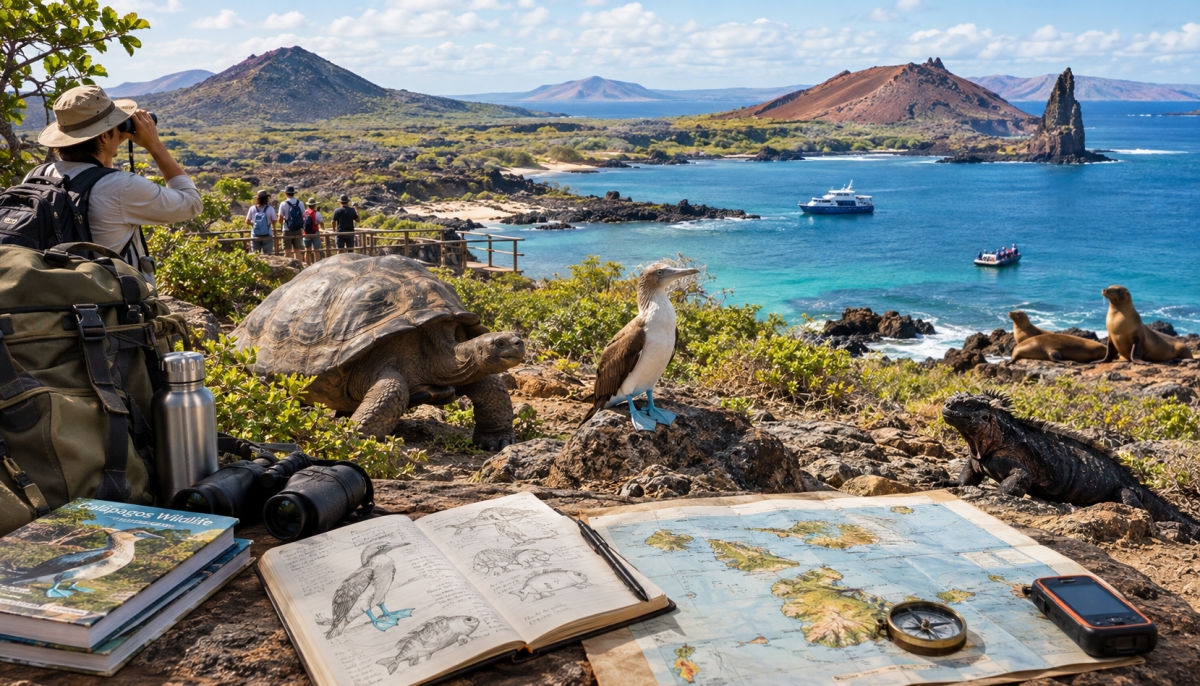
Galapagos Islands: A Responsible Journey Through a Living Natural Laboratory
Introduction
About one thousand kilometres west of mainland Ecuador, the Galapagos Islands rise from the Pacific Ocean as a volcanic archipelago of exceptional scientific and natural value. The islands are famous for giant tortoises, marine iguanas, unusual birds and landscapes shaped by lava, wind and ocean currents. UNESCO describes the archipelago and its surrounding marine environment as a living showcase of ecological, evolutionary and geological processes. That description captures the destination's greatest strength: a visit is not simply a search for rare animals, but an opportunity to observe how isolation and adaptation shape life.
For Arab readers considering Latin America, Galapagos offers a distinctive form of nature tourism. The experience depends on regulated routes, trained guides, careful timing and respect for conservation rules. The islands are not a conventional resort destination where every beach or trail is freely accessible. Many visitor sites operate under controlled itineraries, and the quality of a journey comes from understanding why those controls exist.
Islands Built by Volcanic Processes
The Galapagos archipelago began on the ocean floor. Volcanic activity created islands that emerged above sea level, while erosion and continuing geological movement reshaped them. Western islands such as Isabela and Fernandina are geologically younger than several islands farther east. Across the archipelago, travellers can see dark lava fields, collapsed craters, cliffs, beaches, highland zones and sheltered bays.
This variety explains why a short distance can lead to a completely different environment. A dry coastal area may contain cactus and pale ground, while higher terrain may be cooler and greener because it receives more moisture. Lava surfaces that look severe gradually become habitats as small organisms, plants and animals establish themselves. The landscape therefore provides a visible sequence of change, from fresh-looking volcanic material to mature ecosystems.
Ocean Currents and Remarkable Biodiversity
Three major Pacific currents influence the Galapagos region. Their meeting brings waters with different temperatures and nutrients, supporting rich marine life. Conditions vary by island, season and location. A calm bay may contain sea turtles, rays or sea lions, while rocky shores support marine iguanas and many coastal birds. Offshore waters include larger species that depend on productive currents and protected habitats.
The islands' distance from continental South America allowed populations to develop in relative isolation. Over many generations, plants and animals adapted to specific food sources, climates and island conditions. This helps explain the archipelago's high level of endemism, meaning that certain forms occur nowhere else. Visitors do not need advanced scientific training to appreciate the idea. Differences in shell shape, beak form, behaviour or habitat can show how living systems respond to local pressures over time.
Giant Tortoises and Marine Iguanas
Giant tortoises are among the best-known symbols of Galapagos. Their size, slow movement and long life make any respectful observation memorable. Different island environments supported distinct tortoise populations, and conservation centres now play an important role in research, breeding and restoration. Visitors should follow viewing distances and avoid blocking an animal's path. A quiet approach allows natural behaviour to continue.
Marine iguanas offer another remarkable example of adaptation. They rest on dark coastal rock and enter the ocean to feed on marine vegetation. Their appearance matches the volcanic shore so well that a visitor may overlook them at first. Land iguanas, finches, mockingbirds, flightless cormorants and the most northerly penguin population add further diversity. Each species is part of a wider ecological relationship rather than an isolated attraction.
Visiting by Land or Small Vessel
Galapagos journeys generally follow land-based or vessel-based formats. A land-based itinerary uses inhabited islands as bases and combines local excursions with boat trips. It can provide more time in settlements and a greater choice of accommodation. A vessel itinerary follows a planned route between visitor sites, allowing access to more distant islands. Each format has advantages, and the best choice depends on time, comfort, mobility and interest.
Routes are regulated, so travellers should examine exactly what is included. Important questions concern guide qualifications, group size, transport, equipment, landing type and physical difficulty. Some sites require a dry landing onto a firm dock or rock, while others involve stepping into shallow water before reaching shore. Clear information helps visitors select activities suited to their ability and preferences.
Conservation Rules That Protect the Experience
Galapagos ecosystems are sensitive to introduced species, waste, careless movement and excessive disturbance. Biosecurity checks help prevent seeds, insects and other materials from travelling between islands. Visitors should clean footwear and bags as instructed, keep food within permitted areas and never remove stones, shells or natural objects. Animals must not be touched or fed.
Photography should never change animal behaviour. A longer lens is better than moving too close. Flash, noise and sudden movement may disturb wildlife, and drones are restricted. Staying on marked trails protects both visitors and habitat. These rules are not obstacles to enjoyment; they preserve the possibility of seeing wildlife behaving naturally. A respectful group often experiences more because patient observation reveals details that hurried movement misses.
Preparing for Sun, Sea and Changing Conditions
Equatorial sunlight can be strong even when cloud cover makes the air feel mild. High-protection sunscreen, ultraviolet-filtering glasses, a hat and light clothing that covers exposed skin are practical. Travellers should carry sufficient water in an approved reusable container and follow local waste guidance. Closed walking shoes are useful on uneven lava, while suitable sandals may help at designated wet landings.
Sea conditions vary, so travellers sensitive to motion should seek qualified advice before departure and discuss cabin or route options with the operator. Waterproof protection for documents and electronics is helpful. A small dry bag, spare power, lens cloth and simple binoculars improve daily excursions. Because supply options are more limited than on the mainland, essential personal items should be organised before arrival.
Cultural Considerations for Arab Visitors
A culturally comfortable journey begins with communication. Before booking, travellers can ask about privacy, suitable meal arrangements, activity schedules and spaces for quiet personal needs. Land-based itineraries may offer more flexibility, while vessel schedules are more structured. Neither is automatically preferable; the important point is to understand the daily programme.
Local guides are central to the Galapagos experience. They explain rules, identify species and connect observations with the geology and ecology of each site. Respectful questions are welcome and turn sightseeing into learning. The archipelago encourages a shared ethic found across many cultures: natural abundance should be approached with gratitude, restraint and responsibility.
Conclusion
The Galapagos Islands are among Latin America's most significant natural destinations because geology and life can be observed together with unusual clarity. Volcanic islands of different ages, converging ocean currents, specialised animals and carefully protected visitor sites create a journey rich in meaning. Responsible travel requires planning, but the rules make the experience stronger rather than smaller. By choosing qualified services, following biosecurity guidance and observing wildlife patiently, Arab travellers can encounter a living natural laboratory while helping preserve it for the future.