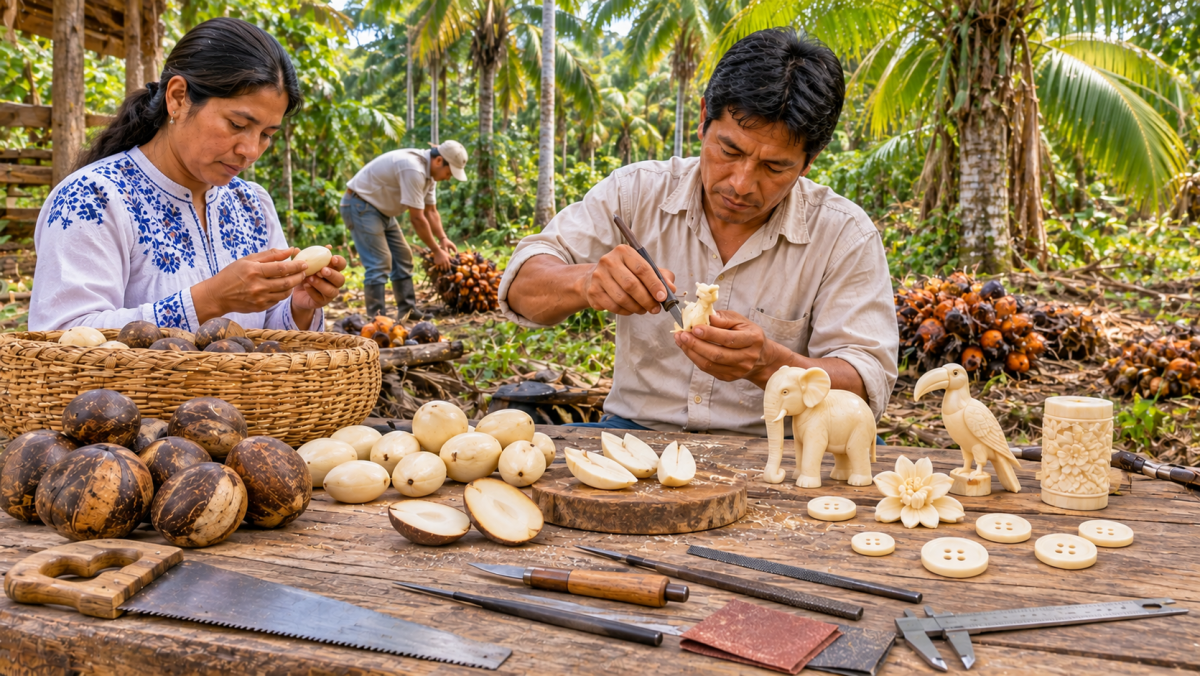
Ecuador’s Tagua: The Palm Seed That Becomes Buttons and Carvings
A remarkable material hidden inside a fruit
An Ecuadorian workshop can turn a small, unassuming palm seed into a button, a miniature sculpture or a polished bead. The finished surface may have the pale warmth of bone, but its origin is entirely botanical. This material is tagua, often known internationally as vegetable ivory. The name describes its appearance rather than its composition: the substance comes from the hard interior of a mature seed. For readers interested in Latin American craftsmanship, tagua offers a fascinating encounter with the intersection of forests, local livelihoods, industrial manufacturing and artistic design. Its history also illustrates how a material once widely traded for ordinary buttons can remain useful after the introduction of mass-produced substitutes. Understanding tagua begins with the living palm, not simply the attractive product on a shop shelf.
The ivory palm of western Ecuador
Several palm species produce materials known as vegetable ivory. In Ecuador, researchers pay particular attention to Phytelephas aequatorialis, a species native to the western part of the country. It grows naturally in tropical and subtropical forest environments, including the western Andean slopes. A study published in People and Nature describes its large, rounded fruit clusters, each containing numerous fruits and seeds. As a seed develops, the endosperm, which supplies reserves for the future plant, changes from a more fluid state into a dense, pale solid. This hardened material is the part used for carving and manufacturing. The distinction between the outer fruit and the usable seed is important: the familiar polished surface represents only one component of a much larger biological structure.
Harvesting maturity rather than cutting trees
Research on the management of the species in Ecuador describes how mature seeds are commonly collected after they fall to the ground. Collecting them does not require felling the palm. The plant can continue producing fruits in future cycles, provided its surrounding conditions remain suitable. However, a harvest is not automatically sustainable simply because the product is botanical. A 2014 study by Brokamp and colleagues notes that premature collection of fruit clusters can reduce the availability of sufficiently mature, high-quality seeds. Immature material is unsuitable for some manufacturing purposes. The same study emphasizes that most harvesting takes place in natural populations, although cultivation also occurs. This demonstrates how an economic incentive for a forest product must be accompanied by knowledge about regeneration, harvest timing and the condition of the forest itself.
How the seed becomes a finished object
The work begins by cleaning and drying the seed. A maker assesses its size, firmness and shape, then chooses a suitable object to produce. For a button, the usable material may be cut into a blank, shaped into a disc, drilled and polished. Decorative pieces can retain portions of the darker outer surface to create contrast against the cream-coloured interior. The Food and Agriculture Organization describes tagua as readily workable through carving, polishing and dyeing. Different objects require different tools and tolerances. A large carved form must fit within the available seed, while a button needs consistent thickness and accurately placed holes. The grain-like appearance of the material may become part of its design. Care is important because excessive heat or moisture can affect the finished piece.
Buttons and a global history
Tagua became an internationally traded forest product during the nineteenth century. According to FAO, the manufacture of buttons from vegetable ivory was an important industry in the late nineteenth and early twentieth centuries. Ecuadorian research also describes the long economic significance of the material in the country’s western region. The eventual rise of synthetic substitutes changed the market, but it did not erase the skills associated with tagua or all demand for its products. Today, buttons and small craft objects remain familiar applications. This is an instructive history for anyone interested in business and manufacturing: a material can move between export markets, local workshops and specialized design uses. Its value depends not only on its physical properties but also on the knowledge, equipment and relationships that connect harvesters with customers.
Practical considerations for designers and buyers
Tagua is suitable for small objects that can be shaped from individual seeds or prepared blanks. A designer should consider natural variation, the maximum usable dimensions and the position of holes or thin edges. When buying buttons for a production run, request samples and confirm thickness, colour range, finishing and the dimensions of the holes. Uniform appearance may require sorting, and dyed pieces can vary slightly from one batch to another. Buyers should also distinguish genuine tagua from other materials marketed under similar names. Ask for a clear description of the raw material and its origin. These details are especially useful for small businesses that want a distinctive component without compromising repeatability. A natural material may be attractive because of its variation, but its tolerances still need to match the intended design.
Forest value and realistic sustainability
The fact that tagua can provide income without cutting down the source palm is important. Yet the economic success of a particular product does not by itself guarantee that a forest will remain intact. Research in western Ecuador identifies conversion of natural habitat as a significant concern. The palm also participates in ecological relationships: animals consume parts of its fruit and may influence the movement of seeds. A sourcing decision should therefore consider harvest practices, landscape conditions and the quality of supplier information. A durable, well-made object can encourage appreciation for the material, while wasteful production and careless collection can reduce that benefit. The aim is not to label every purchase an environmental success, but to understand the conditions that make forest-based production more responsible.
A living material worth caring for
FAO notes that tagua responds to moisture differently from mineral or animal-derived materials. Finished objects are best kept away from prolonged soaking and maintained according to the maker’s instructions. A soft cloth and gentle handling are sensible starting points. For readers in the Arab world, the material offers a new way to discover Ecuador through items that fit naturally into everyday life, such as a shirt button or a decorative accessory. It also illustrates why the raw material matters as much as the finished design. Behind a polished seed stand a living palm, a landscape, the work of collection and a sequence of manufacturing decisions. Tagua is a reminder that a modest object can connect botanical knowledge with generations of practical skill.