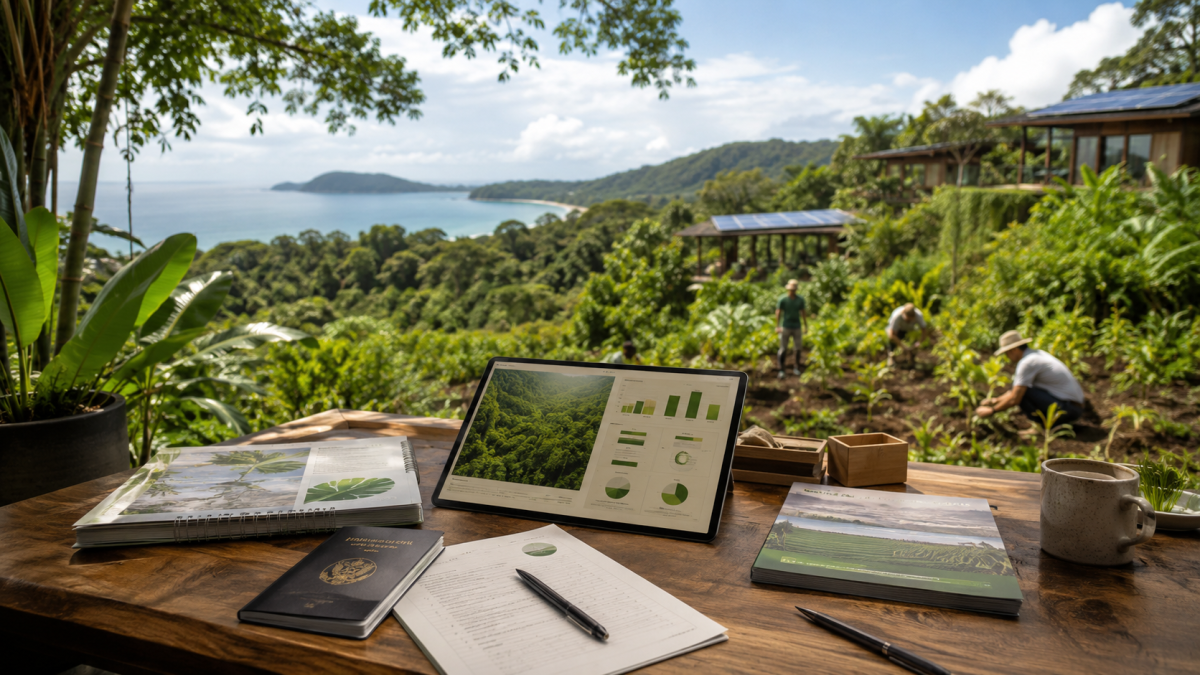
Eco-Residency: How to Get a Green Visa by Investing in Latin American Reforestation
In an era increasingly defined by climate consciousness, global investors and expatriates are no longer settling for traditional residency-by-investment programs. Buying luxury condos in crowded urban centers or depositing capital into dormant bank accounts is giving way to a more purposeful approach: the Eco-Residency. Through "Green Visas," progressive nations in Latin America are offering a unique proposition—the ability to secure permanent residency, and eventually citizenship, by directly investing in the environmental restoration of the planet. By channeling foreign capital into government-certified reforestation projects, investors can achieve a triple bottom line: acquiring a second residency, earning passive income from sustainable timber, and actively fighting climate change. If you are looking to align your immigration goals with your environmental values, here is everything you need to know about getting a green visa in Latin America.
The Rise of the Green Visa in Latin America
For decades, Latin American nations have grappled with the devastating economic and ecological impacts of deforestation. To combat this, governments realized that conservation could not rely solely on public funding; it required the mobilization of private wealth. The concept of the "Green Visa" or "Reforestation Visa" was born from this necessity. By incentivizing foreign nationals with the promise of legal residency, countries can rapidly scale up their reforestation efforts without straining national budgets.
For the investor, the appeal is incredibly strong. Rather than sinking hundreds of thousands of dollars into an overpriced, illiquid real estate market, capital is invested into tangible, growing, biological assets—typically valuable hardwoods like teak, pine, or mahogany. As the trees grow over a 15 to 25-year cycle, so does the investment's value, offering a reliable hedge against inflation while securing a safe haven for the investor's family.
Panama: The Gold Standard of Reforestation Visas
When discussing specific eco-residency programs, Panama is the undisputed pioneer and current regional leader. The Panamanian government has structured a highly regulated, legally secure Reforestation Investor Visa designed to restore the country's depleted tropical forests. To ensure legitimacy, all projects must be strictly certified and monitored by the Ministry of Environment of the Republic of Panama (MiAmbiente).
Panama offers two distinct pathways under its Reforestation Visa framework:
The Regular Process (Starting at $100,000): This is an accessible entry point for solo investors or those with a smaller capital outlay. By investing a minimum of USD 100,000 into a certified forestry project (which typically covers land acquisition, planting, and initial maintenance), the applicant receives a two-year temporary residency card. After maintaining the investment for those two years, the investor can apply for permanent residency.
The Express Process ($350,000): For families or investors seeking immediate security, the Express pathway requires an investment of USD 350,000. The distinct advantage of this route is that it bypasses the temporary residency phase entirely, granting automatic permanent residency to the main applicant, their spouse, and dependent children.
Beyond the residency perks, Panama offers a territorial tax system, meaning any income you generate outside of Panama is completely tax-exempt. Furthermore, earnings derived directly from the harvest of your sustainable timber are often heavily tax-advantaged or tax-deferred under Panamanian law, making it a highly efficient financial maneuver.
Costa Rica: The Eco-Real Estate and "Inversionista" Route
While Panama explicitly calls its program a "Reforestation Visa," neighboring Costa Rica takes a slightly broader approach that is equally appealing to the green investor. Costa Rica is globally famous for its commitment to environmentalism, currently operating on nearly 100% renewable energy and having successfully reversed its deforestation trends.
In 2021, Costa Rica passed Law 9996 to attract foreign capital, lowering the threshold for its "Inversionista" (Investor) temporary residency from $200,000 down to USD 150,000. While this is not restricted strictly to planting trees, a massive and growing segment of this market is dedicated to eco-residency. Investors routinely utilize the $150,000 threshold to purchase tracts of degraded land for personal reforestation, invest in sustainable eco-lodges, or acquire shares in government-approved agricultural and forestry businesses.
The Costa Rican investor visa grants temporary residency for two years, which is easily renewable provided the investment is maintained. After three consecutive years, you can transition to permanent residency. For those who prioritize living in a nation with a deeply ingrained culture of conservation (the famous "Pura Vida" lifestyle) and strict environmental protections, the Costa Rican Inversionista route is an exceptional green pathway.
Financial Returns: The Economics of Teak and Timber
It is crucial to approach an eco-residency not merely as a donation to the environment, but as a viable financial portfolio diversification. Teak, which is the primary hardwood utilized in Panamanian and Costa Rican reforestation visas, is incredibly resilient. It is naturally resistant to rot, termites, and fire, significantly lowering the risk profile of the investment.
Global demand for sustainable teak—used heavily in luxury furniture, yacht decking, and high-end construction—consistently outpaces supply, particularly as nations crack down on the illegal logging of old-growth forests in Asia. Forestry management companies handling these visa-qualifying projects project annualized returns typically ranging from 6% to 12%. Because you are investing in a biological asset, the growth of your wealth is literally tied to the physical growth of the trees, entirely decoupled from the volatility of traditional stock markets.
Due Diligence: Navigating the Risks of Green Investments
While the benefits of an eco-residency are profound, the process requires rigorous due diligence. The most significant risk in pursuing a reforestation visa is investing in an uncertified or poorly managed project. To protect your capital and your immigration status, you must ensure that the forestry management company has a proven track record of successful harvests and is officially registered with the host country's environmental ministry.
Furthermore, biological assets are susceptible to environmental risks such as disease, pests, or extreme weather events. Reputable forestry companies mitigate these risks through modern silviculture practices, proper site selection, and comprehensive crop insurance. Finally, navigating the bureaucracy of Latin American immigration requires expertise. It is absolutely essential to retain an independent, licensed local immigration attorney to handle the visa application, verify the property titles, and ensure that the project fully complies with the legal requirements for residency.
Path to Citizenship and Global Mobility
An eco-residency is not just a right to live in a beautiful, biodiverse country; it is a stepping stone to enhanced global mobility. In Panama, permanent residents who maintain their status for five years become eligible to apply for naturalization and a Panamanian passport. The Panamanian passport is highly respected globally, offering visa-free or visa-on-arrival access to nearly 150 destinations, including the Schengen Area and the UK. Similarly, Costa Rica offers a path to citizenship after seven years of legal residency (or fewer, depending on your nationality of origin). By planting a forest today, you are essentially cultivating a powerful second passport for your future.
Conclusion
The Eco-Residency represents a profound shift in the global immigration landscape. It allows socially responsible investors to move beyond the extractive economic models of the past and actively participate in healing the planet. By pursuing a Reforestation Visa in Panama or a green investment residency in Costa Rica, you are securing a peaceful, tax-efficient haven for your family, generating stable passive income, and leaving a legacy of towering forests for future generations. As the world increasingly prioritizes sustainability, investing in Latin American reforestation is undoubtedly one of the most impactful, forward-thinking ways to acquire a second residency today.