Introduction
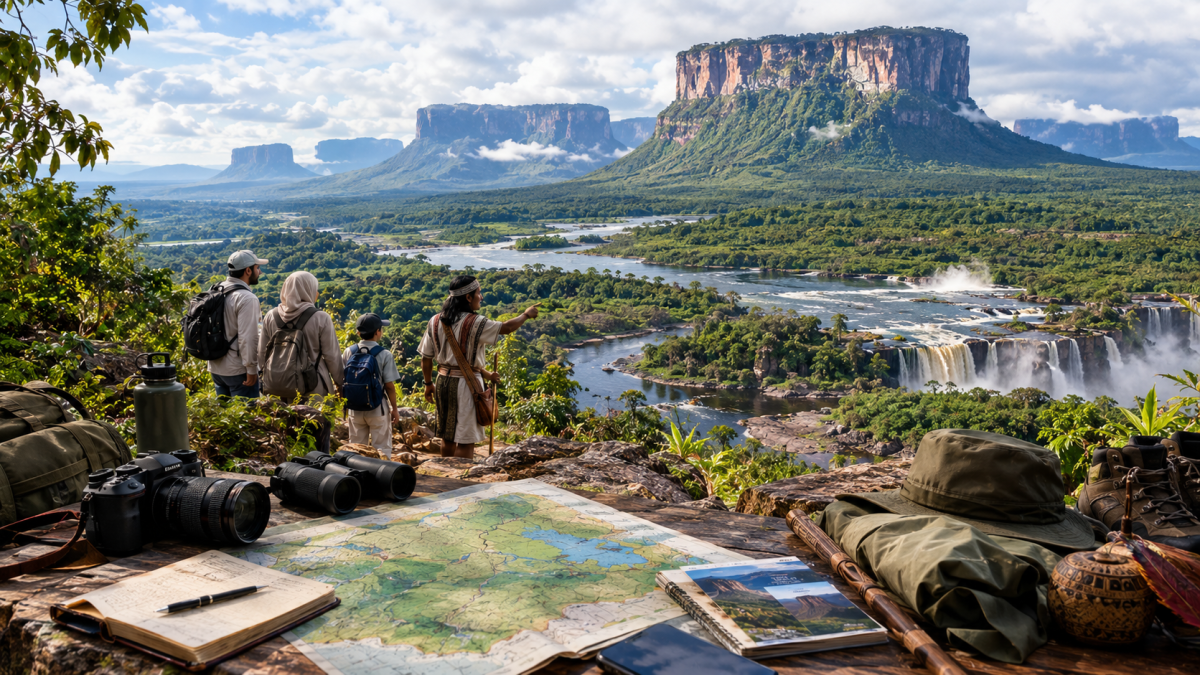
Canaima National Park in Venezuela offers Arab readers a focused way to understand a distinctive Latin American tepui, waterfall and tropical landscape. Canaima covers about three million hectares in south-eastern Venezuela, and roughly two thirds of the park is formed by table mountains known as tepuis. The destination rewards curiosity, but it also requires measured planning. Climate, distance, local rules and the condition of access routes can shape the experience from one day to another. A thoughtful visit therefore begins with reliable information rather than assumptions. This guide explains the place through geography, heritage, practical preparation and responsible conduct. Its central idea is simple: the most memorable journey is not the fastest one, but the one that gives enough time to observe details, respect local knowledge and leave the setting as orderly as it was found.
The character of the place
Vertical cliffs, forest, savanna, rivers and immense waterfalls create a landscape whose geology and isolated habitats are unlike most other regions. This combination gives Canaima National Park an identity that cannot be reduced to one famous photograph. Light, weather, elevation and season change what the visitor sees, sometimes within a few hours. The wider setting also matters: paths, settlements, waterways and working communities connect the main attraction with a living regional landscape. Reading that context helps a traveller understand why certain routes are protected, why access may be limited and why local guidance is valuable. Instead of treating the site as an isolated landmark, it is better to see it as a complete system in which natural forms, human memory and everyday care remain closely connected.
Why the site matters
UNESCO recognizes Canaima for its scenery, geological interest, ecological processes and biodiversity, placing conservation at the centre of every visit. International recognition does not mean that the place is a museum sealed from daily life. It indicates that its qualities deserve long-term care and that visitors share responsibility for reducing pressure. Conservation can include marked routes, limits on group size, seasonal closures, restoration, scientific monitoring and education. These measures sometimes change the easiest itinerary, yet they make the experience more meaningful. A traveller who understands the reason behind a rule is more likely to follow it carefully. The site then becomes a classroom in the broadest sense: it teaches how landscapes and traditions survive when institutions, specialists, local services and visitors all contribute practical attention.
Planning the route
Many visitor areas depend on organized air or river transport, so current conditions, qualified operators and clear baggage limits must be confirmed in advance. Before confirming a schedule, travellers should compare official opening information, transport time, booking requirements and the physical level of each activity. Maps can make short distances appear easy even when roads are slow or terrain is demanding. A realistic plan chooses one main area for each part of the day and keeps extra time for delays, rest and changing conditions. It is also wise to confirm where basic services are available, because remote sectors may not provide shops, cash facilities, mobile coverage or immediate assistance. Written confirmations and offline maps are useful backups. Good planning is not excessive caution; it is what creates space for a calm experience.
Seeing more by slowing down
A first visit to Canaima National Park often produces the urge to include every viewpoint, trail or cultural stop. That approach can make the day feel fragmented. A better method is to select a smaller number of places and observe them closely. Notice the shape of the ground, the direction of the wind, the materials used in buildings or craft, the sound of water or forest, and the way local routes respond to the environment. Short pauses improve both understanding and photography. They also reduce fatigue. When a guide is available, focused questions about geology, ecology, technique or community history can reveal connections that are easy to miss. Depth usually creates stronger memories than a long checklist.
Comfort and preparation
Comfort at Canaima National Park depends on preparation suited to the local setting. Layered clothing handles temperature changes better than one heavy item, while closed footwear with dependable grip supports safe movement. Sun protection remains useful even in cool or cloudy conditions. A reusable water container, simple food appropriate to the day's route, any personal medicine, and a small bag for waste should be part of the basic kit. At higher elevations, the schedule should allow gradual adjustment and steady pacing. In humid or coastal places, protection for electronics and documents is helpful. Families and mixed-age groups benefit from shorter stages, clear meeting points and planned rest. Providers should receive dietary or privacy requirements before arrival.
Respectful observation
Responsible travel at Canaima National Park begins with distance and restraint. Wildlife must be viewed without pursuit, feeding, touching or blocking movement. Archaeological surfaces, geological formations and historic fabric should remain exactly where they are. In living craft settings, visitors should ask before entering work areas or taking close photographs. Noise should stay low on trails and in shared spaces. Marked routes protect both the visitor and the site, even when an informal shortcut appears convenient. Purchasing from authorized local businesses can support skills and services linked to conservation. The goal is not to behave like an invisible guest, but to be a considerate one whose presence does not create extra repair work.
A useful lens for Arab visitors
Arab travellers may find productive comparisons at Canaima National Park. Wide horizons can recall desert travel, craft traditions may echo the value placed on skilled handwork, and strong family hospitality can feel familiar. The differences are equally valuable: altitude, tropical moisture, Patagonian wind or unfamiliar transport patterns may require new habits. Respectful curiosity works better than searching for exact equivalents. Visitors can arrange suitable meals, private spaces and daily routines by communicating clearly in advance. A few Spanish or Portuguese greetings also make interactions warmer. Cultural confidence does not require ignoring differences; it allows a traveller to meet them calmly, ask practical questions and appreciate the place on its own terms.
Learning beyond the visit
The value of Canaima National Park continues after departure. Notes can be organized around themes such as landform, water, architecture, biodiversity, materials or community practice. Families can compare photographs and identify how the same scene changed with light and weather. Students can use official heritage and park resources to verify names and processes. Business readers may notice how guiding, transport, accommodation, food service, conservation and education form a connected visitor economy. The most useful lesson is that quality tourism depends on coordination. A protected or culturally important place remains strong when services are reliable, local knowledge is respected and visitor numbers are managed with care. This perspective is relevant across Latin America and the Arab world.
Conclusion
Canaima National Park is valuable because it combines a clear visual identity with deeper layers of geography, memory and stewardship. Canaima covers about three million hectares in south-eastern Venezuela, and roughly two thirds of the park is formed by table mountains known as tepuis. A successful visit uses official information, realistic timing, suitable clothing and patient observation. It leaves room for rest, listens to local guidance and treats conservation rules as part of the experience. For the Arab reader, the destination offers an accessible path into Latin America without requiring sensational claims or hurried travel. The lasting impression comes from understanding how each element belongs to a larger whole. When travellers move carefully and thoughtfully, they receive more than attractive views: they gain a respectful relationship with a place whose value depends on continued care.