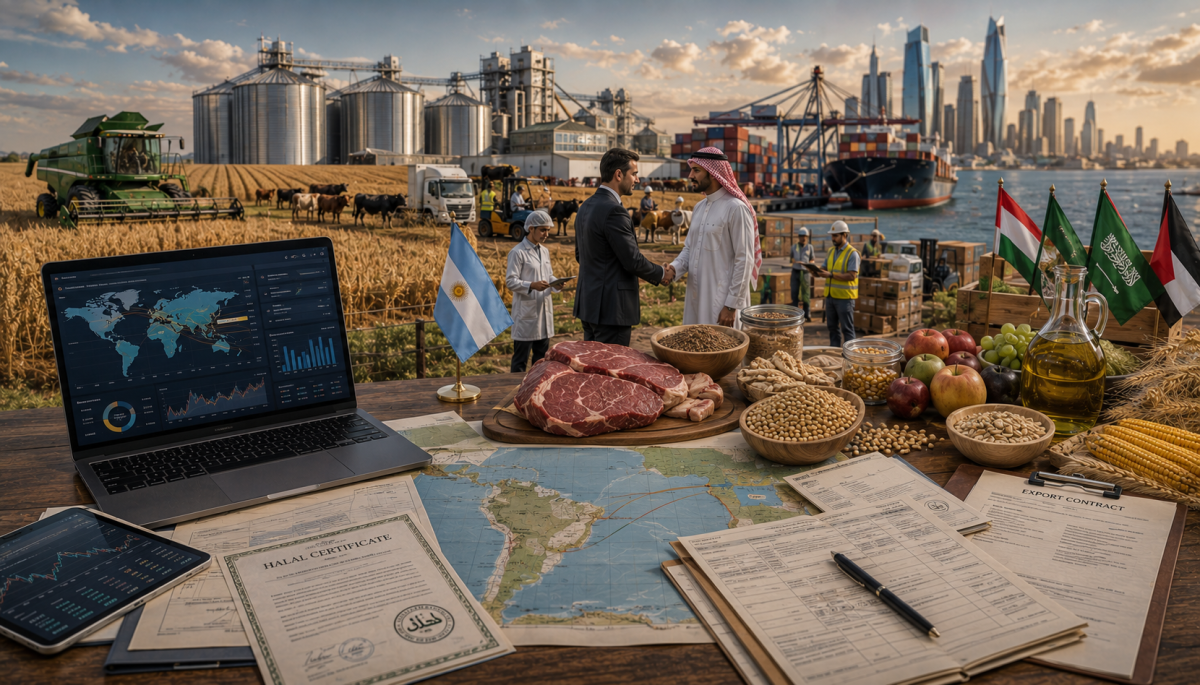
Bridging Hemispheres: Argentine Agricultural Exports to the Arab World
In the complex matrix of global trade, few bilateral relationships are as fundamentally symbiotic as the agricultural partnership between the Argentine Republic and the Arab world. Separated by thousands of miles, the Atlantic Ocean, and distinct cultural histories, these two regions represent a perfect macroeconomic match. Argentina, blessed with the vast, fertile plains of the Pampas, abundant freshwater resources, and a relatively small population, is a powerhouse of food production. Conversely, the Middle East and North Africa (MENA) region faces the structural challenges of an arid climate, scarce arable land, restricted water resources, and a rapidly expanding population. As we move deeper into 2026, understanding the depth, dynamics, and future trajectory of Argentine agricultural exports to the Arab world is essential for global investors, policymakers, and agribusiness leaders.
The Strategic Imperative of Food Security
For the Arab world, food security is not merely an economic issue; it is a matter of paramount national security. Gulf Cooperation Council (GCC) countries, along with populous nations like Egypt and Algeria, rely heavily on imports to meet their domestic nutritional needs. Argentina has stepped into this breach as one of the most reliable, high-volume suppliers on the planet. Unlike other agricultural giants that may use food exports as a geopolitical lever, Argentina has historically maintained a neutral, purely commercial approach to its agricultural trade, making it a highly trusted partner for Arab governments seeking to diversify their supply chains away from volatile regions.
The Cornerstones of Trade: Grains, Oilseeds, and the "Virtual Water" Trade
The foundation of the Argentine-Arab agricultural corridor is built on bulk commodities. Argentina is a top-tier global exporter of corn, wheat, and soybean products (including soybean meal and oil). Countries like Egypt—the world's largest importer of wheat—rely on Argentine shipments to blend with domestic supplies and sustain their massive subsidized bread programs.
However, one of the most fascinating and rapidly growing export sectors is fodder, specifically alfalfa. Dairy industries in the Arab world, such as the massive Almarai conglomerate in Saudi Arabia, require millions of tons of high-protein alfalfa to feed their cattle. Because growing alfalfa requires immense amounts of water—a resource heavily restricted in the Gulf to preserve depleted aquifers—Arab nations have effectively outsourced its production. By importing compressed bales of premium Argentine alfalfa, the Arab world is engaging in the "virtual water" trade, utilizing Argentina's abundant rainfall and fertile soil to sustain their domestic dairy and poultry industries.
The Premium Protein Market: Halal Beef and Poultry
Argentina is globally synonymous with premium beef. However, entering the Arab market requires strict adherence to Islamic dietary laws. To capitalize on this lucrative market, Argentina’s meatpacking industry (frigoríficos) has undergone a massive structural adaptation. Working closely with the Islamic Center of the Argentine Republic (CIRA) and other recognized certifying bodies, dozens of Argentine abattoirs have secured rigorous Halal certifications.
This guarantees that the cattle are slaughtered according to Islamic rites, entirely separated from non-Halal processing lines. Today, Argentine Halal beef can be found in high-end steakhouses in Dubai, supermarkets in Doha, and luxury hotels in Riyadh. Furthermore, Argentina has become a critical supplier of Halal poultry, offering a high-quality, cost-competitive alternative to Brazilian and European exports, particularly for the Saudi Arabian and Emirati markets.
Deep Ties: The Role of the Arab-Argentine Diaspora
The success of this trade corridor is not solely the result of modern logistics; it is deeply rooted in human history. Argentina is home to one of the largest Arab diasporas in the world. During the late 19th and early 20th centuries, hundreds of thousands of immigrants from Syria and Lebanon settled in Argentina. Today, millions of Argentines are of Arab descent. This deep cultural, linguistic, and familial connection provides an invaluable soft-power advantage. It facilitates smoother business negotiations, builds innate cultural trust, and creates a unique bridge of mutual understanding that competitors from other agricultural nations simply cannot replicate.
Beyond Commodities: Ag-Tech and Sovereign Wealth Investment
As the relationship matures, it is moving beyond the simple transaction of raw commodities into the realm of technology transfer and strategic investment. Argentina is a pioneer in agricultural technology (Ag-Tech). Arab nations are actively importing Argentine expertise in no-till farming (siembra directa), highly efficient silo-bag storage systems, and the development of drought-resistant seeds.
Concurrently, Arab capital is flowing into Argentina. Sovereign wealth funds from the UAE, Saudi Arabia, and Qatar have recognized that securing their food supply requires investing at the source. There is increasing Arab investment in Argentine agricultural infrastructure, including deep-water ports along the Paraná River, crushing plants, and irrigation technology, ensuring a stable, streamlined supply chain directly from the Argentine farm to the Gulf table.
Navigating the Challenges of the Trade Corridor
Despite the overwhelmingly positive trajectory, this trade relationship must navigate significant hurdles. The physical distance between the ports of Buenos Aires or Rosario and the ports of Jeddah or Jebel Ali results in long shipping transit times, leaving agricultural shipments vulnerable to global maritime disruptions. Furthermore, Argentina's historically volatile macroeconomic environment—including fluctuating export taxes (retenciones) and complex foreign exchange controls—can sometimes complicate long-term pricing contracts for Arab importers. However, the Argentine government's recent push toward deregulation and economic stabilization in 2026 is actively mitigating these concerns.
Conclusion
The agricultural trade between Argentina and the Arab world is a masterclass in global economic synergy. It represents a flawless alignment of supply and demand, where Argentina’s boundless agricultural capacity meets the existential food security needs of the MENA region. As populations in the Arab world continue to grow and dietary habits shift toward higher protein consumption, the demand for Argentine beef, grains, and fodder will only intensify. Backed by deep historical ties, growing sovereign investments, and expanding Halal infrastructure, this cross-hemisphere partnership is destined to remain a vital pillar of global food security for decades to come.