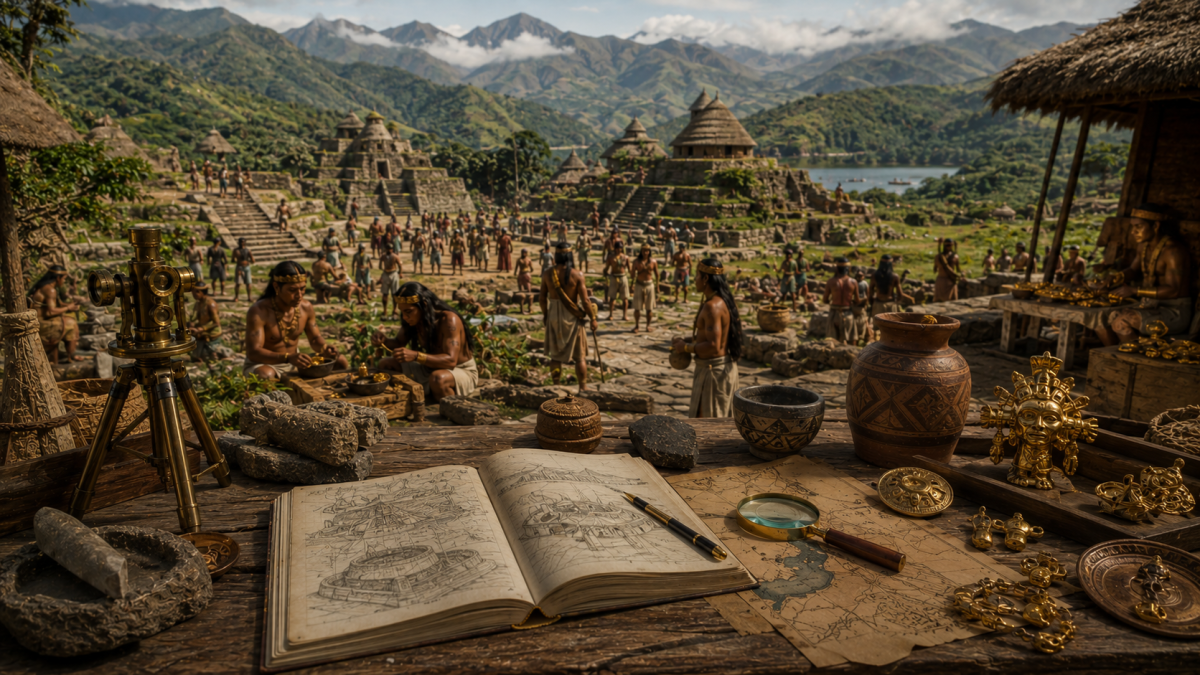
Beyond El Dorado: The Ancient Kingdoms of Colombia Before the Spanish
When examining the tapestry of pre-Columbian history in the Americas, the global spotlight is frequently dominated by the monumental stone pyramids of the Maya and Aztecs in Mesoamerica, or the sprawling, centralized empire of the Incas in the Andes. However, nestled geographically and culturally between these great power centers lies a region of staggering diversity and brilliant innovation: ancient Colombia. Before the arrival of the Spanish conquistadors in the early 16th century, the territory of modern-day Colombia was home to dozens of advanced, complex societies. They did not build empires through relentless military conquest; instead, they formed sophisticated political confederations, mastered some of the most complex metallurgy in the ancient world, and engineered brilliant adaptations to some of the planet's most challenging environments.
The Muisca Confederation: Masters of the Highlands
High in the cold, misty plateaus of the Andes—specifically the Altiplano Cundiboyacense, where the modern capital of Bogotá now sits—thrived the Muisca people. The Muisca formed one of the most advanced political structures in South America, known as the Muisca Confederation. Rather than a single absolute monarch, their society was a loose union of states led by two primary rulers: the Zipa (who ruled the southern territory) and the Zaque (who ruled the north).
The Muisca economy was incredibly robust, built not on gold, but on salt, emeralds, and agriculture. They mined vast quantities of rock salt from towns like Zipaquirá, using it as a highly valuable currency to trade with lowland tribes for cotton, gold, and exotic feathers. However, it is their religious rituals that cemented their place in global mythology. The legend of "El Dorado" (The Gilded One) did not originate as a city of gold, but as a Muisca ritual. Whenever a new Zipa assumed power, he would be covered in sticky resin and dusted entirely in pure gold dust. He would then be rowed out to the center of the sacred Lake Guatavita, where he would dive into the freezing waters to wash off the gold, while his subjects threw priceless golden artifacts and emeralds into the lake as offerings to their gods.
The Tairona: Architects of the Sierra Nevada
On the Caribbean coast, rising abruptly from the sea to snow-capped peaks, lies the Sierra Nevada de Santa Marta. This imposing, vertically layered environment was the domain of the Tairona civilization. The Tairona were brilliant architects and environmental engineers. To survive the steep, jungle-covered mountainsides, they constructed a vast network of terraced stone cities connected by deeply paved stone pathways.
Their crowning architectural achievement is Teyuna, famously known today as Ciudad Perdida (The Lost City). Built around 800 CE—centuries before Machu Picchu—the city features over 200 terraces carved into the mountain, serving as foundations for circular wooden houses, ceremonial centers, and complex drainage systems designed to channel the region's torrential rains without causing erosion. The Tairona were fiercely independent and fiercely resisted the Spanish for decades. Today, their direct descendants, including the Kogi and Arhuaco peoples, still live in the Sierra Nevada, maintaining the spiritual and ecological philosophies of their ancestors, viewing themselves as the "Elder Brothers" tasked with protecting the heart of the world.
The Quimbaya: Virtuosos of Gold
In the lush, volcanic valleys of the Cauca River—the heart of Colombia's modern coffee-growing region—lived the Quimbaya. While they were a smaller and more decentralized society than the Muisca, the Quimbaya are globally renowned for one specific reason: they were arguably the greatest goldsmiths in the history of the pre-Columbian Americas.
The Quimbaya mastered a metallurgical alloy known as tumbaga, a mixture of gold and copper that lowered the melting point of the metals and allowed for incredibly detailed casting. Using the complex "lost-wax" casting method, they created artifacts of breathtaking beauty, precision, and smooth finishes. Their most famous creation is the Poporo Quimbaya, a stunningly symmetrical golden vessel used in religious ceremonies to hold lime (crushed seashells), which was chewed with coca leaves to induce meditative states. Interestingly, the classical Quimbaya period mysteriously declined around the 10th century, hundreds of years before the Spanish arrived, leaving behind a legacy of golden artifacts that still baffle modern jewelers with their technical perfection.
San Agustín and Tierradentro: The Cult of the Dead
Deep in the rugged, isolated mountains of southern Colombia lie two of the most mysterious archaeological sites in the hemisphere: San Agustín and Tierradentro. The cultures that built these sites disappeared long before the Spanish conquest, leaving no written records and no known name, but they left behind a monumental obsession with the afterlife.
San Agustín is home to the largest group of religious monuments and megalithic sculptures in South America. The ancient people here carved hundreds of massive stone idols from volcanic rock, some standing over 20 feet tall. These statues depict a haunting mix of human and animal forms—most notably the jaguar, the eagle, and the serpent—serving as fierce guardians of elevated burial mounds. Just a few hours away in Tierradentro, another culture approached death differently, carving elaborate underground tombs known as hypogea deep into the volcanic rock. Accessible only by spiraling staircases, these subterranean chambers were painted with intricate red, black, and white geometric patterns, designed to mimic the interiors of the homes of the living, ensuring the dead lived in eternal comfort.
The Zenú: Lords of the Water
In the Caribbean lowlands, characterized by massive, flood-prone river deltas, the Zenú (or Sinú) people accomplished an engineering feat that rivals the Tairona. To combat the severe annual flooding of the San Jorge and Magdalena rivers, the Zenú constructed an astonishing network of hydraulic canals spanning over 1.2 million acres. These artificial drainage channels allowed them to control the floodwaters, providing nutrient-rich land for agriculture while simultaneously creating an expansive network of fisheries.
Beyond their hydraulic mastery, the Zenú were renowned weavers. They wove their world into existence, not just with textiles, but with gold. Their golden artifacts often resemble finely woven metallic fabrics, symbolizing the interconnectedness of nature. This deep cultural tradition of weaving survives today in the iconic sombrero vueltiao, the traditional Colombian hat made of woven cane, which traces its geometric patterns directly back to ancient Zenú cosmology.
Conclusion
The ancient kingdoms of Colombia offer a profoundly different narrative of pre-Columbian history. They demonstrate that greatness in the ancient world was not solely defined by the size of a standing army or the height of a stone pyramid. True brilliance was also found in the sustainable terracing of a mountain, the mastery of complex metallurgy, the engineering of massive flood plains, and the creation of democratic, trade-based confederations. Though the Spanish conquest brought devastating diseases and a relentless hunger for their gold, the legacy of these ancient Colombian cultures did not vanish. It lives on in the indigenous communities that still protect the mountains, in the dazzling gold museums of Bogotá, and in the very cultural DNA of modern Colombia.