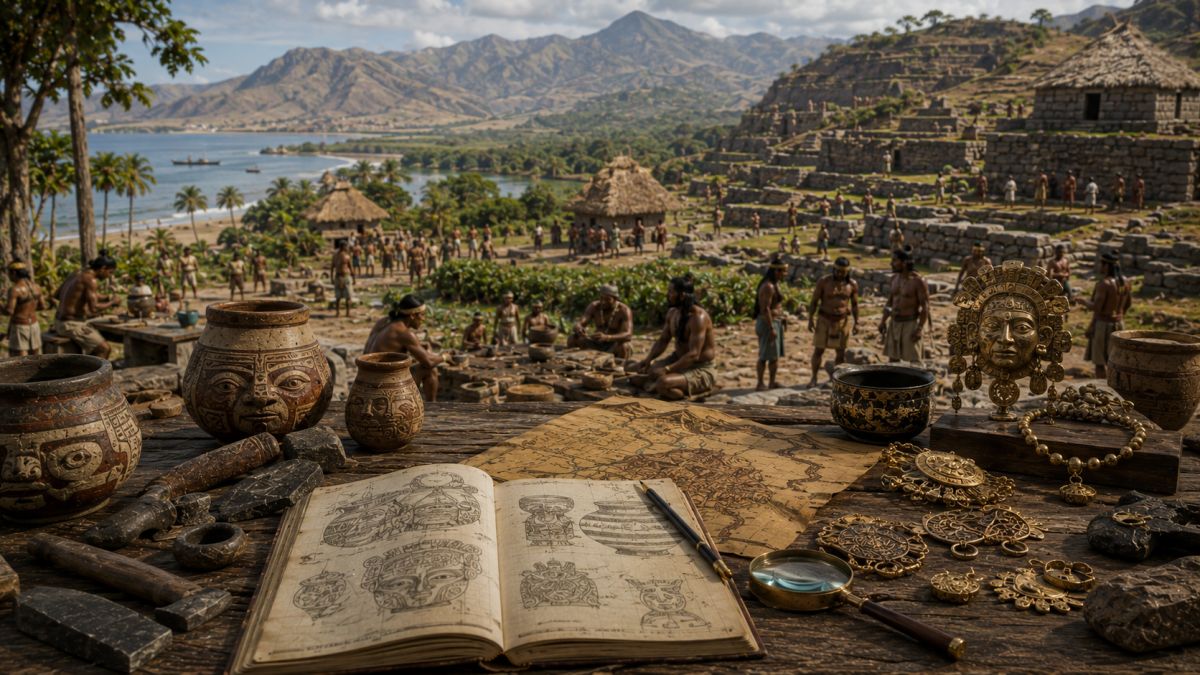
Before the Empire: The Ancient Civilizations of Ecuador
When discussing the ancient history of the Andes Mountains and the western coast of South America, the conversation is almost invariably dominated by the Inca Empire. However, the Inca occupation of what is now Ecuador was relatively
The Valdivia Culture: Pioneers of the Americas
The story of complex civilization in Ecuador begins on the Santa Elena Peninsula with the Valdivia culture, which thrived from approximately 3500 BCE to 1500 BCE. The Valdivia are monumental figures in the archaeological history of the Americas because they are credited with creating some of the oldest known pottery in the Western Hemisphere. Long before the Olmecs emerged in Mexico or the Chavín in Peru, the Valdivia people were molding river clay into highly sophisticated vessels and artistic figures.
The most famous artifacts left behind by this culture are the "Venus of Valdivia" figurines. These small, meticulously crafted clay statues predominantly depict female figures with exaggerated fertility characteristics and elaborate, highly individualized hairstyles. Archaeologists believe these figurines were not merely decorative but served deeply significant ritualistic purposes, likely associated with agricultural fertility, shamanic healing practices, and the prominent, perhaps even matriarchal, role of women in Valdivian society. Their early transition from nomadic hunter-gatherers to a sedentary, agricultural society centered around fishing and maize cultivation laid the foundational blueprint for Andean civilization.
Machalilla and Chorrera: The Evolution of Art and Trade
As the Valdivia culture eventually declined, it gave way to the Machalilla (1500 BCE–1100 BCE) and later the Chorrera (900 BCE–300 BCE) cultures. These societies took the ceramic foundations laid by the Valdivia and elevated them to extraordinary new heights of artistic expression. The Chorrera, in particular, are renowned for their highly polished, remarkably thin-walled ceramics shaped like animals, plants, and human figures.
The Chorrera also invented the "whistling pot," an ingenious ceramic vessel containing a hidden acoustic chamber. When water was poured out of the pot, or when a user blew into the spout, the displacement of air would produce a distinct whistling sound, often mimicking the cry of the animal depicted on the vessel. Beyond their artistic prowess, these cultures significantly expanded regional trade networks. The Chorrera style has been found spread across a vast geographic area, indicating a highly integrated society that utilized the coastal river systems to exchange goods, agricultural techniques, and religious ideologies throughout ancient Ecuador.
La Tolita: Masters of Platinum
Moving forward in time and northward to the coastal border between modern-day Ecuador and Colombia, the Tumaco-La Tolita culture (600 BCE–400 CE) represents a pinnacle of ancient technological achievement. Situated in a region defined by mangrove swamps and complex river estuaries, the people of La Tolita were exceptional artists and, more importantly, the most advanced metallurgists of their era.
While many pre-Columbian cultures worked with gold and copper, the artisans of La Tolita achieved something truly extraordinary: they successfully worked with platinum. Platinum has an incredibly high melting point (1,768°C or 3,214°F), a temperature that European metallurgists could not achieve until the 18th century. The La Tolita people bypassed this barrier by developing an ingenious process of sintering, mixing platinum dust with gold to bind the metals together at lower temperatures. The result was a stunning array of bi-metallic jewelry, masks, and religious ornaments that demonstrated an unparalleled understanding of chemistry and metallurgy, centuries ahead of the rest of the world.
The Manteño-Huancavilca: Lords of the Pacific
In the centuries immediately preceding the Inca expansion, the central and southern coasts of Ecuador were dominated by the Manteño-Huancavilca Confederation (c. 800 CE–1532 CE). Unlike the highland cultures that focused on terraced agriculture, the Manteños looked outward to the vast Pacific Ocean. They were the premier seafarers and merchants of ancient South America.
Using massive ocean-going rafts constructed from lightweight balsa wood and equipped with large cotton sails, Manteño merchants navigated treacherous ocean currents to trade as far north as western Mexico and as far south as Chile. The crown jewel of their trading empire was the Spondylus princeps, a thorny, vibrant red oyster shell found exclusively in the warm equatorial waters off the Ecuadorian coast. In the Andean world, the Spondylus shell was considered more valuable than gold; it was the "food of the gods," vital for rain-making rituals. By monopolizing the harvest and distribution of this sacred shell, the Manteños amassed tremendous economic and political power, creating sprawling coastal cities like Jocay (modern-day Manta).
The Cañari: The Fierce Defenders of the Andes
While the Manteños ruled the coast, the southern highlands of ancient Ecuador were controlled by the Cañari people. The Cañari were a fierce, highly organized, and culturally distinct confederation known for their martial prowess, intricate textiles, and profound astronomical knowledge. Their capital, Guapondelig (modern-day Cuenca), was a marvel of Andean architecture.
When the expanding Inca Empire, led by Topa Inca Yupanqui and later Huayna Capac, attempted to conquer the region in the late 15th century, the Cañari mounted a ferocious and bitter resistance. It took the Incas years of bloody conflict to finally subdue them. Even after their defeat, the Cañari retained a strong sense of identity. The Incas built the monumental city of Tomebamba over Guapondelig and constructed the massive fortress of Ingapirca, which uniquely blends imperial Inca stonework with traditional Cañari architectural styles. The lingering resentment of the Cañari toward their Inca conquerors would later play a pivotal role in history, as they readily allied with the Spanish conquistadors to overthrow the Inca Empire.
Conclusion
The narrative of ancient Ecuador is far richer and more complex than a mere footnote in the history of the Inca Empire. It is a story of profound innovation spanning thousands of years. From the hands of the Valdivia potters who shaped the first clay vessels in the Americas, to the La Tolita metallurgists who conquered the elements, the Manteño navigators who mapped the Pacific trade winds, and the fierce Cañari warriors who fiercely defended their mountain homes. These ancient pre-Inca civilizations laid the cultural, technological, and economic foundations of the Andean world, leaving behind a magnificent legacy that continues to define the rich heritage of modern-day Ecuador.