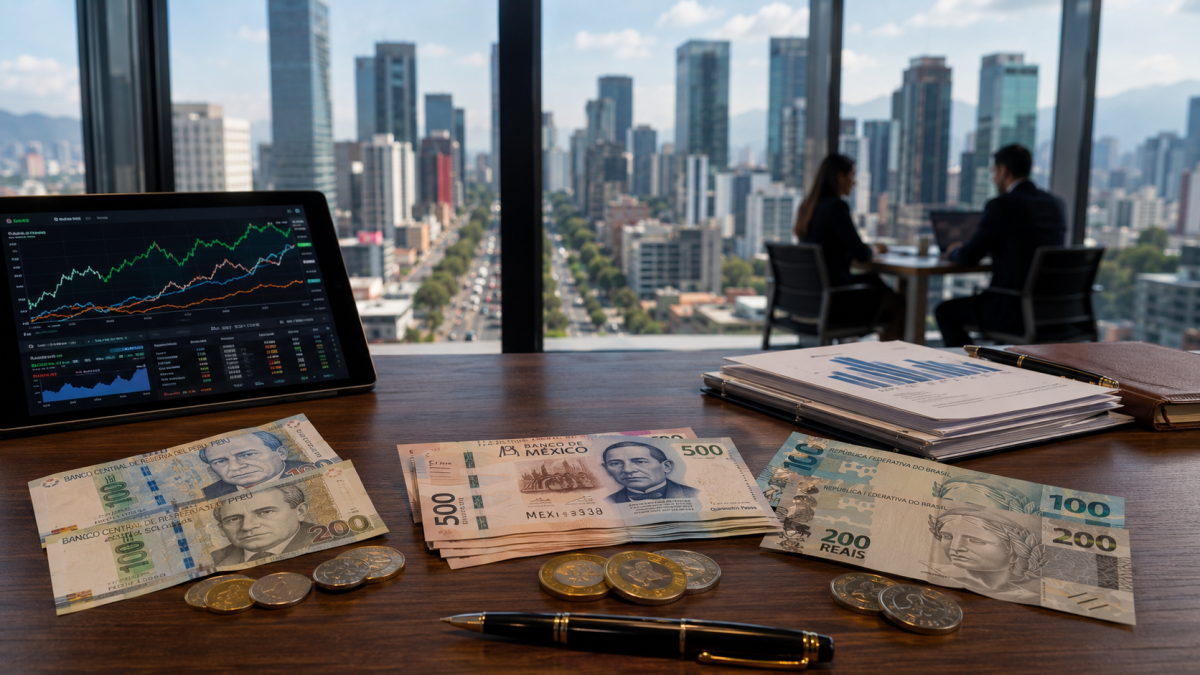
Beating the Dollar: The 3 Most Stable Latin American Currencies to Watch in 2026
The landscape of global foreign exchange in 2026 presents a fascinating departure from historical norms. For decades, the United States Dollar was the unchallenged, undisputed safe haven for global capital. However, a combination of shifting monetary policies, sustained domestic fiscal pressures in the United States, and rapidly evolving global trade routes has cracked that invincible armor. As international investors actively look elsewhere for both yield and security, Latin America has organically emerged as a region of profound financial resilience.
We are currently witnessing regional currencies that do not merely survive global volatility; they exhibit the macroeconomic functional strength necessary to absorb intense market activities and consistently appreciate against the greenback. Managing a national currency in today's hyper-connected, high-stakes global market requires a flawlessly calibrated technical setup. Central bankers must balance interest rate differentials, inflation targets, and foreign exchange interventions with the precision of a master soundboard, filtering out the noise of political turbulence to maintain a clear, steady signal. For those analyzing the 2026 forex markets, here are the three most stable and dynamic Latin American currencies leading the charge.
The Mechanics of the 2026 Forex Landscape
Before diving into the specific currencies, it is crucial to understand exactly how an emerging market currency "beats" the dollar. This phenomenon is largely driven by two macroeconomic engines: the carry trade and structural foreign direct investment (FDI).
The "carry trade" is a strategy where investors borrow money in a currency with low interest rates (historically the US Dollar or the Japanese Yen) and invest it in a currency offering significantly higher interest rates. Several Latin American central banks have been incredibly proactive, hiking rates early and maintaining hawkish monetary policies that offer spectacular yields to international funds. When paired with the massive influx of FDI driven by the global transition to green energy and the restructuring of international supply chains, these currencies experience continuous, heavy demand. They are capturing global market engagement not by accident, but through highly deliberate, creative strategies in economic policy.
1. The Peruvian Sol (PEN): The Undisputed Anchor of Stability
When analyzing Latin American foreign exchange, the Peruvian Sol is essentially the gold standard of the 21st century. While other developing nations have seen their currencies depreciate by double or even triple digits over the last two decades, the Sol has remained immutably robust. The secret to this remarkable endurance is a spectacular history of institutional independence.
The Central Reserve Bank of Peru (BCRP), under the long-term stewardship of Julio Velarde, operates as an isolated, technocratic fortress. It possesses the unique ability to completely decouple its monetary policy from the notoriously intense political theater of Lima. Furthermore, Peru has aggressively amassed Net International Reserves that currently sit at approximately 28 percent of its Gross Domestic Product (GDP)—one of the highest ratios in the world.
These massive reserves act as a perfect shock absorber. When global panic induces capital flight from emerging markets, the BCRP has the liquid ammunition to intervene directly in the open market, smoothing out the peaks and valleys of volatility. Because of this disciplined, data-driven approach, the Sol boasts an inflation rate that consistently tracks lower than its regional peers. For cross-border merchants, international investors, and even citizens of neighboring countries experiencing economic distress, the Peruvian Sol has effectively become a regional safe-haven asset, proving that quiet competence is the ultimate currency.
2. The Mexican Peso (MXN): The Nearshoring Juggernaut
If the Peruvian Sol is defined by its quiet, unshakeable stability, the Mexican Peso is defined by its aggressive, dynamic growth. Often referred to in financial media as the "Super Peso," the Mexican currency has recently recorded some of its strongest annual performances since the implementation of a free-floating exchange rate in 1994, appreciating by double digits against the U.S. Dollar.
The absolute primary driver of this strength is the unstoppable economic phenomenon of nearshoring. As massive global corporations actively relocate their manufacturing, engineering, and digital development hubs away from Asia to mitigate trans-Pacific supply chain risks, Mexico stands as the ultimate geopolitical beneficiary. This represents a masterclass in strategic regional localization. By leveraging its 2,000-mile border with the United States and the protective legal framework of the USMCA, Mexico is securing billions in foreign direct investment every quarter.
Every new automotive plant, aerospace facility, and tech hub built in cities like Monterrey or Guadalajara requires vast amounts of local currency to operate, creating a relentless upward pressure on the Peso. Furthermore, the Bank of Mexico (Banxico) has maintained a fiercely independent and hawkish stance, offering interest rate yields that deeply attract global carry-trade investors. The Mexican Peso is not just riding a temporary wave; it is structurally anchored to a permanent realignment of global trade.
3. The Brazilian Real (BRL): The High-Yield Commodity Titan
Brazil operates on a scale that demands absolute global attention, and the Brazilian Real reflects that immense, multifaceted economic power. In the opening quarters of 2026, the Real has proven to be a formidable asset, driven by a highly effective combination of immense commodity exports and deeply attractive domestic interest rates.
Brazil is not merely an exporter of basic raw materials; it is a highly sophisticated agricultural and energy titan. It dominates global supply chains in soybeans, iron ore, and poultry, and is rapidly becoming a superpower in renewable energy and green hydrogen production. This massive, continuous export machinery ensures a steady, heavy flow of US Dollars entering the Brazilian economy, naturally strengthening the Real.
What makes the Brazilian currency particularly compelling for the international financial community is the Central Bank of Brazil's unwavering commitment to monetary orthodoxy. By keeping the benchmark Selic rate elevated to combat inflationary pressures, Brazil offers a premium yield that is incredibly difficult for institutional investors to ignore. Additionally, Brazil's domestic financial tech sector has undergone a spectacular modernization. The state-sponsored "Pix" instant payment system has virtually eliminated the friction of domestic commerce, formalizing massive sectors of the economy and boosting tax revenues. While navigating the Real requires an understanding of Brazil's occasionally complex political landscape, its underlying structural and functional strength makes it a premier currency for sophisticated investors.
Conclusion
The 2026 financial landscape decisively proves that emerging markets are no longer inherently synonymous with currency devaluation. The Peruvian Sol, the Mexican Peso, and the Brazilian Real are rewriting the rules of global foreign exchange. Through fiercely independent central banking, massive infrastructural investments, and intelligent positioning within the global supply chain, these nations have crafted economic environments that do not just survive the dominance of the US Dollar, but actively challenge it. For expatriates, digital nomads, and international investors looking to diversify their wealth, Latin America currently offers a spectacular portfolio of resilience and growth.