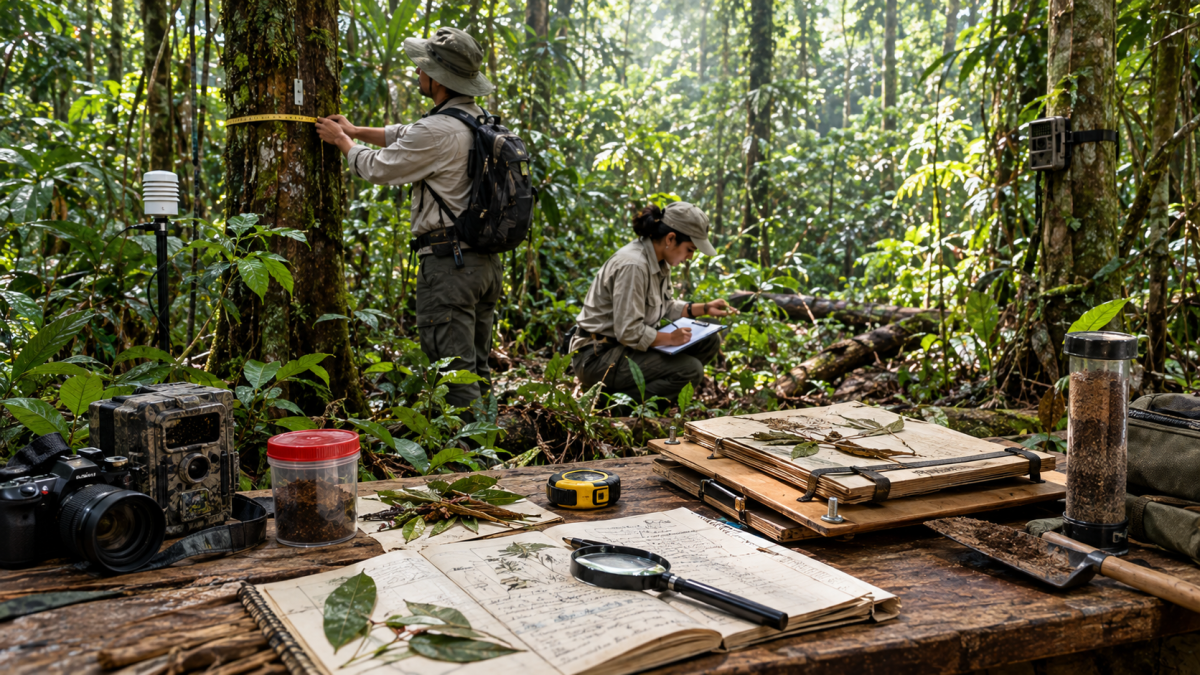
A landscape that does not stand still
A forest can look remarkably similar in two photographs taken years apart. Both images may show dense foliage, tall trunks and patches of sunlight. Yet the apparent continuity conceals a question: are these still the same trees, growing in the same way? On Barro Colorado Island in Panama, a lowland tropical forest offers an unusually rich setting for exploring that question. ForestGEO documents the site as part of its network of forest research plots. [1]
For readers across the Arab world, the value of this story lies not only in discovering another Latin American landscape. It also offers an accessible introduction to scientific observation. A useful record requires more than an impressive photograph or a memorable visit. It requires clear definitions, comparable measurements and the patience to return. These habits can make an unfamiliar forest understandable without pretending that a single number tells its entire story.
Why the same patch matters
The Smithsonian’s documentation describes a permanent study plot measuring 1,000 by 500 metres, covering 50 hectares. Woody stems meeting a diameter threshold of one centimetre are mapped, identified and measured, with numbered
Imagine weighing the contents of one cupboard today and a different cupboard next month. The second total would not reveal what happened inside the first. A permanent plot addresses a similar problem in a much more complex setting. Researchers can ask what changed within a defined area rather than quietly changing the area itself. The boundary does not make the plot identical to every forest in Panama; it makes the comparison within that plot more meaningful.
An unchanged total can hide change
Consider a simplified classroom example, not a result from Barro Colorado. A sample begins with 100 measured stems. Before the next count, four die and four previously smaller stems cross the measurement threshold. The total is again 100. A headline saying that nothing changed would miss the central point: the same total now represents a different set of individuals.
This example separates abundance from turnover. It also explains why entering a measurement record is not necessarily the same event as beginning life. A plant can already be present before becoming large enough for inclusion. Likewise, a diameter measurement describes size, not a birth certificate. Readers should therefore ask exactly what a category means before treating a chart as a direct account of age, survival or the health of an entire landscape.
The discipline of returning
A published ForestGEO study examines forest demography and climate across a multidecade sequence of censuses, with repeated five-year intervals in that record. Its extended perspective tests ideas about forest change against more than a short observational window. [3] The important lesson for a general reader is methodological: the length of the record affects the questions that can be answered responsibly.
Two measurements can show a difference; they do not automatically establish its cause. A longer sequence can help distinguish a persistent pattern from an unusual interval, but interpretation still demands care. Changes in measurement procedures can also complicate comparison. Good science therefore needs a record of how observations were collected, not just a column of final values. An unexpected number is a starting point for checking and questioning, not an invitation to invent a dramatic explanation.
Looking beyond the trunks
ForestGEO’s flowers, seeds and seedlings initiative uses collection traps to investigate another stage of forest life. Its methods describe open-topped mesh traps with a collecting area of half a square metre. [4] Such observations invite a different question from a tree census: what material arrives at a particular spot, rather than which measured stems are already standing there?
Arrival, establishment and later growth should not be collapsed into one event. A seed in a trap is evidence of arrival, not proof that a mature tree will eventually occupy that location. Thinking in stages helps readers understand why researchers combine different kinds of records. The most useful comparison is not always between two grand totals; it may be between successive steps in a process and the conditions separating them.
Other organisms broaden the picture. Smithsonian reporting describes lianas as woody climbers that use trees for support and compete for light. [5] Another account identifies agoutis as important seed dispersers on the island. [6] These examples show why a forest cannot be understood only as a collection of isolated trunks. Different observations illuminate different relationships, and none should be presented as a complete inventory of everything happening there.
A lesson that travels well
A reader does not need to recreate a research station to practise careful observation. With permission, choose a few accessible trees in a courtyard, garden or educational space. Photograph each from a consistent position, note the observation date and describe visible changes using the same categories each time. Do not attach anything to a tree, remove material or interfere with research equipment. The purpose is to develop a repeatable record, not to imitate specialist fieldwork without training.
Keep observation separate from interpretation. “Fewer visible leaves in this photograph” records something that can be checked. “The tree is permanently declining” makes a much larger claim. In a spreadsheet, leave an unobserved value clearly marked as missing rather than entering zero. A zero says that something was checked and absent; a blank may mean that nobody checked. This small distinction can determine whether a later comparison is informative or misleading.
Learning to read a living record
Barro Colorado is valuable to a curious reader because it turns an attractive landscape into a set of answerable questions. Which individuals were measured? What qualified for inclusion? Were the observations comparable? What remains unknown? These questions are useful far beyond tropical ecology. They encourage a practical form of scientific literacy: appreciating evidence while recognizing its limits. The forest becomes neither a frozen postcard nor a simple statistic, but a living place that rewards sustained attention.
Sources
[1] ForestGEO — Barro Colorado Island
[2] Smithsonian — Permanent plot data documentation
[3] ForestGEO — Long term demography and climate study
[4] ForestGEO — Flowers seeds and seedlings initiative
[5] Smithsonian — Research on tropical woody climbers
[6] Smithsonian — Research and biodiversity on Barro Colorado