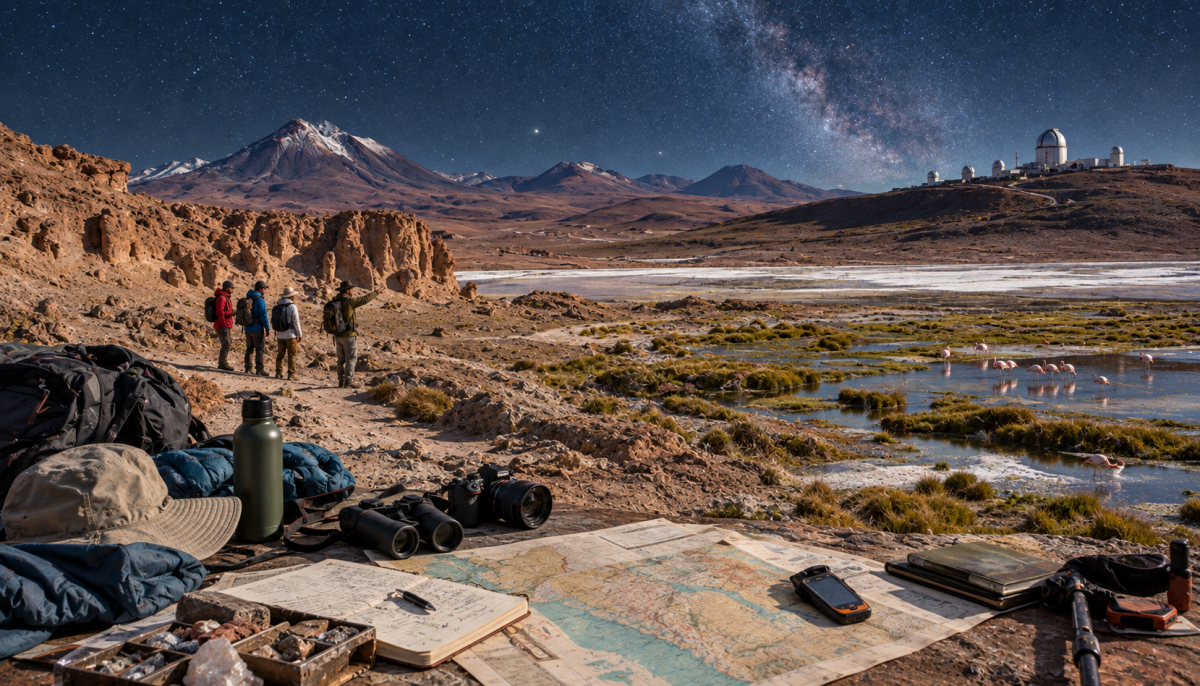
Atacama Desert: Where Earth, Sky and Science Meet
Introduction
Northern Chile contains one of Latin America's most remarkable environments: the Atacama Desert. Its broad salt basins, volcanic horizons, high plateaus and exceptionally clear skies create a destination that combines tourism, geography and scientific discovery. For an Arab audience, the first impression may feel familiar because wide desert spaces, strong sunlight and dramatic horizons also shape many landscapes across the Arab region. Yet the Atacama has a character of its own. Much of it stands at high elevation, the nearby Pacific influences coastal conditions, and the Andes rise along its eastern side.
The desert is not a single uniform plain. Travellers encounter rocky valleys, pale mineral surfaces, dunes, wetlands, lagoons and distant cones of volcanic origin. San Pedro de Atacama is the best-known base for exploring many of these features, while other routes extend toward Antofagasta and the great astronomical facilities of northern Chile. A thoughtful visit rewards curiosity, preparation and respect for an environment where water, shade and biological activity are limited and therefore especially valuable.
Why the Landscape Is So Dry
The Atacama's dryness results from several geographic influences working together. The Andes create a barrier that limits moisture arriving from the east. Along the Pacific coast, the cold Humboldt Current helps produce stable air that does not easily develop into rainfall. Parts of the desert also lie beneath atmospheric conditions that discourage rising moist air. The combined effect has created extremely dry zones, although rainfall and seasonal changes vary across the large region.
Dryness does not mean the landscape is empty. Minerals colour cliffs and plains in red, brown, white and greenish tones. Salt accumulates in low basins where water once collected and then evaporated. Wind reshapes loose material, while rare water flows leave channels and deposits. These processes form a natural record of climate and geology. Researchers study the region because its surfaces can preserve evidence for long periods and because some locations resemble conditions used in studies of other planetary environments.
Valleys, Salt Basins and High-Altitude Lagoons
Near San Pedro, sculpted valleys provide accessible introductions to Atacama geology. Layered rock, salt-rich formations and eroded ridges change appearance as the sun moves across them. Early morning and late afternoon often reveal textures that are difficult to see under midday brightness. Visitors should remain on established routes because apparently firm ground may be fragile, and footprints or vehicle tracks can remain visible for a long time.
Farther into the high plateau, lagoons and wetlands interrupt the dry terrain. Their water, surrounding vegetation and birdlife demonstrate how sharply life concentrates around suitable conditions. Volcanic peaks frame many views, giving the plateau a strong sense of height and distance. These routes may rise quickly, so travellers should allow time to adapt, move calmly and follow qualified local guidance. Weather can change rapidly, and wind at exposed viewpoints may be intense even when the sky looks completely clear.
A Global Centre for Astronomy
The Atacama is internationally known for astronomy. High elevation, dry air, limited cloud cover and distance from major sources of artificial light create excellent observing conditions. The European Southern Observatory operates major facilities in northern Chile. Paranal Observatory, at about 2,635 metres above sea level, hosts the Very Large Telescope and other advanced instruments. La Silla, on the southern edge of the desert at about 2,400 metres, has supported astronomical research since the 1960s.
These facilities show how landscape can become scientific infrastructure. Telescopes need stable, dark and transparent skies, but they also require engineering, maintenance, data systems and carefully controlled operations. Visitors should distinguish between public stargazing activities and professional observatories. Access to research sites is limited, registration may be required and schedules can change. Checking official information before travel is essential. Even without entering a major facility, a guided night-sky experience near an authorised tourism centre can explain southern constellations, the structure of the Milky Way and the importance of reducing unnecessary light.
The Experience of the Night Sky
For many visitors, the Atacama night is the most memorable part of the journey. In a dark location, the number of visible stars can be surprising. The Milky Way may appear as a textured band rather than a faint line, and familiar constellations may sit at unexpected angles when viewed from the Southern Hemisphere. A knowledgeable guide helps turn the spectacle into understanding by explaining distance, scale, stellar colour and the apparent movement of the sky.
Night excursions require practical clothing. Desert temperatures can fall sharply after sunset, particularly at elevation. A warm outer layer, closed footwear and protection from wind improve comfort. Bright phone screens and strong lamps should be used carefully because they affect night vision and disturb other observers. Red-filtered light is often preferred during astronomy activities. Quiet attention also improves the experience; the desert sky becomes more impressive when the eyes have time to adjust.
Planning a Responsible Visit
Strong sunlight, altitude and long road distances are central planning considerations. Visitors should carry sufficient water, use high-protection sunscreen, wear reliable ultraviolet-filtering glasses and keep a hat available. A layered clothing system is useful because conditions may shift between warm sunlight and cold shade. Travellers with relevant health concerns should obtain qualified advice before high-altitude excursions.
Transport should be arranged through responsible services familiar with route conditions. Fuel availability, mobile coverage and roadside assistance can be limited outside established centres. Tours should explain duration, maximum altitude, included equipment and emergency procedures. Travellers should never collect minerals, damage rock formations or leave waste. Water sources and wetland edges deserve particular care because they support concentrated life within a dry region.
Cultural Accessibility for Arab Travellers
Arab visitors may find meaningful connections in the Atacama's hospitality, desert knowledge and respect for open land. At the same time, practical expectations should be discussed in advance. Travellers can ask accommodation providers about privacy, suitable meals and quiet spaces. Clear communication before arrival makes the experience smoother, especially in remote areas where alternatives may be limited.
The most rewarding approach is to treat local knowledge as essential rather than optional. Guides understand road conditions, altitude, changing weather and protected areas. Listening carefully reduces risk and opens a deeper reading of the landscape. The Atacama is not defined only by dryness; it is a place where geology, astronomy, tourism and careful adaptation meet.
Conclusion
The Atacama Desert offers a distinctive journey through salt, stone, altitude and sky. Its valleys reveal erosion, its basins preserve minerals, its wetlands concentrate life and its dark nights support both public wonder and advanced research. For Arab readers, the destination provides an opportunity to compare desert environments while recognising important differences in elevation, climate and geography. With responsible planning, suitable protection and respect for local rules, a visit can become more than sightseeing. It can be an introduction to how Earth systems shape human movement and how a remote landscape helps science explore the universe.