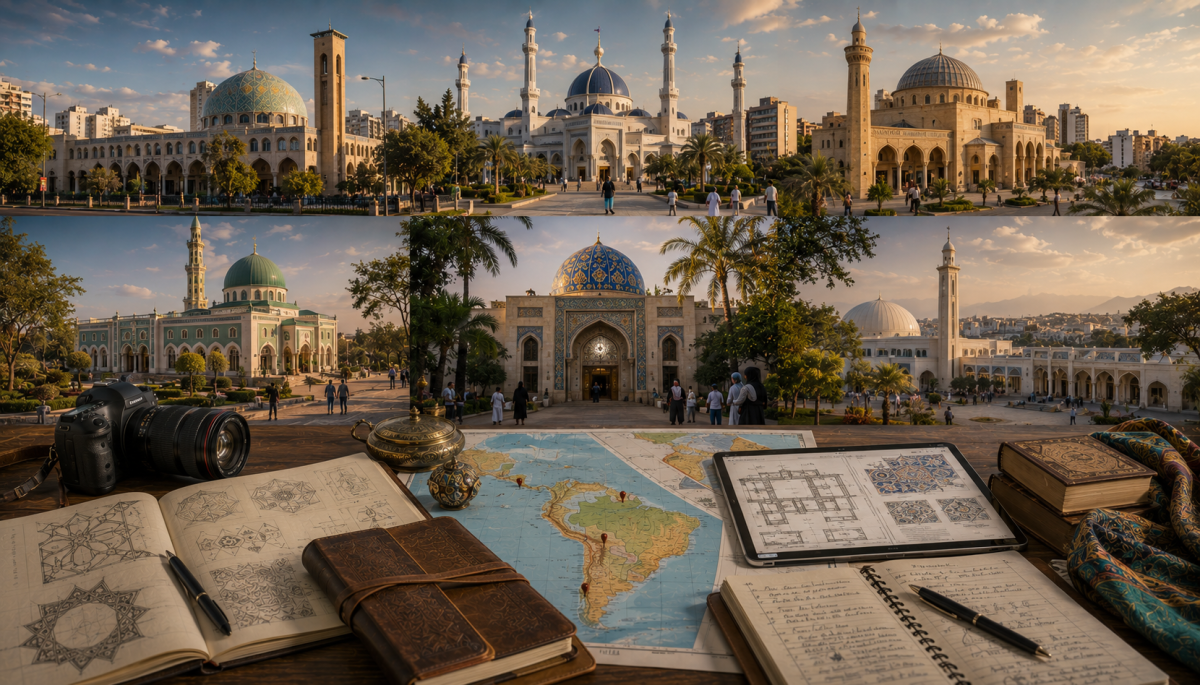
Architectural Marvels: The Largest Mosques in Latin America
Latin America is often perceived almost exclusively through the lens of its Catholic heritage, yet it holds a deeply rich and remarkably diverse religious tapestry. A highly significant, though frequently overlooked, thread in this tapestry is the history of Arab and Muslim immigration. Today, millions of Latin Americans proudly trace their roots to the Middle East. As these vibrant communities established deep roots, gained economic prosperity, and integrated into their new homelands, they built magnificent places of worship. These grand mosques serve as both spiritual sanctuaries and essential cultural bridges. Blending traditional Islamic architectural design with local Latin American landscapes, these structures are true marvels of modern engineering and artistry. Here is an in-depth exploration of the largest and most prominent mosques in Latin America.
The Historical Context of Islam in Latin America
The presence of Islam in Latin America dates back centuries. While the absolute earliest traces arrived with enslaved African populations and the Moorish influence brought over by Spanish and Portuguese colonizers, the modern Muslim community is primarily the result of large-scale migration during the late 19th and early 20th centuries. Fleeing the collapsing Ottoman Empire and seeking new economic horizons, hundreds of thousands of immigrants from modern-day Syria, Lebanon, and Palestine crossed the Atlantic.
Initially working as traveling merchants and establishing small retail businesses, these immigrants—historically referred to across the continent as Turcos because they originally arrived bearing Ottoman passports—gradually integrated into the upper echelons of Latin American society, politics, and commerce. As they achieved significant economic prosperity, they sought to formally reconnect with their spiritual and cultural roots. This desire led to the funding and construction of dedicated Islamic centers. Today, the massive mosques they built stand as monumental, physical symbols of their success, resilience, and lasting contribution to the cultural mosaic of the Americas.
1. King Fahd Islamic Cultural Center (Buenos Aires, Argentina)
Standing proudly in the upscale, leafy neighborhood of Palermo in Buenos Aires, the King Fahd Islamic Cultural Center holds the undisputed title of the largest mosque in Latin America. Inaugurated in 2000, this monumental complex was a generous gift from the Kingdom of Saudi Arabia, constructed on a sprawling 34,000 square meters of prime municipal land donated by the Argentine government.
Designed by the renowned Saudi architect Zuhair Fayez, the architecture is a stunning, traditional representation of Arabic design seamlessly placed within a South American capital. The main prayer hall features a massive, intricately woven carpet brought directly from Saudi Arabia and a dazzling 230-light crystal chandelier. Capable of comfortably accommodating over 1,600 worshippers (1,200 men and 400 women), the complex is much more than a mosque. It houses a primary and secondary school, a divinities school, a sprawling library, and extensive cultural exhibition halls. The center regularly opens its massive doors for free guided tours, actively promoting interfaith dialogue and sharing the richness of Islamic culture with the broader Argentine public.
2. Mosque of Sheikh Ibrahim Al-Ibrahim (Caracas, Venezuela)
Dominating the bustling skyline of Venezuela's capital city, the Mosque of Sheikh Ibrahim Al-Ibrahim is a towering, unmistakable beacon of Islamic faith in the Americas. Construction began in 1989 and was completed in 1993, financed primarily by Saudi philanthropist Sheikh Abdulaziz Bin Ibrahim Al Ibrahim. It proudly ranks as the second-largest mosque in Latin America.
Covering an area of roughly 5,000 square meters, the architectural crown jewel of this complex is its soaring minaret. Standing at a staggering 113 meters (371 feet) tall, it is officially recognized as the tallest minaret in the entire Western Hemisphere. The mosque's majestic 23-meter-high concrete dome creates a serene, acoustically brilliant interior devoted entirely to spiritual reflection, contrasting sharply with the loud, busy streets of Caracas outside. Capable of welcoming up to 3,500 worshippers simultaneously, the complex seamlessly blends classic geometric Islamic patterns and Quranic calligraphy with modern contemporary design elements.
3. Omar Ibn Al-Khattab Mosque (Foz do Iguaçu, Brazil)
Located in the lush, tropical southern Brazilian city of Foz do Iguaçu—famous worldwide for the majestic Iguazu Falls—the Omar Ibn Al-Khatab Mosque is the third-largest mosque in South America. The "Triple Frontier" border region linking Brazil, Argentina, and Paraguay is home to one of the largest, wealthiest, and most vibrant Arab communities in Latin America, numbering well over 25,000 people.
Inaugurated in 1983, the mosque was constructed specifically to serve this thriving demographic. Architecturally, it is highly renowned for featuring one of the largest free-span reinforced concrete domes in Latin America, standing 18 meters high. Its gleaming white exterior, flanked by two towering 31-meter minarets, creates a striking, photogenic visual contrast against the surrounding dense green tropical landscape. The mosque is not only a crucial place of local congregation but also a major regional tourist attraction. Visitors of all faiths are welcomed to learn about Islamic traditions, the Five Pillars of Islam, and to admire its beautiful arabesque interiors.
4. Omar Ibn Al-Khattab Mosque (Maicao, Colombia)
In the remote, arid northeastern region of La Guajira, Colombia, lies the bustling, border commercial city of Maicao. During the mid-to-late 20th century, the city experienced a massive influx of Arab immigrants, particularly from Lebanon and Syria, earning it the affectionate nickname "The Arab Capital of Colombia." At the very heart of this tight-knit community is the Omar Ibn Al-Khattab Mosque, the largest Islamic center in Colombia and one of the most prominent in Latin America.
Constructed in 1997, the mosque was entirely funded by the local Muslim community. Its towering minaret and beautifully tiled domes visually dominate the city's relatively flat skyline. Built using fine imported Italian marble, the mosque features intricate stained glass windows and expansive, highly decorated prayer halls. Beyond hosting daily prayers, it serves as a crucial educational and cultural hub for the region, ensuring that the Arabic language, cultural customs, and Islamic traditions are actively passed down to younger generations born in Colombia.
5. Mohammed VI Center for Dialogue of Civilizations (Coquimbo, Chile)
Perched atop a commanding, windy hill (Cerro Dominante) in the coastal city of Coquimbo, Chile, the Mohammed VI Center for Dialogue of Civilizations is a breathtaking architectural masterpiece of cultural fusion. Inaugurated in 2007, the complex was funded jointly by the Kingdom of Morocco and the local Chilean municipality.
The structure is a visually stunning, exact replica of the famous 12th-century Kutubiyya Mosque located in Marrakesh, Morocco. Its defining feature is a magnificent 40-meter-high square minaret, adorned with intricate, hand-crafted Moroccan tilework, which offers sweeping panoramic views of the Pacific Ocean and the entire port city below. The interior is a profound testament to exquisite Moroccan craftsmanship, featuring carved wooden domes representing different royal dynasties, colorful mosaics, and stunning brass lamps. True to its name, the center is a powerful beacon of cultural exchange. It houses a specialized library with texts in Arabic and Spanish, a museum, and two prayer halls, attracting thousands of visitors annually to foster deep understanding between the Islamic world and Latin America.
Conclusion
The grand mosques of Latin America are powerful, undeniable testaments to the region's historical diversity and the deeply enduring legacy of Arab immigration. From the bustling, cosmopolitan avenues of Buenos Aires and Caracas to the dense tropical borders of Brazil and the breezy coastal hills of Chile, these magnificent structures are far more than just places of worship. They are vibrant community hubs, stunning architectural wonders, and enduring bridges of international cultural dialogue. By welcoming global tourists, actively hosting interfaith events, and proudly displaying the unparalleled beauty of Islamic art and architecture, the largest mosques in Latin America ensure that the diverse, multicultural spiritual fabric of the continent continues to thrive and evolve beautifully in the 21st century.