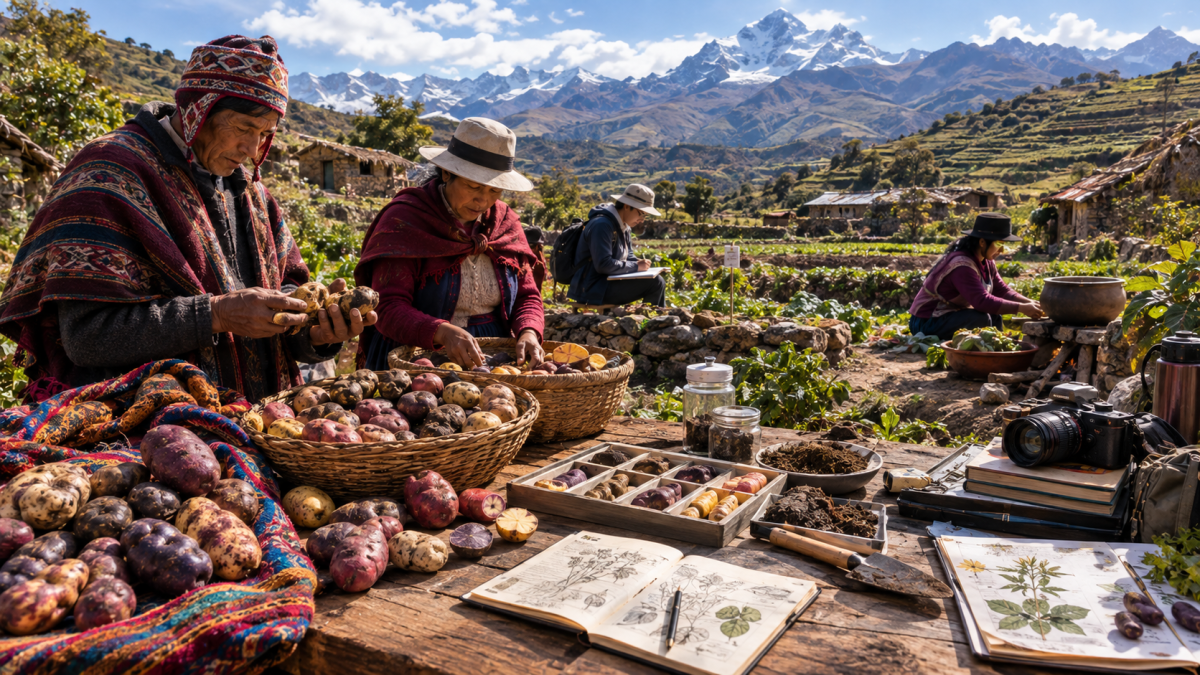
A familiar ingredient with an unfamiliar range
The potato is so familiar in Arab kitchens that it rarely invites questions about its origins. It appears beside rice, inside vegetable stews, in baked dishes and as a simple accompaniment to family meals. Yet the uniform tubers commonly displayed in supermarkets reveal only a small part of its story. In the Andes of South America, potatoes offer a remarkable range of shapes, colours and culinary qualities. Exploring that range provides an accessible introduction to Latin American food culture. It also changes the central question: instead of asking only how a potato should be cooked, we can ask what knowledge has kept different potatoes available.
A crop shaped by mountain environments
The International Potato Center, known as CIP, identifies the Andes as the potato's place of origin and initial domestication. Its account of native varieties describes thousands of kinds grown in the highlands of Peru, Bolivia and Ecuador. [1] A useful way to understand that diversity is to picture a mountain landscape as many growing environments rather than one continuous field. Slope, exposure and elevation change the conditions a crop encounters. A plant that performs well in one location may behave differently elsewhere. The map of potato cultivation therefore invites us to look closely at local conditions, rather than assuming that a single successful variety should suit every farm.
What a variety means at the table
A potato variety is more than a colour on a market stall. Texture matters when deciding whether a cooked piece should retain its shape or soften into a smooth mixture. Size affects preparation, and flavour can influence the ingredients served alongside it. For an Arab reader, an everyday comparison is the choice between rice suited to separate grains and rice selected for a softer dish. The crop name stays the same while the intended result changes. This is a comparison of culinary decisions, not a claim that the two crops behave identically. It helps explain why preserving variety can preserve possibilities in the kitchen.
Learning to describe rather than rank
A thoughtful tasting can begin with modest questions. Is the cooked potato firm or crumbly? Does it feel smooth or floury? How does its flavour work with a simple vegetable accompaniment? These questions are more informative than declaring one unfamiliar variety the best. Use potatoes supplied for ordinary culinary use and follow the supplier's preparation guidance. A small side by side comparison can teach a household more than a complicated recipe that hides every difference. The point is not to create a competition with familiar local potatoes. It is to notice how preparation and ingredient choice influence each other, and to extend a vocabulary of taste and texture.
Fields as places of continuing knowledge
CIP explains that native potato diversity is maintained on farms and within communities, and that many varieties circulate locally rather than entering large commercial markets. [1] This detail matters because a supermarket selection cannot be treated as a complete inventory of food culture. A variety may remain valuable within a particular place even when it is rarely advertised elsewhere. Readers should therefore distinguish commercial visibility from cultural significance. Asking growers how they recognize a variety, where it performs well and what it is used for can reveal information that a photograph cannot. The answer belongs to a specific grower and setting; it should not automatically be generalized to the entire Andes.
Conservation beyond the field
Living cultivation and scientific conservation serve different, complementary purposes. CIP's in vitro collection maintains plant material under controlled conditions using tissue culture. Its cryopreservation work preserves tiny growing tips at extremely low temperatures and checks whether they can recover into normal plants. [2][3] These are specialized conservation methods, not household storage techniques. Their importance is easier to understand by considering what a backup does: it provides another way to retain material if it becomes unavailable elsewhere. A collection still requires accurate identification, careful maintenance and technical expertise. The scientific task is not simply to accumulate samples, but to keep them useful for future work.
Why documentation is part of preservation
Imagine two carefully stored samples with labels that have become detached. Even if the plants survive, much of their usefulness has been weakened. This hypothetical example shows why names, identifying information and records matter alongside biological material. For students, the lesson reaches beyond agriculture. A photograph without a location, an interview without permission or a recipe without a clear ingredient name can also lose essential context. A good article or classroom project should separate observed details from explanations supplied by a grower or researcher. It should preserve local names accurately, acknowledge uncertainty and avoid presenting an attractive guess as a documented fact.
A practical way to explore the subject
An educational visit, where available and arranged with permission, can focus on the relationship between a field, a collection and a meal. Before booking, ask what the activity actually includes: a growing area, a discussion, a cooking demonstration or only a shop. Ask whether interpretation is available in a language you understand. Establish dietary requirements and photography preferences in advance. Do not assume that research facilities accept casual visitors or that a working farm is open to the public. A respectful conversation is often most productive when the questions are specific. Which features distinguish this potato? What preparation does the grower recommend? Which part of the process takes the most attention?
Lessons for readers interested in food businesses
For a food retailer or restaurant, the subject suggests a useful exercise in product description. A label that explains origin, texture and intended use can help a customer make a decision. Attractive colour alone does not answer whether an ingredient fits the dish. Any claim about a named variety, supplier or production method should be checked before appearing on a menu. This is an editorial and service lesson, not a forecast of demand or a recommendation to import agricultural material. It encourages businesses to connect a product's description to verifiable information and to give customers practical reasons for choosing it.
Keeping the story close to everyday life
The most useful conclusion is not that every household must find rare potatoes. It is that a familiar ingredient can carry far more knowledge than its ordinary appearance suggests. Andean native potatoes bring farming choices, culinary preferences and conservation work into the same story. Arab readers can explore that story through trusted educational sources, attentive cooking and respectful questions. Understanding the difference between a market product, a local variety and conserved plant material makes the subject clearer. Above all, it gives proper attention to the knowledge that keeps food diverse, and to the care needed for that knowledge to remain available.
Sources
[1] International Potato Center — Native Potato Varieties
[2] International Potato Center — In Vitro Collection
[3] International Potato Center — Cryopreservation