The Sun's Alignment: The Temple of the Seven Dolls
Twice a year, on the mornings of the spring and autumn equinox, a small crowd gathers at a modest stone temple just outside Mérida, in the northern Yucatán, to watch the sun do something the temple's builders designed it to do more than a thousand years ago. As the sun rises, its light passes directly through the temple's east-facing doorway and out the opposite western doorway, framed perfectly by the structure for a matter of minutes, an alignment so precise it could not have happened by accident.
One of the Yucatán's Oldest Cities
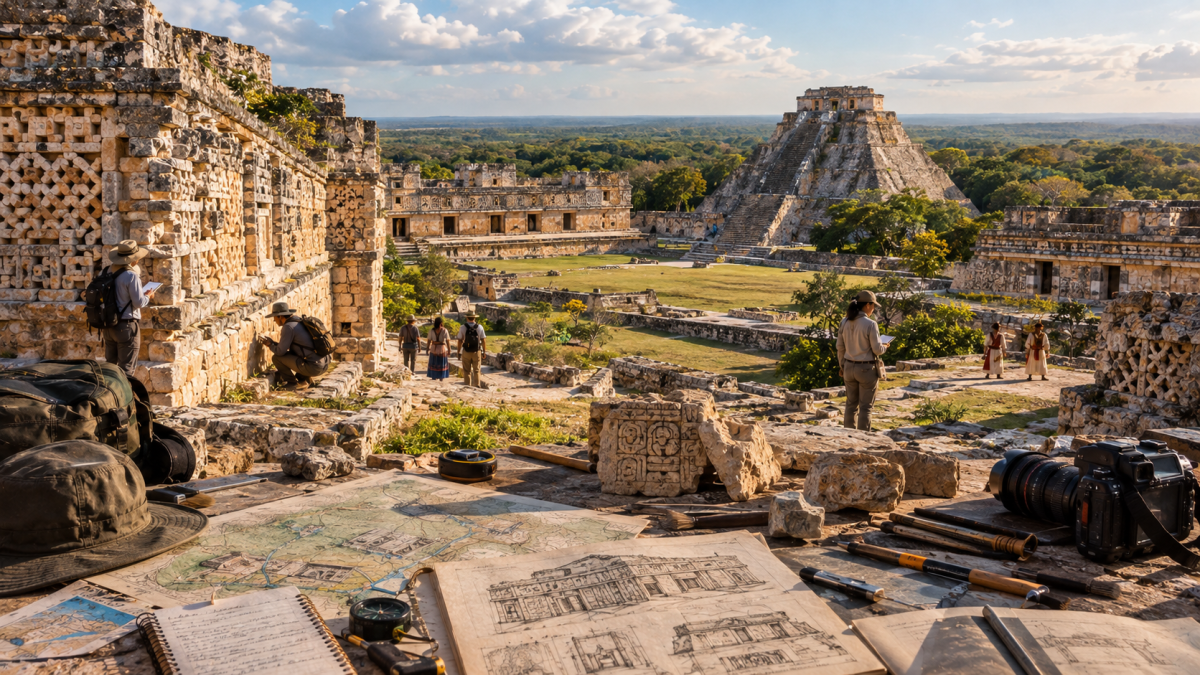
Dzibilchaltún is not one of the Yucatán's most dramatic ruins in terms of scale, but it holds a distinction few other Maya sites can claim: an occupation history stretching across an extraordinary length of time, from as early as the Late Preclassic period, well over two thousand years ago, through the Postclassic era and up to the arrival of the Spanish. Few Maya settlements anywhere were inhabited continuously for so long, making Dzibilchaltún an unusually rich site for tracing how Maya architecture, religion, and daily life evolved across successive generations in the same place.
A Temple Named for What Was Found Inside
The site's most famous structure earned its popular name, the Temple of the Seven Dolls, not from any ancient Maya label but from a 20th-century archaeological discovery. When researchers excavated the small temple, they found seven crude, misshapen clay figurines buried within an offering beneath the structure, some appearing to depict physical deformities or illness. Their exact ceremonial purpose remains debated, but their discovery gave the temple the evocative name it carries today. The building itself is architecturally simple compared to the towering pyramids at sites like Uxmal or Copán, a modest square temple topped by a small tower and pierced by doorways on each of its four sides. That simplicity, however, is precisely what makes its equinox alignment so striking. Dzibilchaltún's builders oriented the temple with such accuracy that, at sunrise on the equinoxes, light travels straight through the structure from east to west,
The Sacred Cenote of Xlacah
Just a short walk from the Temple of the Seven Dolls lies Cenote Xlacah, one of the site's most significant natural features and a major reason the location was settled in the first place. Cenotes, natural sinkholes exposing groundwater, were essential water sources across the Yucatán's dry limestone landscape, and Xlacah, more than 60 meters deep in places, served Dzibilchaltún's population for centuries. Beyond its practical role, the cenote also functioned as a place of ritual offering. Archaeological dives into its depths have recovered pottery, jade, and human remains, artifacts consistent with the broader Maya practice of treating cenotes as sacred portals connecting the human world to the underworld, deities, and ancestral spirits believed to reside within the earth's watery depths.
A City That Outlasted Its Neighbors
While many Maya centers rose and fell within a few centuries, Dzibilchaltún's population persisted through multiple political eras, adapting as regional power shifted across the peninsula. At its peak, during the Late Classic and into the Postclassic period, the settlement may have supported a substantial population spread across a wide urban area, with causeways connecting different sections of the city, a level of continuity that offers archaeologists a valuable long-term record rarely available at sites with shorter occupation spans.
Visiting Dzibilchaltún Today
Dzibilchaltún today functions as both an archaeological park and a small on-site museum showcasing artifacts recovered from the ruins and the cenote, including a notable collection of colonial-era items reflecting the site's continued use even after the Spanish conquest, when a small chapel was built directly atop the ancient plaza. For visitors willing to arrive at dawn on the spring or autumn equinox, Dzibilchaltún offers a rare experience: watching a piece of astronomical engineering built more than a thousand years ago perform exactly as intended, sunlight tracing a path through stone doorways aligned with a precision that still draws crowds every single year.