Introduction
If you stand today among the ruins of Copán, surrounded by thick jungle and the distant sound of tropical birds, it is hard not to feel that you are standing inside a story that never fully ended. Ancient Honduras is not just a chapter of the past—it is a layered, living narrative shaped by migration, innovation, and cultural exchange over thousands of years.
Long before Spanish ships appeared on the horizon, this land was home to complex societies that cultivated crops, mapped the stars, carved their histories into stone, and built cities that rivaled any in the ancient Americas. Honduras, often overshadowed in popular history by its larger neighbors, was in fact a critical frontier of the Maya civilization and a meeting ground between distinct cultural worlds.
To understand ancient Honduras is to understand a place where ideas traveled as much as people did—where the boundaries between civilizations were porous, and where innovation thrived at the edges.
Before the Cities: The First Hondurans
Thousands of years before the rise of monumental architecture, the earliest inhabitants of Honduras lived in small, mobile communities. They hunted, gathered, and gradually learned to cultivate the land. By around 2000 BCE, maize agriculture had taken root, transforming not only diets but entire ways of life.
These early societies did not leave behind towering pyramids or written records, but they laid the foundation for everything that followed. Among their descendants were groups like the Lenca people, whose cultural presence would endure for centuries and, in many ways, into the present day.
What is striking about these early communities is not what they lacked, but what they built quietly: systems of cooperation, knowledge of the land, and spiritual traditions tied deeply to cycles of nature. These were not primitive beginnings, but adaptive, intelligent responses to a demanding environment.
Copán: A City Written in Stone
By the early centuries of the Common Era, western Honduras had become part of a much larger and more intricate world. The rise of Copán transformed the region into one of the southernmost strongholds of the Maya.
Copán was never the largest Maya city, nor the most militarily powerful, but it may have been one of the most intellectually refined. Its rulers invested not only in buildings but in memory itself. They carved their history into stone—literally.
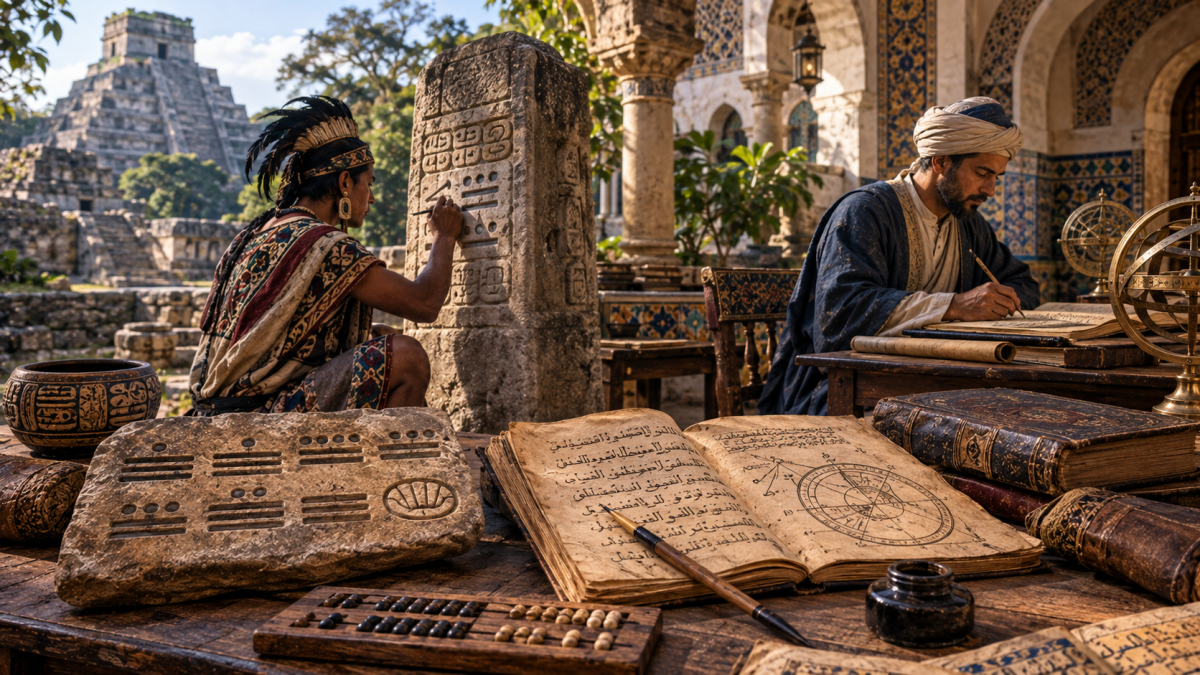
The city’s monuments, especially its famous stelae, are among the most detailed in the Maya world. These towering stone slabs depict rulers in elaborate ceremonial dress, surrounded by hieroglyphic inscriptions that recount births, accessions, victories, and rituals. Through them, we know the names and deeds of individuals who lived more than a thousand years ago.
One of the most celebrated of these rulers is Uaxaclajuun Ub'aah K'awiil. His reign in the 8th century marked a peak in Copán’s artistic and architectural achievement. Under his patronage, the city became a center of sculpture so intricate that even today it challenges modern understanding of ancient craftsmanship.
Walking through Copán, one encounters not just ruins but intention. The ball court, for instance, was not merely a place for sport; it was a stage for ritual, tied to cosmology and myth. The hieroglyphic stairway—one of the longest known texts in the Maya world—was more than decoration. It was a statement: that history mattered, that lineage mattered, and that time itself could be recorded and understood.
Knowledge as Power
What sets Copán apart is not just its beauty but its intellectual ambition. The people who lived there were deeply engaged with questions of time, astronomy, and meaning.
Like other Maya centers, Copán developed a sophisticated writing system—the most advanced in pre-Columbian America. This script allowed them to document political events, religious beliefs, and genealogies with remarkable precision. It also reveals a worldview in which rulers were not just political leaders but intermediaries between the human and the divine.
Astronomy played a central role in this worldview. The movement of celestial bodies was carefully observed and recorded, informing calendars that governed everything from agriculture to ritual ceremonies. Time, for the Maya, was not abstract. It was sacred, cyclical, and alive.
This intellectual culture did not exist in isolation. Copán was part of a broader network of cities, each contributing to and drawing from a shared pool of knowledge.
A Connected World
Ancient Honduras was never a remote or isolated region. On the contrary, it was deeply embedded in long-distance trade networks that connected it to major centers such as Tikal and even the distant metropolis of Teotihuacan.
Through these networks flowed goods that carried both practical and symbolic value: jade, obsidian, cacao, feathers, and finely crafted ceramics. But trade was never just about objects. It was also about ideas—artistic styles, religious concepts, and political strategies.
This constant exchange helped shape Copán’s identity. It was not merely a recipient of influence but an active participant in a dynamic, interconnected world.
The Quiet Collapse
Then, sometime in the 9th century, the rhythm changed.
The great monuments ceased. The inscriptions stopped. The city, once alive with ceremony and movement, began to empty.
The decline of Copán, like that of many Maya cities, was not a sudden catastrophe but a gradual unraveling. Scholars point to a combination of environmental stress, population pressure, political instability, and possibly prolonged drought. The very systems that had supported the city’s growth may have contributed to its fragility.
Yet it is important to resist the idea of disappearance. The people did not vanish. They adapted, moved, and transformed. The collapse of the city was not the end of a culture, but the end of a particular way of organizing it.
Beyond the Maya Horizon
While Copán dominates discussions of ancient Honduras, it was never the whole story. Other groups, including the Pech people and the Tolupan people, developed their own social structures and cultural traditions across different regions of the country.
These societies were often less centralized than the Maya, but no less complex in their relationship to the land and to each other. They navigated dense forests, rivers, and mountains, building lives that were flexible and resilient.
Their histories remind us that ancient Honduras was not defined by a single civilization, but by diversity.
Conclusion
The ancient history of Honduras resists simplification. It is not just the story of a great city rising and falling, but of a region constantly in motion—shaped by migration, exchange, and adaptation.
Copán remains its most visible symbol, a place where stone still speaks. Recognized today by UNESCO, it continues to draw scholars and travelers alike, each trying to piece together the lives that once animated its plazas and temples.
But the deeper story lies beyond the ruins. It lives in the continuity of indigenous cultures, in agricultural traditions that stretch back millennia, and in the enduring human capacity to create meaning in even the most challenging environments.
Ancient Honduras was never a periphery. It was a frontier—one where worlds met, where knowledge flourished, and where the past still lingers, just beneath the surface of the earth.