Puyango Petrified Forest: Reading Ecuador’s Ancient Trees in Stone
Introduction
A tree trunk usually suggests growth, shade and a material that eventually returns to the soil. At Puyango in southern Ecuador, that familiar shape introduces a different kind of story. Fossil wood invites the visitor to consider how a living structure can survive as a mineral record. The site lies between the provinces of El Oro and Loja, and its name brings together two ideas that seem difficult to reconcile: a forest and stone. [1]
For readers in the Arab world interested in Latin America’s natural heritage, Puyango offers an accessible starting point for understanding deep time. The attraction is more than the unusual appearance of individual trunks. It is the relationship between a fossil, the material around it and the scientific methods used to interpret both. Approached this way, the landscape becomes a place for careful observation rather than a collection of curious objects.
A fossil forest is a record, not a frozen scene
Research published in Sustainability in 2020 places Puyango’s fossil wood within the Cretaceous and discusses both silicification and carbonization in its preservation. These terms describe different pathways by which traces of plants enter the geological record. They also remind us that the phrase “petrified forest” gathers complex processes under a simple, memorable name. [2]
It is tempting to imagine every visible trunk standing exactly where its tree once grew. That conclusion requires evidence. A visitor can distinguish the shape of an object from an explanation of how it arrived in its present position. Similarly, a broad geological age describes a context; it does not supply an identical birthday for every specimen. These distinctions make the story richer, because they leave room for the actual work of investigation.
How wood can become a mineral archive
A general explanation from the National Park Service describes burial limiting oxygen and slowing decay, followed by dissolved minerals entering wood and crystallizing as organic material breaks down. Silica is important in that process. This explains a mechanism of petrification; details established for another fossil locality should not automatically be transferred to Puyango. [3]
The useful image is a structure whose material changes while some evidence of its former organization survives. “Stone wood” therefore describes both a resemblance and a transformation. Looking at a surface, one may recognize a trunk outline without being able to identify the original tree. Recognizing that limit helps separate a pleasing visual impression from a botanical identification, which may require specialized analysis.
From the trail to the microscope
A 2025 petrographic study at Escuela Politécnica Nacional examined museum samples from Puyango and Nabón. In the Puyango samples it identified several forms of silica, including opal, chalcedony and microcrystalline quartz. These were findings from selected samples, rather than a complete inventory of every fossil at the site. [5]
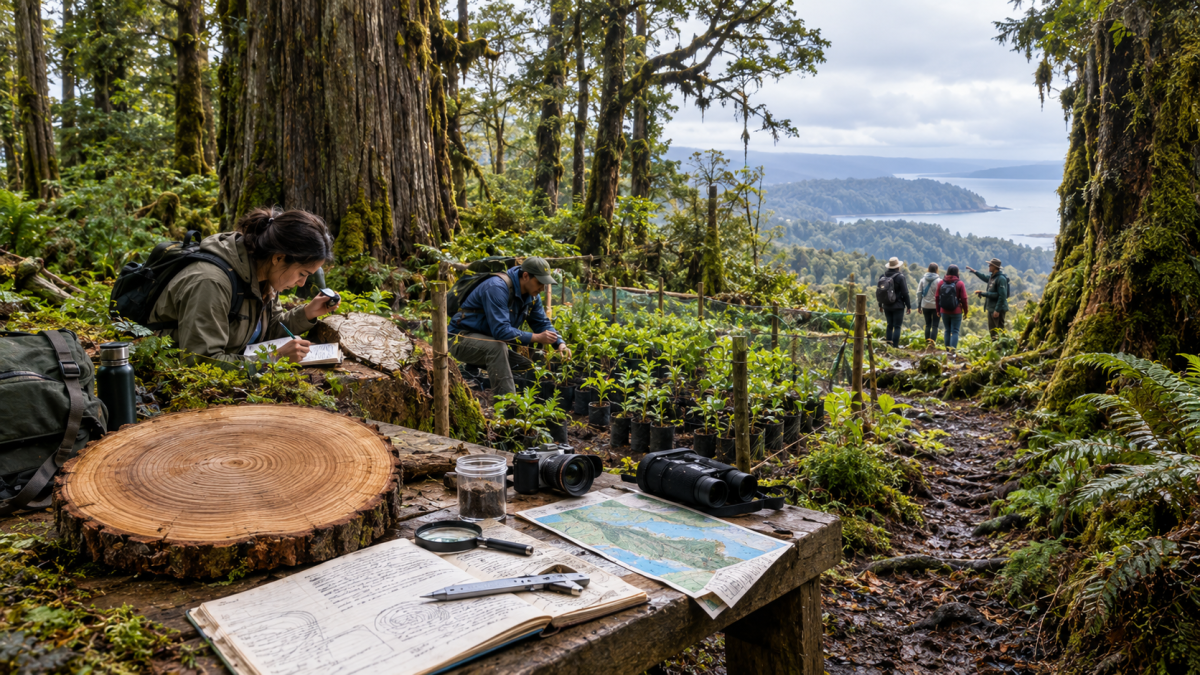
This change of scale is central to Puyango’s appeal. From a path, a trunk is a large, recognizable form. In a laboratory, a small sample can reveal mineral textures beyond ordinary sight. Neither view replaces the other. The landscape supplies relationships and scale; analysis supplies another level of detail. A photograph of a whole specimen and an image through a microscope answer different questions about the same material.
Reading what lies below the surface
A GeoLatitud study published in 2019 used electrical and seismic methods to investigate the subsurface at Puyango. The researchers interpreted resistivity anomalies as evidence of buried fossil trunks. The study demonstrates how physical measurements can contribute to an investigation beyond what is exposed at ground level. [4]
For a nonspecialist, the important lesson is methodological: a signal becomes meaningful through interpretation and its geological setting. An instrument does not produce a complete ancient landscape at the press of a button. Measurements, comparisons and explanations must work together. This gives a family or student group a productive question to take into the field: what evidence would help test the explanation offered for this particular feature?
Two landscapes within one visit
Ecuador Travel presents Puyango within a guide to the country’s dry forest destinations and describes walking, a site museum and bird observation among its activities. [7] That framing encourages attention to the present landscape as well as the fossil record. Living vegetation and ancient mineralized wood belong to different times, even when both appear in a single view.
A useful personal exercise is to make two short sets of notes. One records what is visible now: light, terrain, vegetation and the position of an exposed trunk. The other records the interpretation supplied by a guide, display or scientific source. Keeping those notes distinct prevents the contemporary setting from being mistaken for a complete picture of the ancient environment. It also makes later reading more precise.
A practical approach to an educational visit
Before arranging travel, confirm access, opening arrangements, guiding options and path conditions directly with the site. For a group arriving from abroad, also clarify the language of interpretation and the amount of walking involved. These practical details matter more than building an itinerary around an unconfirmed journey time. Allow space for questions and breaks, especially when different ages are travelling together.
On site, begin with an overview of the area before concentrating on individual specimens. Use the same sequence for each observation: the overall form, the visible surface and the surrounding material. Photographs can follow that sequence too. A wide view retains context, while a closer image records detail without moving the object. Leave fossils and loose fragments where they are, and follow the site’s instructions about paths and permitted contact.
An inventory published in GeoLatitud in 2018 emphasizes the scientific, educational and recreational value of geological places at Puyango and its surroundings. [6] This combination offers a sensible standard for a visit: enjoyment and understanding should support one another. A memorable excursion need not depend on a dramatic claim. Understanding one specimen carefully can be more rewarding than rushing through many without context.
Conclusion
Puyango rewards a patient way of looking. Its fossil trunks connect familiar tree shapes with unfamiliar spans of time, while research opens a path from visible surfaces to minerals and subsurface measurements. For an Arab audience exploring Ecuador through natural history, the site offers a focused encounter with the questions that make geology engaging. The most valuable souvenir is an improved ability to distinguish what we see, what evidence explains and what remains to be studied.