Barichara’s Stone Craft: Earth, Sandstone and Skilled Hands in Colombia
Introduction
Stone in Barichara is both a building material and an invitation to look more closely. In this town in Santander, Colombia, paved streets meet white houses and clay-tiled roofs. Colombia Travel describes that combination together with the streets rising and falling across the terrain. [1] It is a setting whose visual coherence can be appreciated immediately, although the skills behind it take longer to understand.
For an Arab audience interested in architecture and traditional crafts, Barichara offers a useful question: how does a place acquire character through ordinary materials? The answer lies partly in the relationship between earth, stone and the people who work them. A wall, a threshold and a carved object reveal different decisions about form and finish. Following those decisions gives the town a more specific identity than a photograph alone can convey.
Stone and earth have different roles
FONTUR identifies rammed earth and the sandstone commercially known as piedra Barichara as defining elements of the town’s architecture. It describes rammed earth as soil compacted in layers inside forms, and notes the sandstone’s ochre, yellow and reddish tones. [2] The distinction matters: an architectural landscape associated with stone can also depend on earthen construction.
Rather than assuming that every pale wall is masonry, the interested visitor can ask what is beneath its finish. Surface appearance and construction method answer different questions. The same color can unite materials with different properties, while one material can appear in several colors or textures. Reading a building therefore begins by separating what its outer layer shows from what a reliable explanation establishes about its fabric.
A building technique is a form of knowledge
Research from Universidad Santo Tomás examines rammed earth as a vernacular building technique in Barichara, emphasizing local builders and the possibilities of their materials. Its description also identifies adobe, rammed earth and stone within the town’s building traditions. [6] This is a reminder that “traditional” names a field of practical knowledge, rather than a single decorative style.
For a general reader, the contrast between a block and a compacted layer is particularly useful. A wall can be assembled from separate units or formed through a different sequence of operations. Asking about that sequence directs attention to preparation, order and workmanship. It also avoids treating an attractive facade as a complete account of the structure behind it. Understanding heritage begins with knowing how things were made.
From a rough piece to a deliberate shape
The local cultural project Saberes Patiamarillos describes stone carving as a process that begins with a sketch and attention to scale. The stone is selected and marked, initial shaping is followed by progressively finer chiselling, and finishing changes according to the intended surface. [4] That sequence makes an apparently simple object easier to appreciate.
Consider the design of a small geometric ornament. Before any material is removed, its proportions must be resolved. A change to the outline can affect the balance of the whole piece; a final texture can make an edge appear sharper or softer. This is an interpretive exercise, not a description of a particular maker’s commission. It helps explain why the finished object contains decisions that are no longer visible.
The craft extends beyond ornament
Artesanías de Colombia presents stonework as a major craft in Barichara and describes tools including points, bush hammers, mallets and polishing equipment. Its craft guide also connects the material to large paving slabs and to objects such as animal figures and tables. [3] This range links the scale of the town to the scale of an individual workshop.
A piece made for a floor and one intended for close inspection invite different kinds of attention. In the first, one might notice alignment, joints and the relationship between adjacent pieces. In the second, a contour or a small change in texture becomes more prominent. Neither scale should eclipse the other. The skill that makes an object expressive belongs in the same discussion as the skill that makes everyday surroundings coherent.
Why documenting construction matters
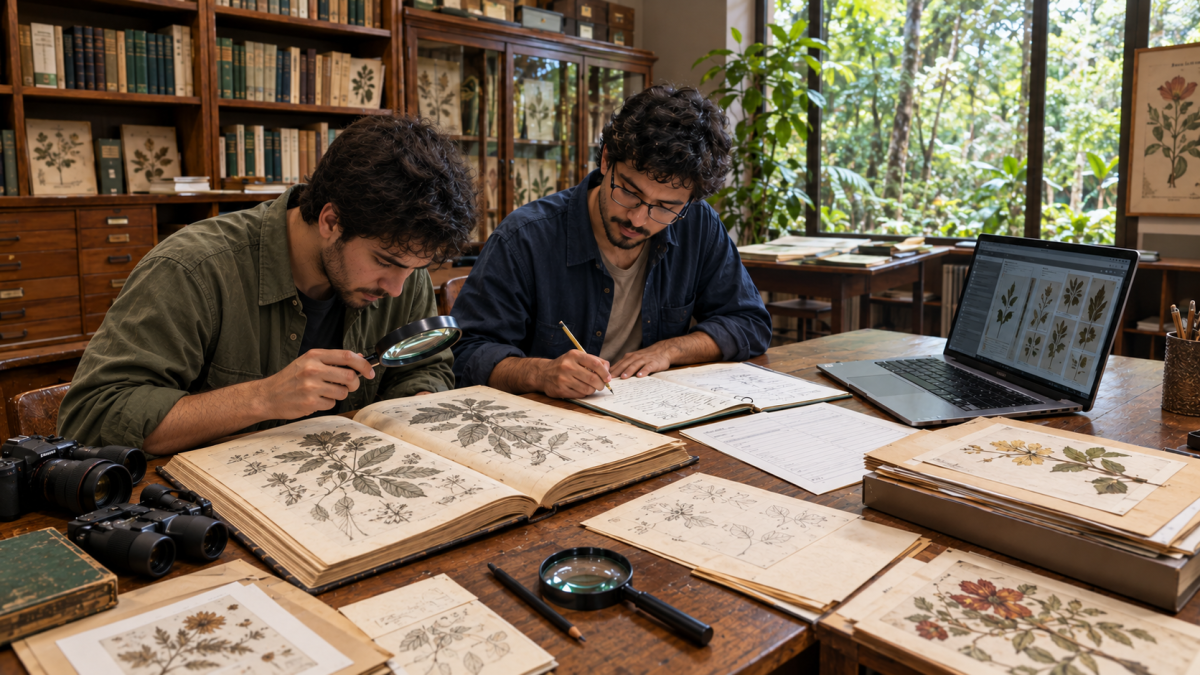
A study published through the Universidad de Valladolid’s earthen architecture collection developed a catalogue using thirteen Barichara houses. It recorded materials, building types, condition and alterations, combining visual documentation with interviews. [5] The sample was a research method for understanding selected buildings, rather than a claim that every property is identical.
For visitors, this suggests a better meaning of preservation than an unchanging surface. A building has a history of use and intervention, and its current appearance may not explain that history by itself. A careful record helps distinguish what is known from what is assumed. The same principle applies to a travel notebook: identify the place, describe the detail and record where its explanation came from.
Meeting a working tradition respectfully
A workshop visit can give an architectural excursion a clear focus, provided access is agreed in advance. Ask whether visitors are received, what can be demonstrated and which language is available for explanations. A workshop remains a workplace. Permission to enter does not imply permission to handle equipment, touch unfinished pieces or photograph every stage.
Questions about process usually lead to a more informative encounter than broad requests for a “typical” souvenir. How was the form planned? Which stage required the most careful correction? Why was this finish chosen? If considering a purchase, clarify the material, dimensions, weight, packing and delivery arrangements. For a traveller returning to an Arab country, practical handling may determine whether a modest piece is more suitable than a larger commission.
Connecting the workshop with the town
After learning about a material, return to ordinary building details with a more attentive eye. Compare a threshold with paving, or a smooth edge with a textured face, without assuming they were made at the same time or by the same hand. The aim is to recognize choices, not to assign an unsupported date or attribution to every object.
A family can turn this into a compact design exercise: choose one detail, sketch its outline and describe the relationship between shape and surface. No contact with the building is needed. Such an exercise encourages specific appreciation of Colombian workmanship while leaving room for comparison with familiar crafts at home. Similar materials do not, by themselves, prove a shared origin or direct historical connection.
Conclusion
Barichara’s appeal becomes more substantial when its architecture is understood through making. Stone carving, earthen building and the documentation of houses offer complementary views of a town whose character depends on accumulated skill. For Arab readers, the rewarding discovery is the relationship between a recognizable material and the local knowledge that gives it form. What first appears as a harmonious scene can become a thoughtful encounter with work, design and the care of inherited places.