Arms Wide Open: The Making of Christ the Redeemer
When observing the skyline of Rio de Janeiro, it is impossible to ignore the colossal silhouette that crowns the city. Towering above the lush, vibrant landscape of Brazil's former capital, Christ the Redeemer stands as a marvel of 20th-century engineering and a global icon of hospitality. Throughout history, monumental architecture has been used by civilizations to express their loftiest ideals—from the towering minarets and vast domes of Islamic architecture in the Middle East to the ancient pyramids of Egypt. In a similar spirit of profound ambition, the creators of this massive Art Deco statue sought to build something that would not only define a nation but also welcome the entire world. Today, Christ the Redeemer is universally recognized not just as a religious monument, but as a breathtaking triumph of collaborative artistry and human ingenuity.
The Vision Atop the Mountain
The story of the statue begins long before the first stone was ever laid. The idea of placing a massive monument atop Mount Corcovado—a dramatic, 2,300-foot granite peak rising sharply from the city—was first proposed in the 1850s by a local priest. He suggested the project to Princess Isabel of Brazil, envisioning a grand symbol that could be seen from any point in the city. However, the political climate of the time, followed by the separation of church and state when Brazil became a republic in 1889, caused the idea to be shelved and largely forgotten.
The concept was resurrected in 1920, following the devastation of World War I. Civic and religious leaders in Rio de Janeiro, seeking a unifying symbol to counteract what they perceived as a growing sense of societal instability, proposed the monument once again. This time, the idea gained immense popular support. In 1921, to commemorate the upcoming centennial of Brazil’s independence, the project was officially approved. Funding was gathered entirely through public donations, reflecting the deep collective desire of the Brazilian people to create a lasting landmark that would represent their heritage and values to the world.
An International Collaboration of Art and Engineering
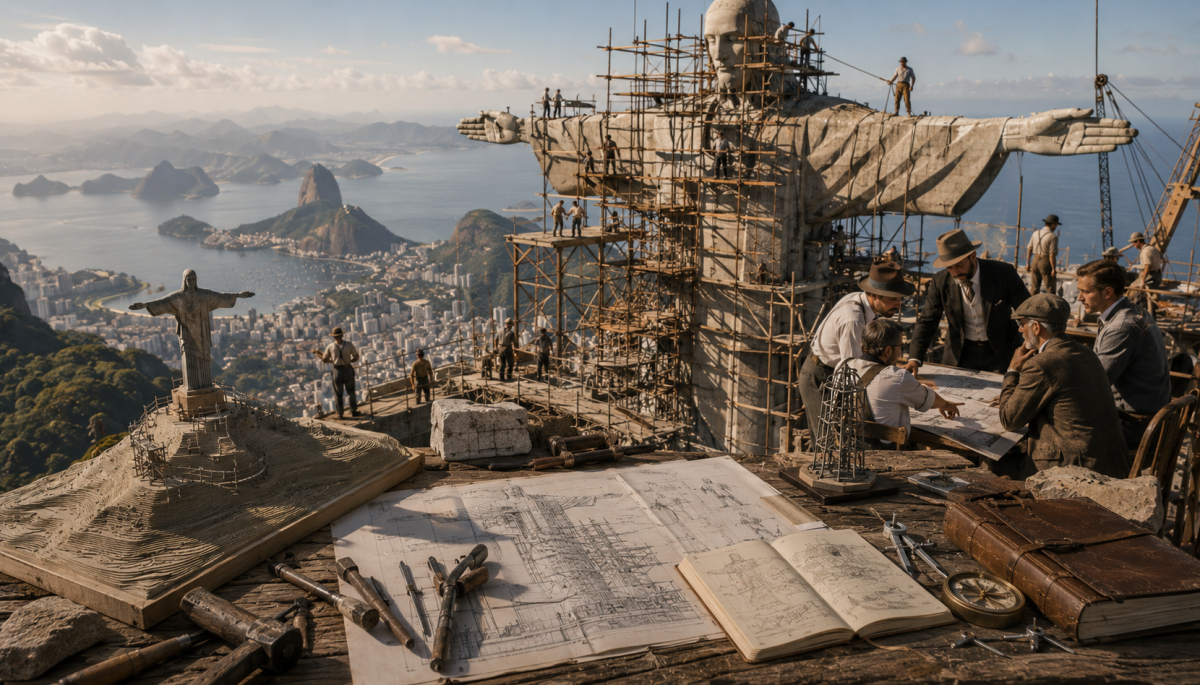
Building a colossal statue on a sheer, windswept mountain peak was an engineering nightmare. The task required an unprecedented level of international collaboration. The initial design was conceived by the Brazilian engineer Heitor da Silva Costa. He envisioned a figure standing with arms outstretched, not just as a traditional religious pose, but as a universally understood gesture of peace and welcoming.
To bring this vision to life, da Silva Costa traveled to Europe to assemble a team of world-class talents. He collaborated with the renowned French-Polish sculptor Paul Landowski, who created the scale models and sculpted the hands and the sweeping Art Deco robes. The face of the statue, arguably its most expressive feature, was entrusted to the skilled Romanian sculptor Gheorghe Leonida. The Art Deco style was chosen for its clean, geometric lines, which would ensure the statue remained visually striking and highly visible from miles away, avoiding intricate details that would be lost at such a distance.
The structural engineering was equally critical. To withstand the fierce winds, torrential tropical rains, and frequent lightning strikes atop Corcovado, the structure could not be built with traditional bronze or stone. French engineer Albert Caquot was brought in to design the internal framework. He made the revolutionary decision to use reinforced concrete, a relatively new architectural material at the time, which provided the immense tensile strength necessary to support the statue's wide wingspan.
The Miracle of Soapstone and Concrete
Transporting the materials to the summit was a monumental logistical challenge. All the necessary concrete, steel, and tools had to be hauled up the steep, dense jungle terrain using the narrow-gauge Corcovado Railway. Over the course of nine years of grueling labor, from 1922 to 1931, the workforce assembled the statue piece by piece in the harsh mountain conditions, remarkably without a single fatal accident.
While reinforced concrete provided the structural integrity, Heitor da Silva Costa knew it was not aesthetically pleasing, nor would it withstand the harsh weather well on its own. He found the perfect solution in steatite, commonly known as soapstone. Found in abundance in Brazil, soapstone is highly resistant to extreme temperatures and erosion. Millions of triangular soapstone tiles were meticulously cut by hand. In an incredible display of community effort, local volunteers, including many women from the parishes of Rio, gathered to glue these small stone triangles onto strips of cloth, which were then applied to the concrete shell of the statue. It is said that some volunteers wrote messages or the names of loved ones on the back of the tiles before attaching them, embedding the personal histories of the Brazilian people directly into the monument.
A Symbol of Welcoming and Peace
Completed in 1931, the statue stands 98 feet tall (excluding its 26-foot pedestal) and its outstretched arms span an impressive 92 feet. However, its true impact goes far beyond its physical dimensions. In Brazilian culture—much like in Arab culture—hospitality and the warm welcoming of guests are considered paramount virtues. The open arms of Christ the Redeemer have come to symbolize this deep-seated cultural trait.
Whether one arrives in Rio by ship, plane, or car, the monument is there, seemingly embracing the city and all who enter it. It transcends its origins to become a secular symbol of peace, unity, and the diverse, multicultural fabric of the Brazilian nation. It serves as a reminder that greatness in architecture is not only measured by height or cost, but by the emotional resonance the structure holds for its people.
Modern Challenges and Preservation
Today, maintaining a century-old concrete monument in a tropical climate requires constant vigilance. Due to its extreme altitude, the statue is struck by lightning multiple times a year. In 2014, a severe storm damaged the thumb of the right hand, necessitating a massive restoration project. The Brazilian government, alongside heritage organizations, works tirelessly to inspect and repair the soapstone casing and the internal concrete structure, ensuring that the monument remains pristine.
Conclusion
Christ the Redeemer is more than a statue; it is a masterclass in vision, resilience, and international cooperation. It stands as a profound example of how human beings can transform a daunting, inaccessible mountain peak into a platform for art and unity. Recognized globally as one of the New Seven Wonders of the World, it continues to watch over the spectacular bay of Rio de Janeiro, offering a timeless, open-armed welcome to every traveler who journeys to the vibrant heart of South America.