Introduction: Beyond Myths and Ruins When we turn the pages of ancient Mexican history, we are not merely reading a record of extinct civilizations that have turned into tourist attractions; rather, we are diving into the depths of complete worlds that were far ahead of their time. These worlds were pulsating with advanced science, complex art, and precise social and political organization, centuries before European explorers set foot in the Americas. This geographical region, which we know today as "Mexico" and parts of Mesoamerica, was the cradle of some of the greatest civilizations in all of human history. These societies developed in astonishing ways, leaving behind a cultural and architectural legacy whose imprints remain alive and influential to this day. In this article, we will take you on a fascinating historical journey through time, starting from the humble beginnings of human settlement, passing through the mysterious Olmec civilization and the astronomical genius of the Maya, and arriving at the military and economic might of the mighty Aztec Empire.
Early Beginnings: The Deep Roots of Settlement and Agriculture For thousands of years, the first human groups found a suitable haven for settlement and the formation of the first societal nuclei in the topographically and climatically diverse lands of Mexico. Excavations and archaeological evidence indicate that human presence in this region dates back more than ten thousand years. In those ancient eras, the early inhabitants relied on a primitive lifestyle based primarily on hunting and gathering wild fruits and plants.
However, the major quantum leap that changed the course of human history in the Americas occurred when ancient man discovered agriculture, specifically the domestication and cultivation of the corn (maize) plant. Corn in these cultures was not just an agricultural crop to satisfy hunger; it became the axis of existence and the backbone of building civilization. Some ancient myths, such as the sacred "Popol Vuh" book of the Maya, even narrate that the gods created the first human from corn dough. This radical shift from a life of constant nomadism to agricultural settlement is what allowed the emergence of the first villages, which grew and expanded over time to become massive cities, and then empires with tremendous political and economic weight.
The Olmec Civilization (1500 - 400 BC): The Mother Culture of Mesoamerica If we want to talk about foundational roots, we must stop at the "Olmec" civilization, which the majority of historians and archaeologists consider the "Mother Culture" from which all subsequent Mesoamerican civilizations emerged. The Olmec settled in the tropical coastal regions bordering the Gulf of Mexico (in the present-day states of Veracruz and Tabasco).
The most distinguishing feature of the Olmec civilization, which remains a scientific mystery to this day, is their artistic legacy represented by the giant basalt stone heads. These heads, each weighing tons, were carved with precise and strong facial features. The question remains: how were these peoples able to transport these massive volcanic rocks for distances exceeding tens of kilometers through forests and swamps without the use of wheels, draft animals, or metal tools?
In addition to their artistic prowess, the Olmec laid crucial civilizational foundations that included:
Developing Complex Religious Systems: They created deities that were passed down to later civilizations, such as the rain god and the corn god, in addition to their veneration of the jaguar.
Inventing Early Forms of Writing: They were among the first peoples of the region to use hieroglyphic symbols to document events.
Mathematics and Time: They laid the first building blocks for the advanced chronological calendar that was later developed by the Maya and Aztec civilizations. They also invented the ritual ball game that became a defining characteristic of all Mesoamerican cultures.
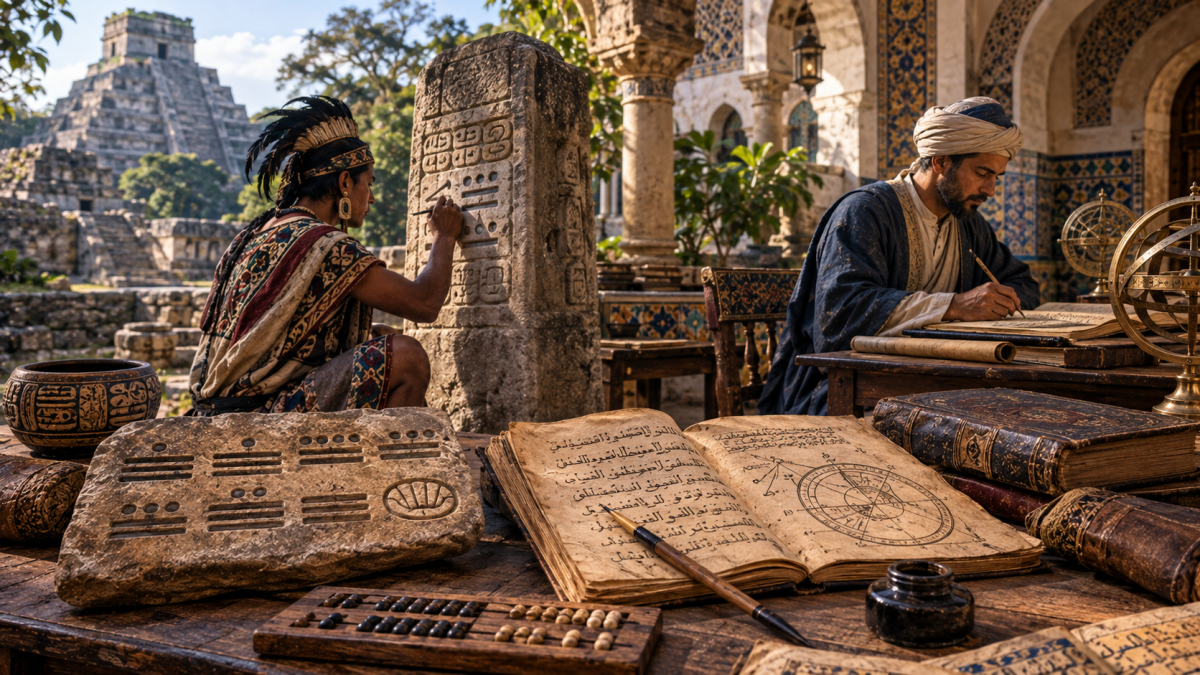
The Maya Civilization (2000 BC - 1500 AD): Geniuses of Astronomy and Mathematics When the "Maya" civilization is mentioned, images of dazzling scientific achievements immediately come to mind. The Maya were not merely skilled builders of stepped stone pyramids; they were scientists and thinkers of the highest caliber. They built massive metropolises amidst dense tropical forests, such as the cities of "Tikal," "Palenque," and "Chichen Itza." Their empire was not centrally unified; rather, it consisted of a network of independent city-states, each with its own ruler and army, which fought or allied with one another.
The Maya excelled in scientific fields that surpassed what many civilizations of the Old World had achieved during the same era:
Precise Astronomy: They built astronomical observatories and observed the movements of stars and planets with extreme precision. They were able to calculate the cycle of the planet Venus and predict the times of solar and lunar eclipses without possessing any modern optical instruments.
Advanced Mathematics: The Maya civilization is considered one of the first human civilizations to recognize and use the concept of the "number zero," an exceptional intellectual achievement that revolutionized their calculating capabilities and enabled them to perform highly complex astronomical and architectural operations.
The Complex Calendar: They invented several overlapping calendar systems, including a highly accurate solar calendar that had a lower margin of error than some calendars used in Europe during the Middle Ages.
Despite this civilizational sophistication, the late Classic period of the Maya (around 900 AD) witnessed a mysterious collapse of many of their major cities, as their inhabitants abandoned them and they were swallowed by the forests. Scientists today believe that this collapse was the result of a deadly combination of climate changes represented by severe droughts, alongside civil wars and the depletion of environmental resources.
Teotihuacan: City of the Gods and the Greatest Architectural Mystery In the heart of the high Valley of Mexico emerged the city of "Teotihuacan," which was not just an ordinary city, but one of the largest and most important urban centers in the ancient world. At the height of its prosperity (around 500 AD), its population exceeded the one hundred thousand mark, making it a rival to the major capitals in Asia and Europe at the time.
This city is characterized by its precise, orthogonal urban planning and its wide streets, foremost among them the main axis known as the "Avenue of the Dead," which is lined with awe-inspiring architectural monuments, most notably:
The Pyramid of the Sun: A massive structure considered one of the largest ancient buildings in the Western Hemisphere.
The Pyramid of the Moon: The main center for holding religious rituals and majestic public celebrations.
The surprising thing is that the identity of the builders of this great city remains unknown to this day. We do not know their original language nor the true name of their city. Even the name "Teotihuacan" was given to it by the Aztecs centuries after its abandonment, meaning in their language "the place where the gods are born," because the Aztecs were so deeply amazed by the enormity of its ruins that they believed the gods personally built it to be the center of the universe's creation.
The Aztec Civilization (Mexica): Military Power and Innovative Engineering In the fourteenth century AD, the Aztecs (who called themselves the Mexica) emerged as a striking force that founded a sprawling empire. The Aztecs began as nomadic warrior tribes searching for a promised land, until they settled and built their legendary capital, "Tenochtitlan" (in the exact location where the current capital, Mexico City, sits).
The city was founded on a small island in the middle of the waters of Lake "Texcoco." To face the lack of space and provide food for the growing population, the Aztecs invented a brilliant agricultural and engineering system known as "Chinampas," which are artificial floating agricultural islands built from mud and vegetation over the lake's waters, characterized by massive and sustainable agricultural productivity.
The Aztec Empire was characterized by prominent features:
Political and Military Organization: They possessed a highly disciplined army that enabled them to subjugate dozens of neighboring peoples and impose a strict system for collecting taxes and tribute.
Economy and Trade: Their markets, such as the great "Tlatelolco" market, bustled with tens of thousands of merchants and shoppers daily, where all commodities were sold, from gold and precious stones to rare bird feathers and diverse agricultural crops.
Religious Rituals: Their faith was closely tied to human sacrifice, due to their firm belief that human blood was the vital nourishment that ensured the continuous shining of the sun and prevented the end of the world. These sacrifices were offered in majestic ceremonies atop the temple summits.
Daily Life: Societies Rich in Detail and Knowledge These civilizations were not limited to building temples and waging wars; they were vibrant societies with precise systems:
Cuisine and Agriculture: Ancient Mexico presented the world with crops that have become essential to global food security today, such as tomatoes, beans, peppers, and cacao. Cacao had an exceptional value, as its beans were used as currency in the markets, and the bitter, spiced "chocolate" drink made from it was exclusively for the nobility and priests.
Education and Social System: Education was compulsory and organized. The state allocated schools for the general public to teach them agriculture, crafts, and military skills, while other schools were dedicated to the nobility to study astronomy, politics, history, and theology.
The Fall of Empires and the Beginning of the Colonial Era In the early sixteenth century (1519 AD), Spanish conquistadors led by "Hernán Cortés" arrived on the shores of Mexico. This moment signaled the beginning of a tragic chapter and a devastating end for the indigenous empires. Despite the overwhelming numerical superiority of the Aztec army, the impregnable capital Tenochtitlan fell in 1521 after a bitter siege.
This horrific fall was not solely the result of Spanish military capabilities; several decisive factors combined to lead to this outcome:
Military and Technical Superiority: The Spanish possessed firearms, cannons, and steel armor, in addition to horses, which were previously unknown on the continent, causing great psychological terror among the indigenous populations.
Strategic Alliances: With political astuteness, Cortés exploited the state of resentment and hatred harbored by the oppressed peoples against the harsh Aztec rule. The Spanish formed alliances with powerful tribes like the "Tlaxcala," who supplied the invaders with tens of thousands of warriors and logistical support.
The Deadly Biological Weapon: This was by far the most lethal factor. The Europeans brought with them diseases and epidemics unknown in the Americas, foremost among them smallpox. Due to the complete lack of prior immunity among the indigenous populations, these diseases claimed the lives of millions, leading to a demographic and social collapse that decisively facilitated the conquest mission.
An Indelible Legacy: The Immortal Imprint on Modern Mexico Despite the devastating conquest and the establishment of a colonial era that lasted for centuries, the spirit of these great civilizations did not die. Their legacy remains deeply rooted and is clearly evident in all aspects of life in modern Mexico:
Linguistic Influence: Indigenous languages, led by "Nahuatl" (the Aztec language), remain alive and are used by millions. Many global words are derived directly from this language, such as the word "tomato" (Tomatl) and "chocolate" (Chocolatl).
Culture and Gastronomy: Contemporary Mexican cuisine is a natural extension of ancestral tables, where tortillas and sauces based on corn and chili peppers remain the foundation.
Cultural and Religious Syncretism: This is clearly evident in the globally renowned "Day of the Dead" (Día de los Muertos) celebrations, which represent a brilliant and unique blend of European Catholic rituals and the ancient beliefs of indigenous peoples in honoring the spirits of their ancestors.
National Identity: Mexicans today look upon their indigenous roots with immense pride and honor. Modern Mexican art and famous murals are replete with symbols inspired by the era of the Olmec, Maya, and Aztecs, confirming that this heritage is an inseparable component of their national identity, which they proudly display to the world.
Conclusion In conclusion, studying ancient Mexican history goes beyond merely recounting the events of a remote past; it is a living testament to human genius and the exceptional ability to create, adapt to harsh environments, and build complex and prosperous civilizations. From the towering pyramids of Teotihuacan to the mathematical innovations of the Maya, and from the cultivation of corn to the founding of vast empires, this history proves that great civilizations may fall militarily or collapse politically, but their spirit and achievements remain engraved in the memory of humanity. A deep understanding of this brilliant history gives us a clearer perspective to appreciate human cultural diversity and confirms that the legacy of those peoples will remain a beacon illuminating the paths of history for future generations.