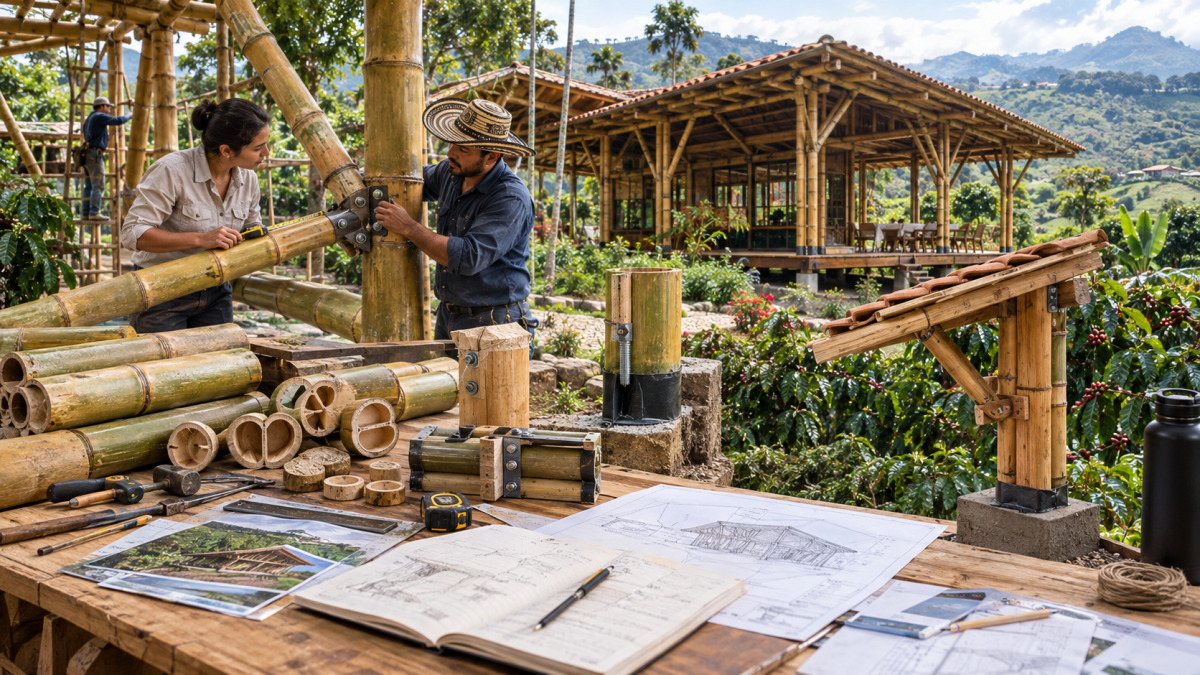
Seeing a building through its material
A row of bamboo columns invites a different kind of architectural attention. Instead of following a smooth wall, the eye follows individual poles, their changing widths, and the places where they meet. In Colombia, guadua offers a way to explore the relationship between a plant and the decisions that turn it into a building material. For readers in the Arab world, this is an accessible introduction to Latin American design through construction, observation, and practical questions.
The most useful starting point is to look closely rather than accept a dramatic label. A photograph can show an impressive roof, but it cannot establish how that roof performs or how much work keeps it in good condition. Understanding guadua architecture means separating appearance from engineering while appreciating both. It also means noticing the skills behind an apparently simple arrangement of natural pieces.
A plant with a regional setting
Kew Science identifies Guadua angustifolia as a bamboo in the grass family. Its native range includes Colombia, Ecuador, Peru, Venezuela, and Trinidad and Tobago, and it grows primarily in wet tropical environments. This botanical context helps explain why guadua should be understood as a regional plant resource rather than as a generic material with identical origins everywhere. [1]
That distinction is useful when reading an architectural description. The word bamboo covers more than one plant, so a photograph alone is not a reliable identification. Ask which species was used and where the material came from. For an exhibition, a clearly labelled sample can be more informative than a broad promotional claim. It connects the finished object to a living plant and encourages a more precise conversation about place, selection, and use.
Why the connections deserve attention
Guadua Bamboo, a producer that publishes material guidance, describes a central joinery challenge: bamboo poles are hollow, taper along their length, and are not perfectly circular. Their nodes also occur at varying intervals. These characteristics mean that joining two poles requires attention to the actual pieces rather than treating them like identical manufactured components. [2]
For the observer, the connection becomes a useful place to pause. Look at how one member approaches another and whether several pieces come together at a single point. Notice what remains visible and what disappears behind another element. These observations do not tell you whether a joint is safe, but they reveal design choices that a distant view can hide. A connection can become the most informative detail in the entire photograph.
A simple drawing exercise helps. Sketch the outline of a support and mark where it changes direction or meets another part. Use questions beside the sketch instead of inventing answers. What holds this piece in position? Which details would require an explanation from the designer? This keeps architectural curiosity separate from the mistaken idea that a visual impression is enough to reproduce a structure.
Moisture belongs in the design conversation
Research presented by Universidad de los Andes treats round guadua as a structural material whose physical and mechanical behaviour responds to environmental conditions. Its project description explains that changing moisture content can affect strength and dimensions. The lesson for a general reader is straightforward: a natural pole does not stop responding to its surroundings once it becomes part of a building. [3]
INBAR preservation guidance illustrates protective design through roof overhangs, concrete footings, and drainage. It also explains that preservative treatment can improve resistance to insect and fungal attack. These are reminders that durability depends on preparation and exposure as well as the visible form of a finished structure. [4]
When examining a building, therefore, include the roof edge and the base in your view. Ask how maintenance is organized and which parts need regular inspection. Avoid translating the word natural into a promise of permanence. The interesting question is how the material is cared for over time. This approach makes the discussion more useful than treating a newly completed building as the final chapter of its story.
Colombian design beyond the material label
The Sociedad Colombiana de Arquitectos describes architect Simón Vélez as a designer who uses guadua both structurally and decoratively. It highlights his development of connection systems and his engagement with traditional Colombian materials. His work provides one named point of entry into the subject, without representing every guadua builder or every architectural approach in Colombia. [5]
A useful way to study any designer is to compare different views of one project. Begin with the overall shape, then examine a closer image of the supports, and finally consider how the space is used. Ask whether the material helps explain the design or whether the description relies too heavily on its name. A building should still be discussed as a place with movement, shelter, and everyday purposes, not merely as a demonstration of an ingredient.
Questions that travel across cultures
Readers familiar with courtyards, shaded passages, or carefully worked timber can approach guadua through questions they already ask of architecture. Where is the shade? How does the edge of a roof define a place to pause? What can be learned from the way two materials meet? These are invitations to compare particular buildings, not claims that different regions share one tradition or that every climate requires the same solution.
The comparison becomes stronger when differences remain visible. A detail observed in Colombia should not be copied elsewhere solely because it looks appealing. Local conditions, intended use, available skills, and professional assessment all matter. Likewise, a broad environmental claim needs evidence about sourcing, preparation, transport, service life, and maintenance. Asking for that evidence is compatible with admiring the design; it simply gives admiration a more careful foundation.
A closer way to appreciate guadua
For a visit to an accessible exhibition or building, choose a small observation theme rather than trying to record everything. Focus on connections, roof edges, or the sequence of spaces. Follow site instructions, ask permission where needed, and leave working areas to the people responsible for them. If studying remotely, keep the project name and image credit with your notes so that different examples do not become mixed together.
Guadua architecture rewards this measured attention. A first impression of repeating poles can develop into questions about craft, material behaviour, and the relationship between design and care. Colombia offers a distinct setting for that exploration. The result is a more grounded appreciation of Latin American architecture, one that values the finished space while remaining curious about the decisions and work that make it possible.
Sources
[1] Kew Science — Guadua angustifolia
[2] Guadua Bamboo — Joints and joinery
[3] Universidad de los Andes — Guadua rolliza
[4] INBAR — Bamboo preservation guidance
[5] Sociedad Colombiana de Arquitectos — Simón Vélez